
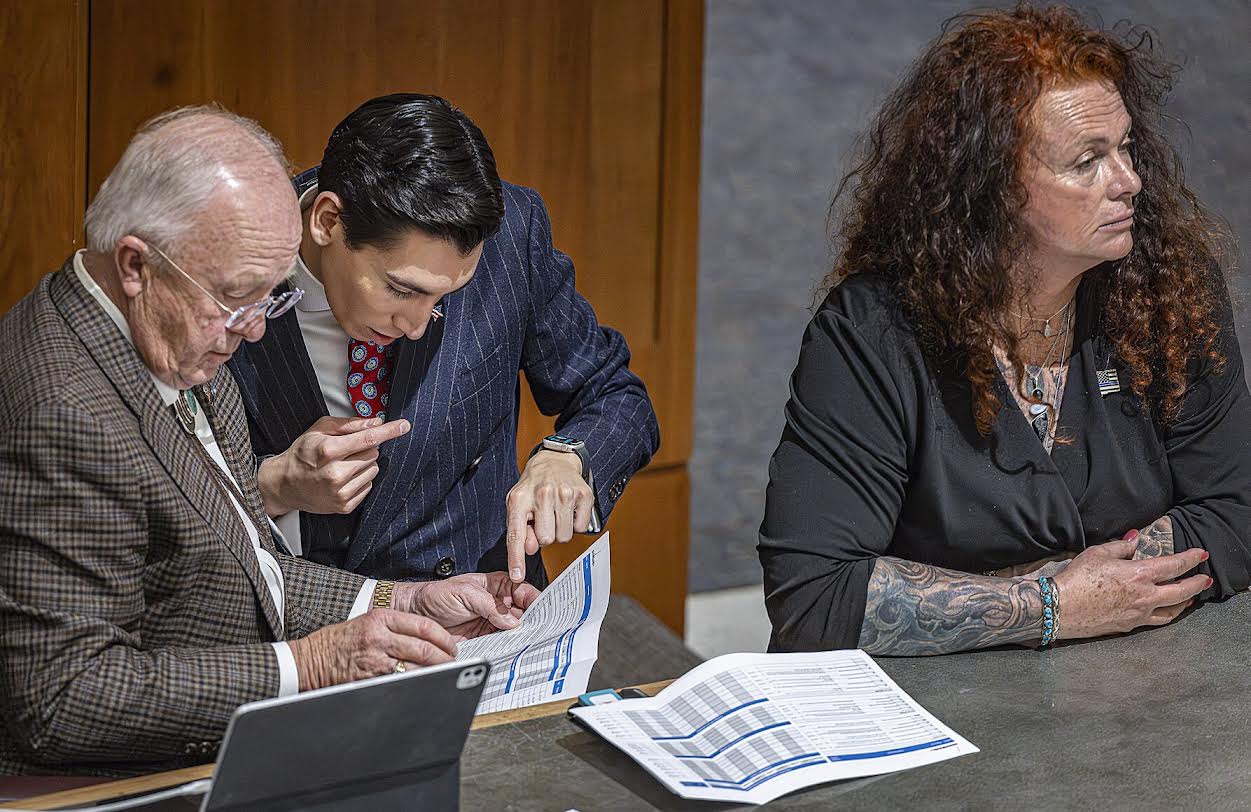
 State Sen. Jim Townsend, left, talks with House Republicans John Block and Stefani Lord before a contentious Senate debate Tuesday, Feb. 3, 2026, at the state Capitol on a bill that would ban local governments from entering contracts to operate federal immigration detention centers. Townsend said it would leave roughly 1,000 people without employment. The Senate passed the measure, sending it to the governor. Photo by Jim Weber/The New Mexican
By CLARA BATES
The Santa Fe New Mexican
Local governments in New Mexico will be banned from contracting with the federal government to operate immigration detention centers under a bill sent to the governor’s desk Tuesday night following a Senate vote of approval.
Gov. Michelle Lujan Grisham plans to sign the bill into law, her chief spokesperson confirmed.
That could place New Mexico on a collision course with the federal government as it pursues aggressive civil immigration enforcement. Opponents also warned it would spur job losses in rural communities with few employment options, and would result in detainees being sent to other states.
The Senate passed the Immigrant Safety Act on a vote of 24-15 after hours of debate. It was a party-line vote with most Democrats in favor; Sen. George Muñoz, D-Gallup, voted against the bill.
The House of Representatives passed the measure, House Bill 9, on Friday. It is one of a few key measures to clear both chambers at the midway point of the 30-day session, which ends Feb. 19.
HB 9 prohibits local governments from entering into new contracts to operate detention centers for U.S. Immigration and Customs Enforcement or renewing contracts. The bill also prohibits local law enforcement from entering formal partnerships with ICE allowing police to help carry out federal civil immigration enforcement efforts.
New Mexico is home to three detention facilities that contract with ICE — in Cibola, Otero and Torrance counties. They have faced allegations of poor conditions along with due process and human rights violations.
“We have an opportunity to disassociate ourselves from this federal government’s cruel and unconstitutional mass deportation agenda,” said Sen. Antoinette Sedillo Lopez, D-Albuquerque, who has sponsored similar bills in years past.
The House passed a bill last year that stalled in the Senate. This year, Sen. Joseph Cervantes, D-Las Cruces, who previously opposed the bill, co-sponsored it.
Cervantes said he had believed it would be better for immigrant detainees to remain in New Mexico than in other states. Now, “I stand today and I made publicly known that my heart has changed; my mind has changed.”
He added, “I’m hoping that all my colleagues here on my right and around the state will realize we’re better than this.”
‘Built on prisons’
Sen. Ant Thornton, R-Sandia Park, whose district includes the Torrance County Detention Facility, said the county relies on immigrant detention economically.
“I’m really concerned about the impact on my community,” he said, proposing an amendment that would have required the state to reimburse the county for lost taxes, income, and other spending related to the loss of jobs. The amendment was defeated.
“Estancia is going to turn into a ghost town,” Thornton said.
Muñoz, whose district includes the Cibola County Correctional Center, said the town of Grants won’t be able to recover.
“You want to see a town dry up like a tumbleweed and blow away, get ready,” he said, calling Grants a town “built on prisons.”
“We have to figure out how we’re going to help these people in these counties where they had resources or income, and now it’s going to disappear,” he said.
Sen. Jim Townsend, R-Artesia, said the bill would leave roughly 1,000 people without employment, and only shift detainees elsewhere.
“We have no idea where they’re going. We know they’re going to be transferred someplace else. And we’ll have absolutely no way to ensure their lives, and I would say we’re better than that,” he said.
Sedillo Lopez said the counties award subcontracts to for-profit companies, which limits oversight.
“It has become increasingly clear that ICE under this administration feels emboldened to further restrict efforts for local monitoring and oversight,” she said.
HB 9 won’t guarantee facilities are shut down because it only regulates government entities. Private prison companies can still contract directly with ICE.
Michael Coleman, the chief spokesperson for Lujan Grisham, wrote in an email the governor will sign the bill and noted it was a priority for her.
“Gov. Lujan Grisham believes New Mexico’s law enforcement resources — including detention facilities — should be used to keep communities safe from dangerous criminals, not to target those who stay out of trouble and go to work to provide for their families,” Coleman wrote.
Police partnerships
HB 9 also prohibits partnerships between local law enforcement agencies and the federal government known as 287(g) agreements, which allow police to help carry out federal civil immigration enforcement. Curry County is currently the only county in New Mexico with such an agreement.
But the debate Tuesday evening dealt mostly with the provision on detention facilities.
Regarding the component banning civil immigration enforcement, Coleman wrote law enforcement agencies “should not be diverted from their core mission of keeping New Mexicans safe.”
The U.S. Department of Homeland Security, which oversees ICE, said in a statement Tuesday evening those partnerships are essential.
“These New Mexico sanctuary politicians would make New Mexico less safe as a direct result of this policy. Our partnerships with state and local law enforcement are key to removing criminal illegal aliens including murderers, rapists, pedophiles, gang members, and terrorists from American communities,” Tricia McLaughlin, assistant secretary for public affairs, said in the statement.
“When politicians bar local law enforcement from working with us, that is when we have to have a more visible presence so that we can find and apprehend the criminals let out of jails and back into communities,” she added.
McLaughlin’s email included photos of five immigrants convicted of crimes and descriptions of each.
“These are the types of public safety threats arrested by ICE in New Mexico that these sanctuary politicians are choosing to protect,” she wrote.