
 In the Canyon Country, the path from point A to point B might be blocked by cliff, canyon, or both. View through a canyon maze from our recent Mountaineers trip. Courtesy/Reiner Friedel
By BILL PRIEDHORSKY
Los Alamos Mountaineers
The Los Alamos Mountaineers have a soft spot in their heart for the hard country of the Colorado Plateau – the place that Edward Abbey called “something strange, marvelous, full of wonders … a surreal land of form and color.” We who live in the Southwest are lucky to be so close to this terrain, because there is nothing else like it in the country, if not the world. The Mountaineers have returned to this place many times, finding places where hardly anyone goes in southeastern Utah and northeastern Arizona.
Hiking around the canyon country is not like hiking in other places. In gentler parts of the world, even without a trail, the route from point A to point B can be straightforward – down the valley, across the meadow, up the hillside, but you can get there from here. In the canyon country, you cannot always get from point A to point B, at least not travelling in anything like a straight line – a cliff or a canyon will block your way, so you go around, picking your way along until you find a valley or a gentler slope that lets you through. And that is the fun of it – finding a way through, with out-of-this world views at every turn.
There are innumerable places to explore in the Canyon Country – the author’s lifetime count includes 139 such outings. But he, and the Mountaineers who come with him, have settled on a certain kind of rough comfort. Forsaking their backpacks, they have formed a partnership with a llama packer operating out of Boulder, Utah (population 227). BJ Orozco’s llamas carry our gear to camp, delivering about twice as much payload per person as a backpacker can carry. This opens the door to small luxuries like camp chairs, sun showers, roll-up tables, and better food and wine.
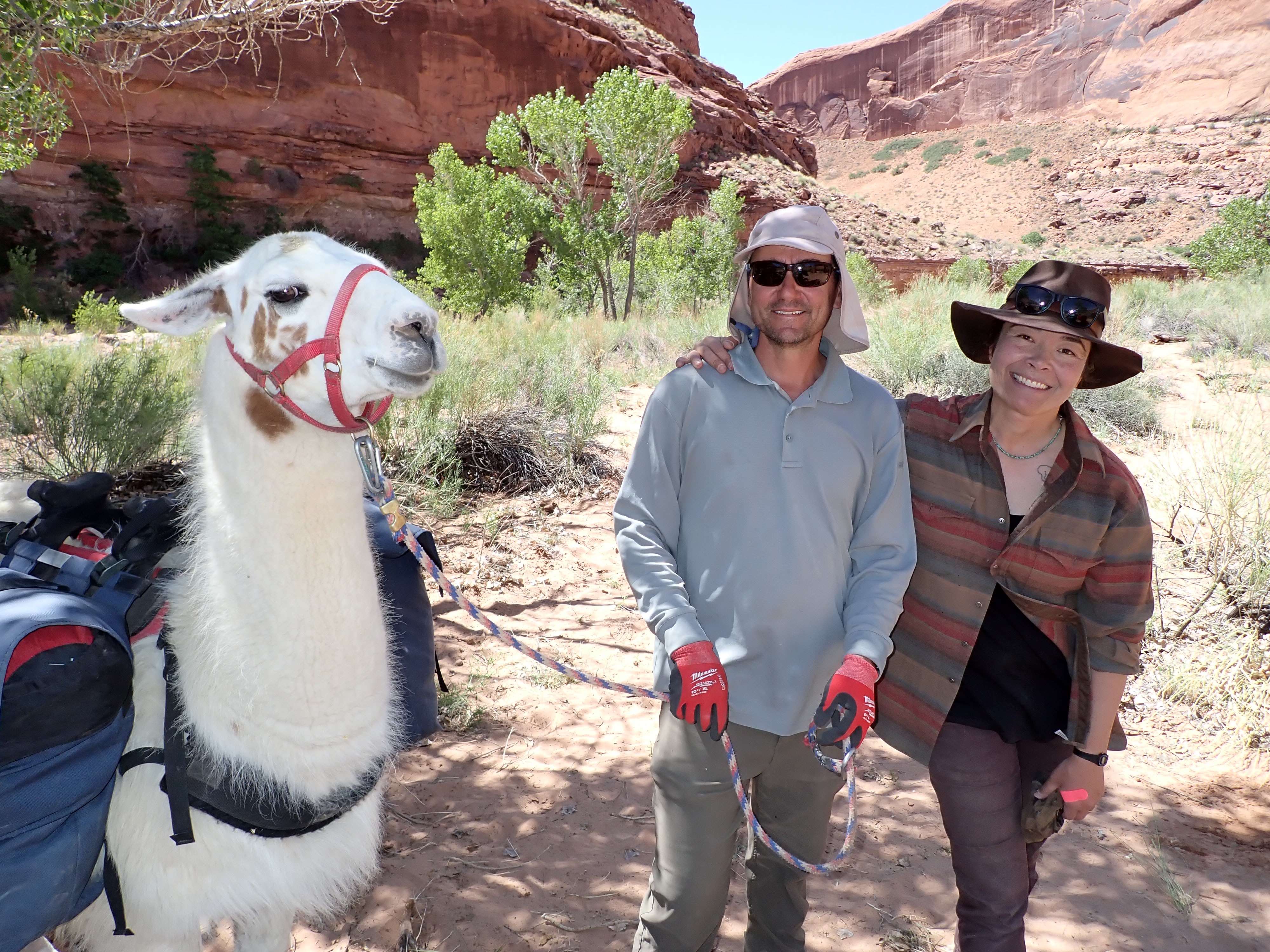 Guides BJ and Laurel with a llama helper. Courtesy/Bill Priedhorsky
BJ’s stomping ground is the Grand Staircase-Escalante National Monument, almost 3,000 square miles of largely untracked wilderness in southern Utah, much of it draining into the Escalante River. While the terrain is an arid desert, there are many springs, small creeks, and waterholes, providing plenty of water for drinking, cooking, and washing. A typical Mountaineers outing includes 6 nights in camp and thus 5 days for exploration, and the terrain is interesting enough that there are new things to see every day. Once the hiking is over for the day, it is time to relax, have some snacks and maybe a little wine before dinner, then watch the evening come on and the stars come out.
 A rocky sentinel above camp catches the last rays of the setting sun. Courtesy/Reiner Friedel
On our most recent trip, we camped near a flowing stream and explored in every direction for the next five days. Two days were spent following side canyons near camp, studying their rocky walls, enjoying little water pockets, and working our way up and over dry waterfalls. Although our camp was less than four miles from the highway, we saw no one else for a whole week. Only our own sociable little party broke the intense solitude. It was in fact reassuring to see the odd contrail and know that civilization still existed outside our canyon.
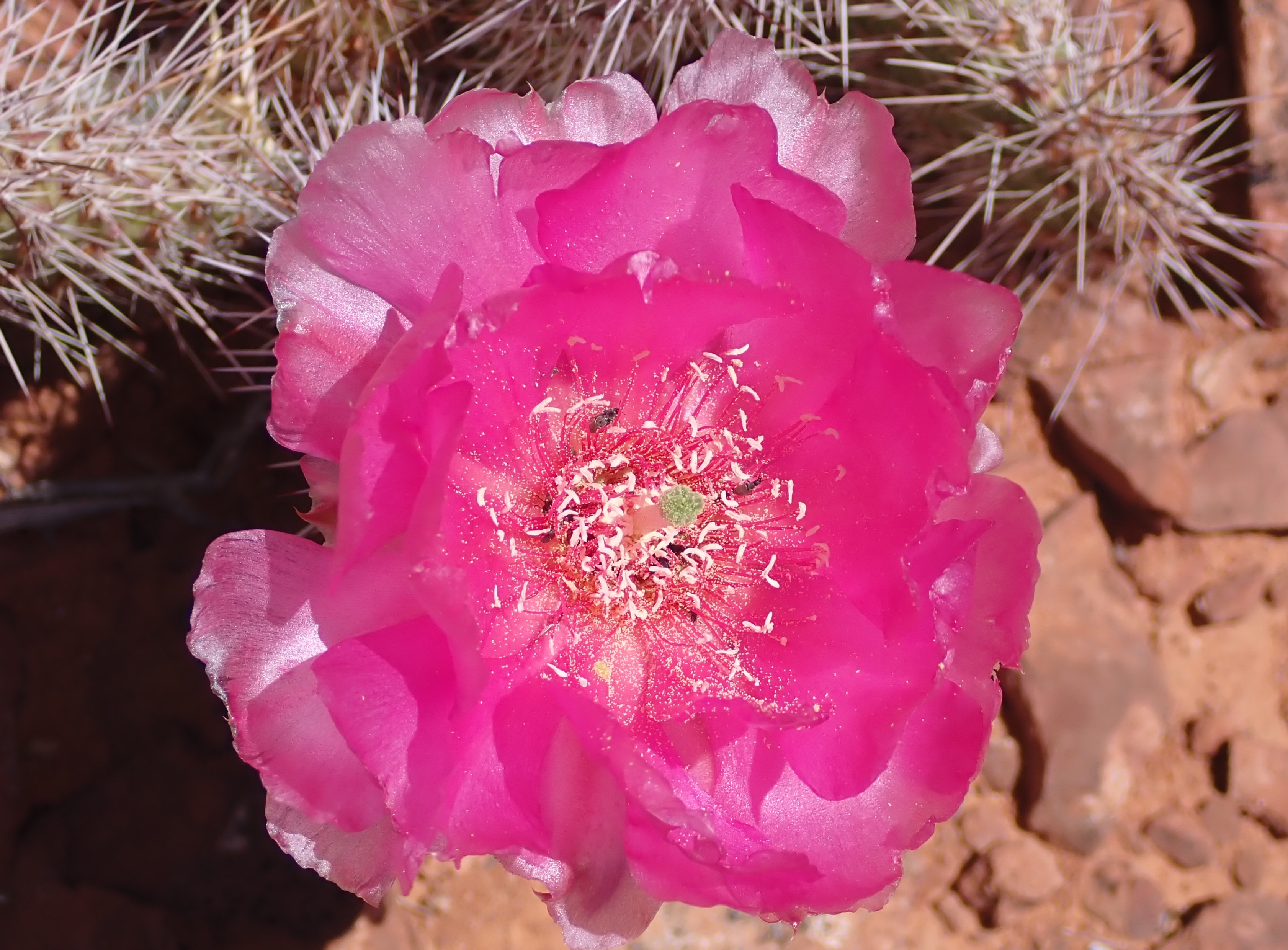 Spring trips bring desert flowers, like this cactus flower blooming near camp. Courtesy/Bill Priedhorsky
Route finding got more exciting when we climbed up out of the canyon. We found just a few ways up and out, through little slots and gullies that penetrated the cliffs that otherwise boxed us in. Once on top, the terrain turned into chaos – domes and little canyons interspersed with sandy flats. The path was sometimes straightforward – climb a dome, get to the top, head for the next dome, and repeat. On day four, for example, one dome led to another until we found ourselves looking 400 feet down to the camp that we had left 3 hours before. We could see camp, but could not get down 400 feet of cliff, so back we turned, retracing our route to our little pocket of “civilization”. That day was essentially non-technical – if one picked the best path, none of the rock was too steep to hike up or down, no rope assist needed. The bare rock is called “slickrock”, because it is slippery if you are a horse and your shoes are made of iron, but actually provides a good grip for a person in hiking boots. In fact, hiking across slickrock is easier than slogging through the sandy bottoms, so we stayed on the rock whenever we could.
 The Mountaineers party hiked from one dome to the next until they could see their camp 400 feet below them. Courtesy/Bill Priedhorsky
Another day, we went looking for trouble. On a previous day we had been intrigued by a jumble of bare sandstone in the near distance. The topographic map did not make any sense – the contours were a confusion of whirly lines that failed to cohere into anything regular. We reached the terrain by hiking past the top of a 200-foot dry fall, surmounting the first high dome, then following one little valley after another, deeper and deeper into the maze. Every corner gave up a new, otherworldly view, of a world made up of bare rock, where everyday things like dirt and vegetation were rare on the ground. Eventually we hit a dead end – we couldn’t reach the next dome because a little canyon intervened, and the way down to the next major canyon was too steep to descend. We turned back, but even finding a way home took us to an obstacle, which we surmounted only because a brave member of our party, with particularly good balance, was able to walk up a steep sandstone slope, and offer a rope that eased the way up for everyone else. This was not technical rock climbing, but rather a rope “handline” that provided an extra bit of balance to make a hard slope straightforward.
 Working our way back to camp through a sandstone maze, thanks to a rope assist. Courtesy/Bill Priedhorsky
When you are setting out, a week-long trip seems like it will last forever. But suddenly the week is drawing to an end – first the last day of hiking, then the last evening in camp, then packing everything onto the llamas for the last hike of the trip, the hike to take us back to the cars. Our sadness at leaving was tempered by the hope of another trip to come. Canyon trip number 140 is already on the calendar, and the Mountaineers are ready for one more adventure.
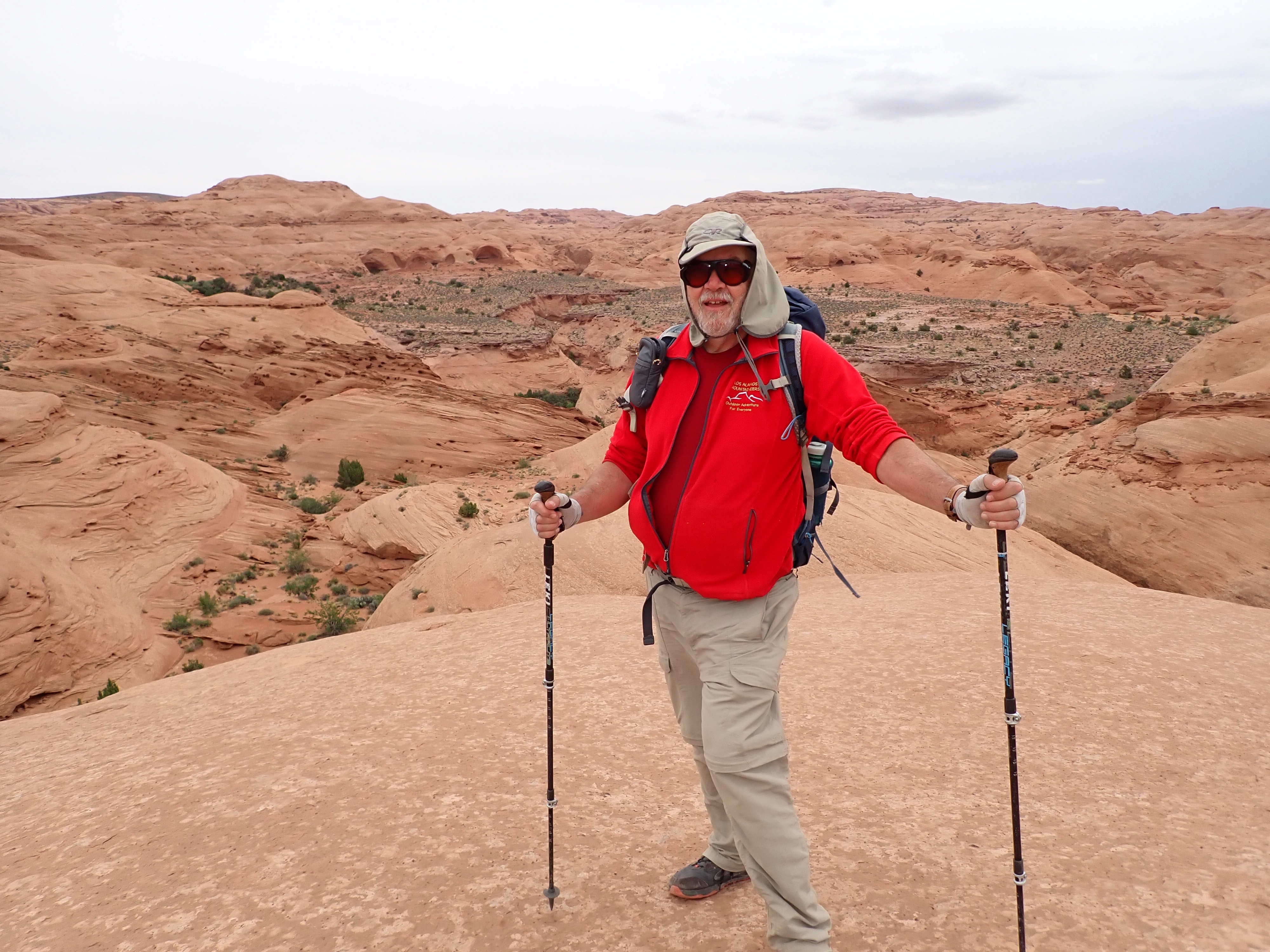 Author and trip leader Bill Priedhorsky atop a sandstone dome. Courtesy/Bill Priedhorsky
If you want to go: The Los Alamos Mountaineers offer spring and fall llama trips to the Utah Canyon Country, which are popular and book up quickly. Or you can design your own trip with guide BJ Orozco, picking a destination that suits your level of ambition. Either drop camps or catered trips are possible. In a drop camp, your party is on their own once the llamas deliver your gear; alternatively, BJ is happy to cater your meals and guide your hikes.