
By RACHEL ZERVAKOS
DALA
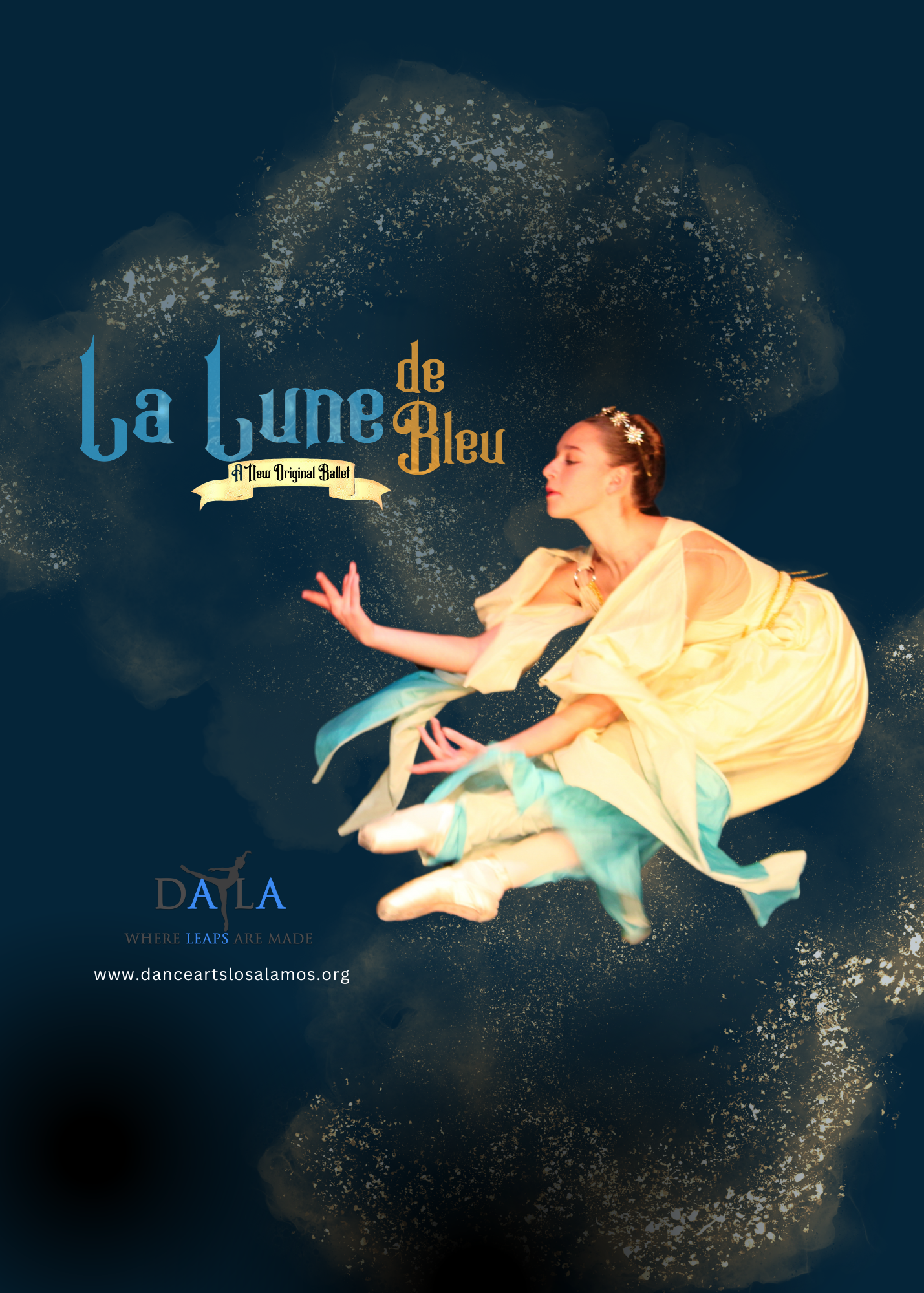
Each spring, Dance Arts Los Alamos (DALA)presents a full-length ballet, most recently including the beloved classical repertoire Giselle (2023) and The Tales of Don Quixote (2024). This year, Dance Arts Los Alamos is making its largest leap yet as we premiere an all-new original full length ballet in three acts, entitled La Lune de Bleu.
From the storyline, to the music, choreography, sets and costumes, this production is a labor of love that has been in progress for over two decades. As the May 2, 2025 world premiere draws near, we invite our community and beyond to witness a remarkable piece of art and storytelling.
The libretto (storyline) of La Lune de Bleu was written by DALA Artistic Director Jonathan Guise.
The ballet follows the love story of Selene, the Moon Goddess, and Endymion, a mortal shepherd. After falling in love, Selene faces divine disapproval and the schemes of Pan, the God of the Forest. Endymion, seeking to reunite with Selene, accepts help from Pan and Hades but becomes trapped in the Underworld. Selene pleads with Zeus and the gods of Mount Olympus for help, but must descend into Hades’ realm to rescue Endymion herself, and once there, find a way to escape with her divine power and soul.
As DALA’s Rehearsal Director, it has been my honor to collaborate with Mr. Guise and the DALA team on the ballet. Observing Mr. Guise bring his vision to life was a masterclass in the creative process, and recently I had the chance to interview him about this ambitious project.
How did the storyline of La Lune de Bleu come to be?
JG – I suppose it began with the image of the moon rising over the ocean on a beautiful evening in Florida, when I was performing with a dance company there early in my career. I thought that the pure beauty of the moon itself ought to be represented in a ballet. Around that time I was rehearsing a piece that was themed on Greek mythology, which sparked my interest in that subject. Soon after, I moved to Chicago, where I found a book on mythology that included the myth of Selene and Endymion. I remember it was at the downtown Chicago library that I actually began writing the ballet. I started thinking about how to alter the well known story of Selene and Endymion and combine it with other myths and versions, and discussed the idea of turning this into a formally structured ballet with colleagues and friends. I continued to tinker with the ideas and revisit this project at various points in my life, and it evolved all the way through 2024.
What made 2025 the right time to finally bring this ballet to life in full?
JG – I’ve been talking about doing this ballet for the past 7-8 years at DALA, and this was the right year because I felt that we had the student body capable of handling the choreography and the level of dancing required.
In your view, what does this ballet signify for DALA as an organization?
JG – A giant leap!
Who should come to see this ballet?
JG- Anyone who wants to see a story about destined love and drama set on the stage of classical ballet told with contemporary sensibility.
This is an ambitious show all around, but especially so in regard to production elements. Tell us about your vision for the sets and costumes.
JG – I wanted to take a traditional approach on the costumes, but with new ideas.
RZ – Right, we have a lot of traditional ballet costume structure, but they have asymmetrical lines and softer, more flowing fabrics than we might see in a fully classical ballet.
JG – For the sets, I am hoping they will illustrate a modern interpretation of a classical look. For example, the shape of the set pieces, rather than color, illustrates the landscape, which you will see in pieces like the mountains and the moon – which doesn’t look like our moon as we normally see it.
Are there any artists or specific works that influenced your creative process and vision for La Lune de Bleu?
JG – Major musical influences for me were composers Ennio Morricone and Jean Sibelius. For the sets, the influence of Salvador Dali’s use of line combined impressionistic ideals of Van Gogh. For choreography, I followed the template structure of a classical ballet after Marius Petipa (regarded as the father of classical ballet, famous for Swan Lake, Sleeping Beauty) but for the movement itself I was inspired by concepts of William Forsythe’s contemporary ballet work and Twyla Tharp’s crossover contemporary work. The excitement of Tharp’s choreography really influenced me in the opportunities I had to work with her; she has always been really good at taking something classical and keeping it classical but throwing in a hint of something contemporary and unexpected.
For this ballet, we are joined by three amazing guest artists for the roles of Endymion, Pan, and Zeus. Why is it important to give students the opportunity to perform alongside professionals?
JG – It pushes the students to dance at their highest level of potential, and puts them in a situation where they know they are expected to be professional, respectful, inclusive, and disciplined. It also gives them the opportunity to network beyond their regular community and expand their view of the dance market.
What do you hope audiences will take away from seeing this ballet?
JG – A renewed view of what a classical ballet can be.
We began rehearsals with the dancers in January 2025, beginning with the audition process and immediately starting choreography. DALA serves over 320 students in Los Alamos and surrounding communities, and students in Ballet Level 2 and above, through the Adult Ballet classes, had the opportunity to audition for La Lune de Bleu. The cast includes 75 dancers, including three professional guest artists and several Los Alamos community members appearing in character acting and dancing roles! I spoke with some of our dancers about their experience being part of this new production.
As a dancer, what aspect of being part of the creation of a brand new ballet has stood out to you or surprised you?
Margaret Kelley, 16 (Hera/Aphrodite) – Something that stood out to me was how each act of the ballet has certain composers or musical flavor; I was really surprised how much thought went into making each act really depict the story through the music.
Sierra Esquibel, 16 (Polyhymnia/Rain) – I was also really surprised by the music, especially when we found out how long it took to find all of it!
Anna Simakov, 16 (Nymph Soloist/Player) – I was surprised by how well the plot works in the ballet, for example the fact that in the first act we see Orpheus in the play – which that story ends badly – which is like foreshadowing for what happens in Act 3 in the underworld, but it goes differently.
Ciara Hinrichs, 16 (Athena/Nike)- The fact that so many people are involved, that the show involves the whole town. The high school is making the sets, and people from the town, who don’t usually dance, are playing characters. It’s awesome that we got so many people involved!
Ariana Kimball, 14 (Nike/Demeter) – For me, it was developing our own characters, because there is no example to go from. For this ballet, you just get an idea from your choreographer and you run with it your own way to make the new character all your own.
Thanos Stamatopoulos is a Los Alamos based physicist by day, and dancer by weekend, who will be portraying the pivotal role of Hades King of the Underworld.
Thanos, what has it meant to you to be part of this ballet?
T.S. – It’s very fulfilling to be part of this ballet! DALA treats every dancer as family, regardless of their age or level. And, the more exposure you get to the teachers and dancers, the more you realize how strong the DALA family bonds are!
Being from Athens, Greece yourself, what was your initial thought when you learned that we were doing a ballet about Ancient Greek mythology?
T.S. – It was exciting and surprising! Being thousands of miles away from home in the middle of nowhere and being asked to participate in a ballet that’s centered around your culture is once in a lifetime experience! Never in my wildest dreams I could’ve imaged that!
As a dancer, what is something you will take away from this experience?
Jana Gauss, 15 (Aphrodite/Hera) – This might sound cheesy, but for me it’s that you are capable of so much more than you think! [The choreography] is so challenging physically, and I’ve seen everyone do so many amazing things they thought they couldn’t do just in the past three months!
Ciara H. (Athena/Nike) – That in order for something so big like this to come together, everyone has to do their part. It won’t work if everyone isn’t putting in the same amount of effort to pull together.
Performances will take place at 7 p.m., May 2, 2025 and at 2 p.m., May 4, 2025 at Duane Smith Auditorium in Los Alamos. The cast of DALA dancers will be joined by guest artists Aiden Moss of Ballet San Antonio; Skylar Burson of Ballet Tucson; and freelance artist Brandon Penn. The production will feature all new choreography by Jonathan Guise, Rachel Zervakos, Karina Wilder, Allison Beaux, Isabella Jimenez, Audrey Roman, and Natalie Smith, with all new costume and scenic design by local Los Alamos artists and designers. Secure your seat today – tickets are available online now! $5/student, $10/seniors, $25 general admission.
In conjunction with La Lune de Bleu, DALA’s third annual Spring Gala Fundraising Event will take place at 7 p.m., Sunday, April 27 at Historic Fuller Lodge. Tickets to the gala event are $75, and include a reserved seat at the Friday, May 2 performance of La Lune de Bleu.
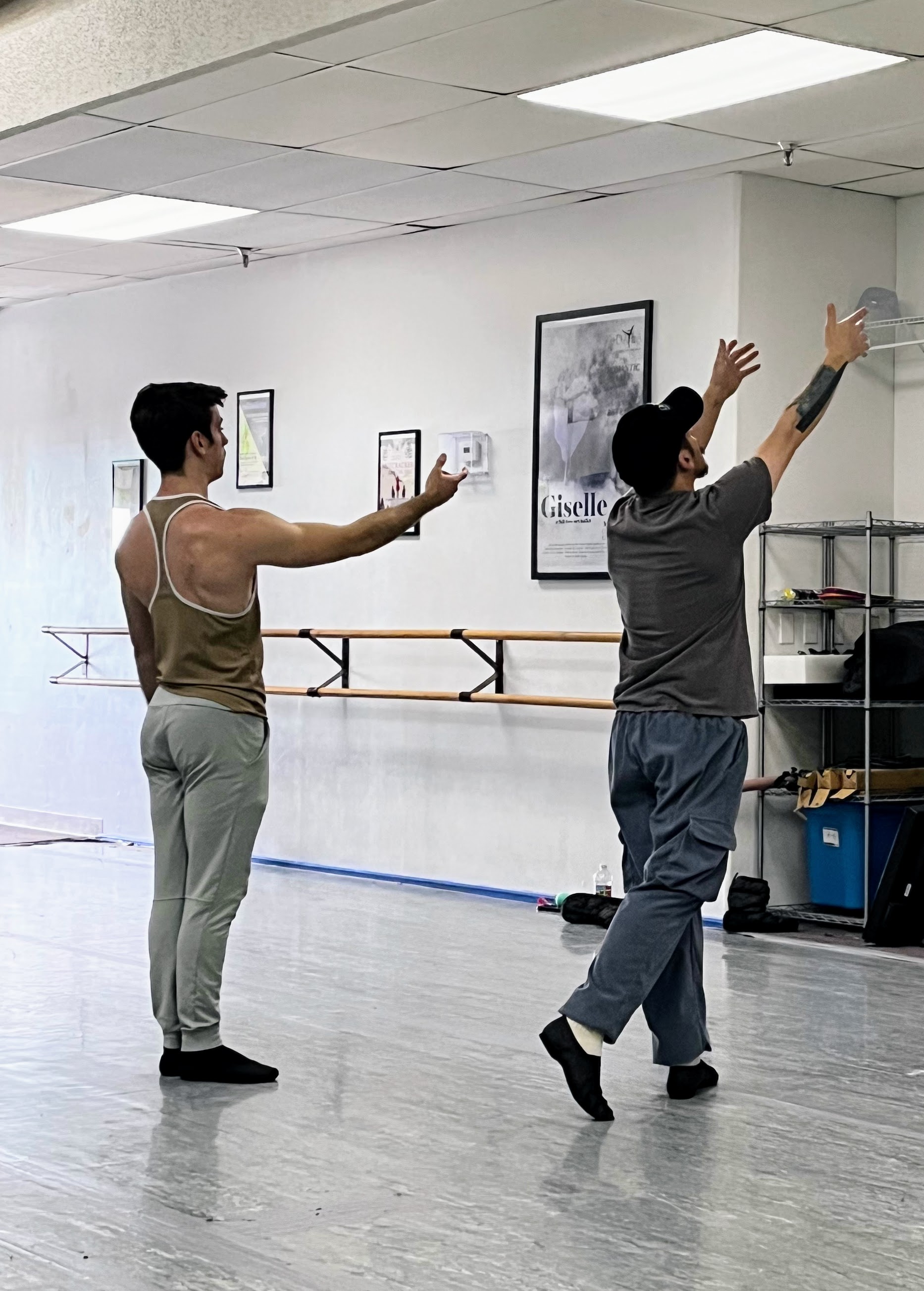 Jonathan Guise coaches guest artist Aiden Moss in the original choreogrpahy for Endymion Act 1. Photo by Rachel Zervakos