
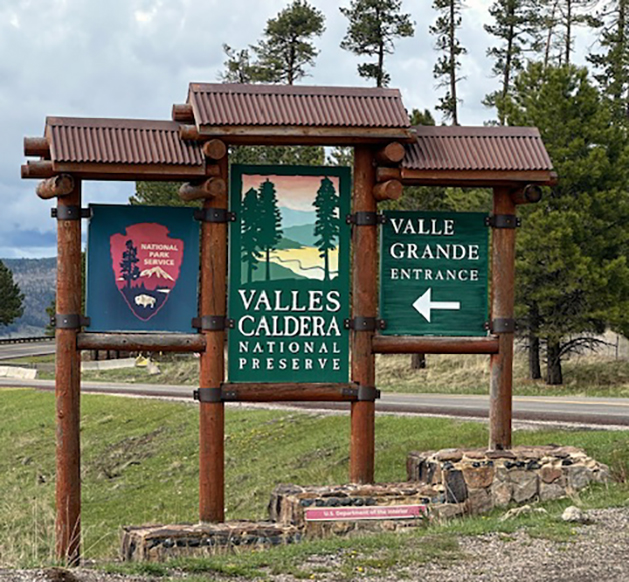
 Valles Caldera National Preserve has big plans for the future and shared those plans during a May 16 press tour. Photo by Kirsten Laskey/ladailypost.com
 Chief of Interpretation, Education and Volunteers Dave Krueger, left, listens to Acting Chief of Facilities Jonathan Allbach describe the improvements being planned for the parking lot located outside the main visitor center at Valles Caldera National Preserve. Photo by Kirsten Laskey/ladailypost.com
By KIRSTEN LASKEY
Los Alamos Daily Post
kirsten@ladailypost.com
It is undeniable that Valles Caldera National Preserve is a beautiful place. From the jigsaw-shaped lines of the Jemez Mountains to the epic sweep of the grass meadow in Valle Grande, there isn’t a corner not worth exploring or a site that shouldn’t be captured in a photograph.
This National Park attracted more than 76,000 people in 2023 and the Valles Caldera team have numerous plans to help bring more attention to the park while also preserving and maintaining it for the future.
Park Superintendent Jorge Silva-Bañuelos, Acting Chief of Facilities Jonathan Allbach and Chief of Interpretation, Education and Volunteers Dave Krueger shared some of these plans during a press tour May 16.
They explained that a long-range management plan is being developed; the plan is expected to be finalized in 2025. The plan will then be presented to the National Park Service to request funding.
A goal, Silva-Bañuelos said, is to make Valles Caldera accessible to everyone.
“One of the main goals … is to share it with others,” he said. “Our real goal is to promote public access and recreation. My sincere belief is given its location … it will be one of the highest visited parks in New Mexico.”
The long-range management plan includes the possibility of rerouting the main entrance road away from the wetlands as well as paving it. Allbach mentioned that improvements are planned for the parking lot at the end of the main entrance. Further in the park, near the Cabin District, he mentioned that two temporary parking lots are being constructed and a gate with a digital keypad is being installed for those who reserve a backcountry vehicle pass to punch in their code.
Besides infrastructure, the park team is planning to include more audio and visual elements. For instance, inside the ranger station located in the cabin district, Krueger noted there are plans for a three-dimensional map of the park that would provide information about the park – everything from human history to geology. Furthermore, along the perimeter of the park that borders N.M. 4, the hope is to construct viewing platforms for visitors to utilize.
Big plans are also in the works for Sulphur Springs, the park’s geothermal site. The gurgling of mud pots and an acid green pond with its own pockets of bubbling water make it prime to be a popular spot for visitors. The charred ruins of a bathhouse and the impacts of mining need to be addressed and park staff mentioned some type of boardwalk is being brainstormed for the area.
Krueger mentioned a variety of programs and events are being scheduled at Valles Caldera. These events include Sopapilla y Estrellas night sky event July 5, National Public Lands Day volunteer event Sept. 28, Valles Caldera Fall Fiesta Oct. 5-13 and Valles Caldera’s 10th anniversary as a National Park Dec. 19.
The goal, he said, is “to get people up here and experience some of the things that we offer.”
Besides special events, Krueger noted that Valles Caldera also offers a Junior Ranger Program, which comes with a Junior Ranger Training Manual. Plus, there are volunteer opportunities, too.
“We want to provide opportunities for people to connect to the park,” he said.
While Valles Caldera is meant to be shared and enjoyed by everyone, Silva-Bañuelos noted that there needs to be a balance between preservation and visitors.
The park staff is making moves to reduce its carbon footprint. For instance, its fleet now includes electric vehicles and, with the assistance of funds from the Inflation Reduction Act, electric charging stations are being planned. There are also plans to remove propane and natural gas use in the park. Furthermore, it was reported that the park has a robust recycling program.
Being active in reducing greenhouse gas emissions and mitigating global warming is important, Silva-Bañuelos said.
“(We) put a lot of work in (and) spend a lot of effort on improving the ecology and restoration to the landscape,” he said. “Now we are also focusing our efforts on improving and enhancing visitor access and opportunities … we are hoping to become a model in sustainability. We recognize that the Jemez Mountains is a hot spot for climate warming, which is a challenge. But we are looking at what we can do to address our contributions to global warming.”
Fire mitigation is another major focus. During the tour, Silva-Bañuelos pointed out a patch of old-growth forest. The conifer trees were neatly spaced apart from one another with wide swaths of grass. This is the ideal; he said, there should be 40-60 trees per acre. The problem is more and more trees are getting packed tightly together, totaling between 1,000-2,000 trees per acre.
To address this, Silva-Bañuelos said the park is partnering with Santa Clara Pueblo and Jemez Pueblo to cut down small-diameter trees and do pile burnings.
There are other challenges to address; and while they don’t look as ominous or intimidating as wildfires, these obstacles still pose a problem to the environment: trespassing cattle.
Cattle are attracted to Valles Caldera, Silva-Bañuelos said, because “it has two things that cows love. We have grass and we have water.”
To diminish these animals’ enjoyment of the park landscape, he explained that the U.S. Forest Service and National Park Service have teamed up to perform cattle mitigation, committing $1 million each to this effort. A virtual fencing pilot project is being tried where cattle are given collars that are linked to GPS. If the cattle wander off course, they will receive a few initial noises to steer them in the correct direction; if that doesn’t work then they will receive a small shock.
A cattle wrangler has also been hired and corrals are erected to collect wayward cows.
Valles Caldera is brimming over with potential and park staff emphasized the public’s involvement is key to its success – whether it is visiting the park or weighing in on its long-range management plan. For more information, visit https://www.nps.gov/vall/index.htm
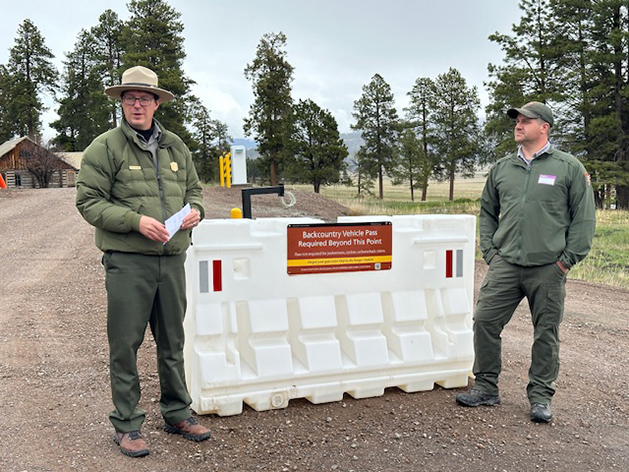 VCNP Chief of Interpretation, Education and Volunteers Dave Krueger, left, and Acting Chief of Facilities Jonathan Allbach discuss the digital keypad and gate that will be installed to allow visitors who purchase back country passes to punch in their code and be granted access. Photo by Kirsten Laskey/ladailypost.com
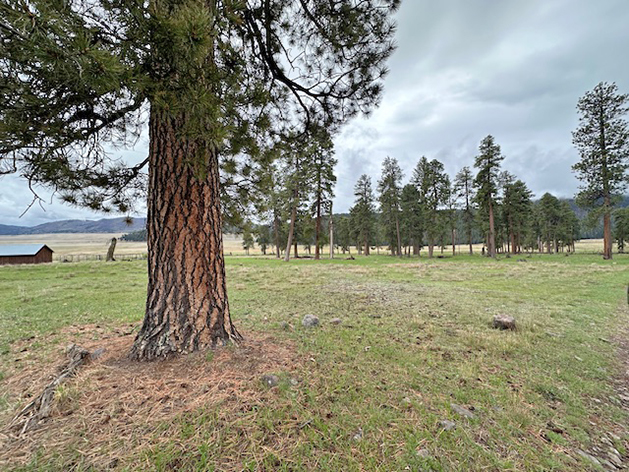 One of the sites in the cabin district at VCNP that will offer a temporary parking lot. Park staff explained that the temporary parking lots will be built on top of fabric in order to prevent any impact on the environment. Photo by Kirsten Laskey/ladailypost.com
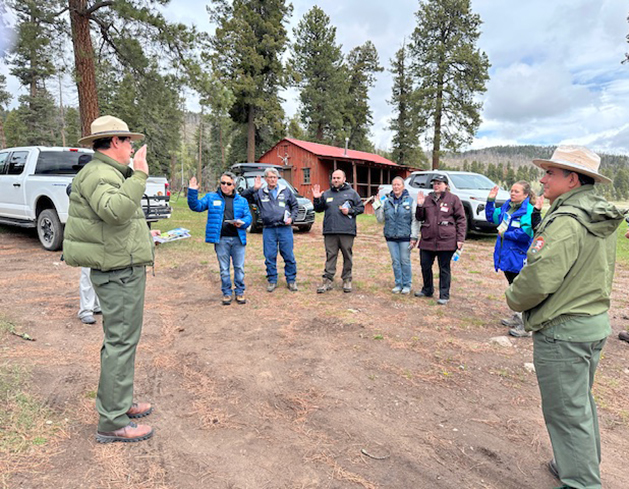 VCNP Chief of Interpretation, Education and Volunteers Dave Krueger, left, inducts participants on the press tour into the park’s Junior Ranger Program while Park Superintendent Jorge Silva-Bañuelos, right, looks on. Photo by Kirsten Laskey/ladailypost.com
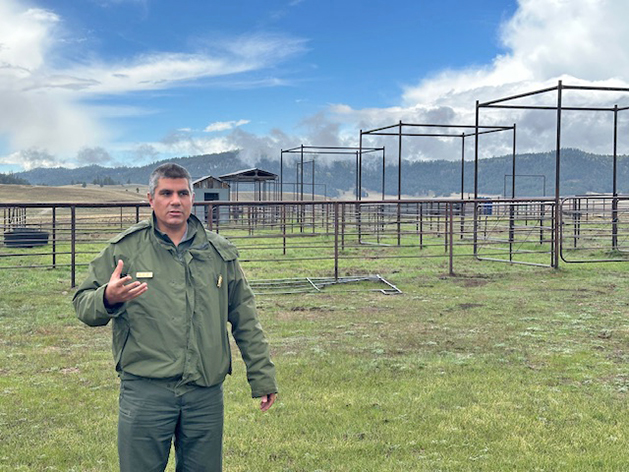 VCNP Superintendent Jorge Silva-Bañuelos discusses the strategies the park is utilizing to mitigate trespassing cattle. These methods include a virtual fencing pilot project as well as hiring a cattle wrangler and putting cattle into corrals. Photo by Kirsten Laskey/ladailypost.com
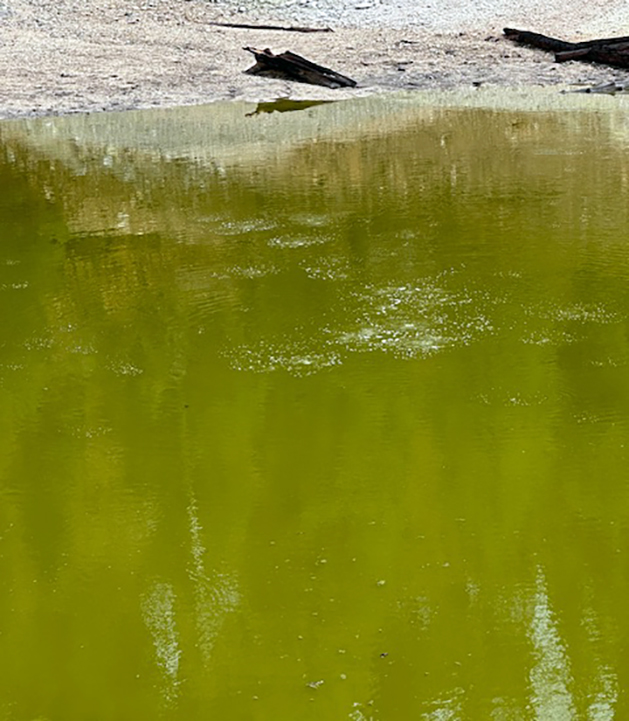 An acid green pond features pockets of bubbling water at Sulphur Springs in VCNP, the park’s geothermal site. Photo by Kirsten Laskey/ladailypost.com
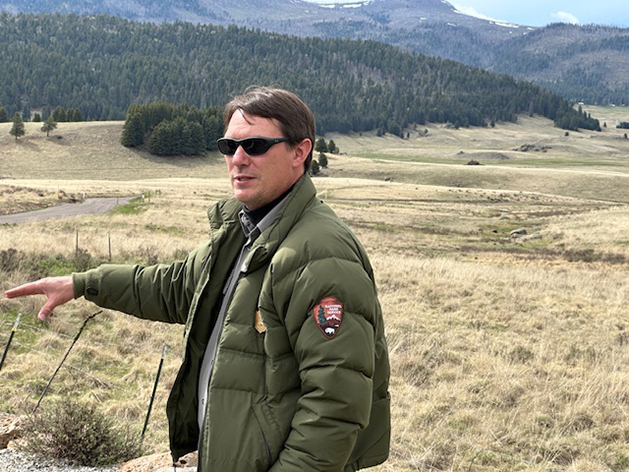 VCNP Chief of Interpretation, Education and Volunteers Dave Krueger discusses plans to re-route the main entrance road into the park. Photo by Kirsten Laskey/ladailypost.com
 VCNP Park Superintendent Jorge Silva-Bañuelos discusses the methods the park is utilizing to mitigate wildfire. These methods include partnering with Santa Clara Pueblo and Jemez Pueblo to cut down small-diameter trees and do pile burnings. Photo by Kirsten Laskey/ladailypost.com