
 Staff Report
The government officially shut down at midnight after Congress deadlocked and failed to pass a funding measure to keep it open. Those entities critical to protect lives and property are deemed essential and will stay open.
About shutdowns
In the United States, government shutdowns occur when funding legislation required to finance the federal government is not enacted before the next fiscal year begins. In a shutdown, the federal government curtails agency activities and services, ceases non-essential operations, furloughs non-essential workers, and retains only essential employees in departments that protect human life or property. Shutdowns can also disrupt state, territorial, and local levels of government.
Funding gaps have led to shutdowns since 1980, when Attorney General Benjamin Civiletti issued a legal opinion requiring it. This opinion was not consistently adhered to through the 1980s, but since 1990, all funding gaps lasting longer than a few hours have led to a shutdown. As of February 2024, 10 funding gaps have led to federal employees being furloughed.
The most significant shutdowns include the 35-day shutdown of 2018–2019 during the first Donald Trump administration[3], caused by a dispute over expanding barriers on the U.S.–Mexico border; the 21-day shutdown of 1995–1996 during the Bill Clinton administration, over opposition to major spending cuts; and the 16-day shutdown in 2013 during the Barack Obama administration, caused by a dispute over implementation of the Affordable Care Act (ACA). The other seven shutdowns lasted five or fewer days.
Shutdowns disrupt many different government services and programs. Notably, they close national parks and other public institutions (such as Washington, DC’s federally managed museums), reduce government revenue, and reduce economic growth due to the disruption of major services. During the 2013 shutdown, financial-rating institution Standard & Poor’s said that the shutdown had “to date taken $24 billion out of the economy” and “shaved at least 0.6 percent off annualized fourth-quarter 2013 GDP growth”.
Overview
Under the separation of powers created by the United States Constitution, the appropriation and control of government funds for the United States is the sole responsibility of the United States Congress. Congress begins this process through proposing an appropriation bill aimed at determining the levels of spending for each federal department and government program. The finalized version of the bill is then voted upon by both the House of Representatives and the Senate. After it passes both chambers, it proceeds to the President of the United States to sign the bill into law.
Government shutdowns tend to occur when there is a disagreement over budget allocations before the existing cycle ends. Such disagreements can come from the president – through vetoing or threatening to veto any finalized appropriation bills they receive – or from one or both chambers of Congress,[8][9] often from the political party that has control over that chamber. A shutdown can be temporarily avoided through the enactment of a continuing resolution (CR), which can extend funding for the government for a set period, during which time negotiations can be made to supply an appropriation bill that all involved parties of the political deadlock on spending can agree upon.
A CR can be blocked by the same parties if there are issues with the content of the resolution bill that either party has a disagreement upon, in which case a shutdown will inevitably occur if a CR cannot be passed by the House, Senate or president. Congress may, in rare cases attempt to override a presidential veto of an appropriation bill or CR. Such an act requires there to be majority support of two-thirds of both chambers.
Prior to the 1980s, many federal agencies continued to operate during shutdowns, while minimizing all nonessential operations and obligations, believing that Congress did not intend that agencies close down while waiting for the enactment of annual appropriations acts or temporary appropriations. However, Attorney General Benjamin Civiletti issued two opinions in 1980 and 1981, that more strictly interpreted the Antideficiency Act in the context of a funding gap, along with its exceptions. The opinions stated that, with some exceptions, the head of an agency could avoid violating the Act only by suspending the agency’s operations until the enactment of an appropriation. In the absence of appropriations, exceptions would be allowed only when there is some reasonable and articulable connection between the function to be performed and the safety of human life or the protection of property. However, even after the Civiletti opinions, not all funding gaps led to shutdowns. Of the nine funding gaps between 1980 and 1990, only four led to furloughs.
Shutdowns of the type experienced by the United States are nearly impossible in other forms of government:
- Under the parliamentary systems used in most European and Asian nations, stalemates within the government are much less likely, as the executive head of government (i.e. the prime minister) must be aligned with the legislature majority or at least not be opposed by the legislative majority, and may be (though not necessarily always must be in some countries) a member of the legislature itself, and must maintain the approval of the legislature to remain in power (confidence and supply). Typically a legislature is suspended if a budget fails to pass (loss of supply), and the head of government must resign, since the budget is a matter of confidence. Then the head of state may either appoint another member of legislature who can garner majority support, or dissolve the legislature and conduct fresh general elections.
- In other presidential systems, the executive branch typically has the authority to keep the government functioning even without an approved budget.
Effects
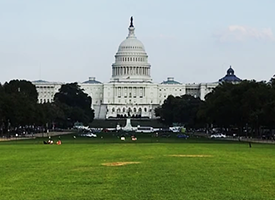
Units of the National Park System closed during the 2013 federal government shutdown. Shown here is the National Mall.
While government shutdowns before 1995–1996 had very mild effects, a full federal government shutdown causes a large number of civilian federal employees to be furloughed. Such employees are forbidden even to check their e-mail, a prohibition that some agencies enforce by collecting government-issued electronic devices for the duration of the shutdown.
Because of the size of the government workforce, the effects of a shutdown can be seen in macroeconomic data. During the 2013 shutdown, for example, 800,000 employees were locked out, payment was delayed to 1.3 million workers,[14] confidence in the job market decreased for a month, and GDP growth slowed 0.1–0.2%. The loss of GDP is a bigger sum than it would have cost to keep the government open.
The complete effects of a shutdown are often clouded by missing data that cannot be collected while specific government offices are closed.
Some effects of the shutdown are difficult to measure and can linger afterward, such as destroyed scientific studies, lack of investment, and deferred maintenance costs. The 2018–2019 shutdown curtailed safety and law enforcement investigations, caused air travel delays as essential workers stopped showing up, shut down some facilities for Native Americans and tourists, and delayed regulatory approvals and immigration hearings for non-detainees.
The exact details of which government functions stop during a shutdown is determined by the Office of Management and Budget.
What stays open
- “Emergency personnel” continue to be employed, including the active duty (Title 10) military, federal law enforcement agents, doctors and nurses working in federal hospitals, and air traffic controllers.
- Certain agencies continue their day to day operation with minimal staffing, including the National Weather Service, the Army Corps of Engineers, and parts of NASA.
- Members of Congress continue to be paid, because their pay cannot be altered except by direct law.
- Mail delivery is not affected as the United States Postal Service is self-funded and the funds are not appropriated by Congress.
- Some offices, such as the Patent and Trademark Office, can rely on operating reserves to remain open for a few months.
- Sometimes, the Washington, D.C. municipal government remains open. For example, during the 2013 shutdown, the city remained open because Mayor Vincent C. Gray declared the entire municipal government to be essential.
What is shut down
- For the Department of Defense, at least half of the civilian workforce, and the full-time, dual-status military technicians in the US National Guard and traditional Guardsmen (those on Title 32 status), are furloughed and not paid while the shutdown is in effect.
- Programs that are funded by laws other than annual appropriations acts (like Social Security) may also be affected by a funding gap, if program execution relies on activities that receive annually appropriated funding.
Arguments for and against
During the 2013 shutdown, the moral philosopher Peter Singer argued in Slate that shutdowns were evidence that the U.S. Constitution’s separation of powers constituted “a fundamental flaw”.
In 2019, following the end of the 2018–19 shutdown, Michael Shindler argued in The American Conservative that shutdowns protect popular sovereignty. He writes, “No other political phenomena so forcefully and dramatically obliges the whole people to recognize that their ideological divisions have become so great that the exercise of their sovereignty has become virtually impossible”, and “During a shutdown, the government, which is bound by elaborate mechanisms to the national will, becomes confused. For a moment, it seems as if the march of American history is at a standstill. There are only two means of moving forward: either government officials follow the will of something other than the nation or the nation engages in a momentous reconciliation of its will.”
In 2024, Michelle Buehlmann argued that government shutdowns are a form of brinkmanship. Elected officials use them to coerce their opponents into conceding.
In September 2025, Ezra Klein, arguing in favor of the Democratic party shutting down the government by the end of that month, argued that people voting in favor of funding a corrupting government is an act of complicity in that corruption, and that shutting the government down is a form of resistance against said government even if the end outcome of the shutdown is uncertain. In addition he argued that a shutdown can create media public attention toward the negative traits of those opposed to a shutdown.
Source: From Wikipedia, the free encyclopedia