
 Casablanca sign at Mohammed V Square. Photo by Debbie Stone
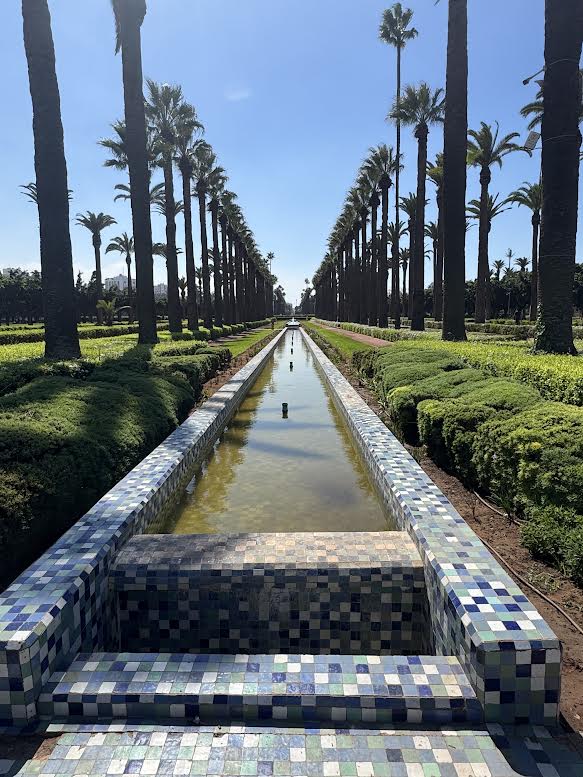 Arab League Park. Photo by Debbie Stone
By DEBBIE STONE
Santa Fe
For the Los Alamos Daily Post
Casablanca is Morocco’s largest city and economic hub, boasting a major port, but many travelers bypass it, using it only as their entrance and exit point in the country. Perhaps this is because its modern appearance doesn’t fit their romanticized vision of Morocco, lacking the allure of beloved tourist hot spots like Marrakesh or Fes.
During my recent trip to this North African country, I decided to spend two days in Casablanca to check it out and form my own opinion. And I’m glad I did, as I discovered that the “White City,” as it’s known for its many whitewashed buildings, is a vibrant metropolis with a cosmopolitan feel and an intriguing blend between old and new. Not to mention its key location along the Atlantic Coast, which offers a picturesque seaside backdrop and plenty of beaches.
The most significant and iconic site in Casablanca is the Hassan II Mosque. This famed house of worship was built on a platform partially extending over the ocean to reflect a connection to the sea and nature.
It’s an impressive place due to its grand size and has the distinction of being Africa’s largest mosque, as well as the seventh largest in the world. There’s space for 25,000 worshippers inside and 80,000 on the grounds outside. Its towering minaret is also notable, as it’s the second highest in the world at almost 300 feet tall. Atop it sits three round balls representing the three major world religions – Judaism, Christianity and Islam – a common feature on many mosques.
Commissioned by King Hassan II (the father of Mohammed VI, the current king) in 1986 and completed in 1993, the mosque was designed by French architect Michel Pinseau. It’s a showcase of Moroccan artistry and architectural expertise. Remarkably, a bulk of it was funded by a public subscription campaign. Millions of Moroccans around the globe contributed to the project, demonstrating dedicated commitment.
This mosque is the only one in the country that non-Muslims can enter and tours are strictly regulated. While waiting for our tour to begin, I marveled at the scale of the mosque and its surrounding campus. The building itself is 660 feet long and 330 feet wide and the entire complex is 22 acres, including a hammam (bathhouse), madrassa (Islamic school), museum, library and conference center.
The immensity of the mosque is overwhelming once you step inside. After removing our shoes, we were introduced to our tour guide, an older gentleman who wore dark glasses. He told us that he had “problems with his eyes, but not with his mouth.” A young man led him by the elbow around the mosque while he proceeded to regale us with historical and cultural details about the place. He also offered insight into the religious traditions and practices of Islam.
The prayer hall is split into three long areas separated by archways. At each end of the building are large doors with numerous decorative windows above them. And at the east end of the hall, which faces Mecca, is the area where the imam stands during prayers. Off to his right is a raised wooden pulpit where he delivers his sermon during Friday prayers.
Much of the interior of the building is covered with intricate carvings on the columns, walls and arches. Over 10,000 artisans and craftsmen worked on the project and all of the main materials utilized – granite, plaster, marble and wood – came from Morocco. Another two elements, the Carrara marble and glass chandeliers, were imported from Italy.
The designs are traditional Islamic and Moorish, however, modern elements are also integrated into the mosque such as an automatic sliding roof that opens to the sky, heated floors and electric doors.
Women and men pray separately in designated sections, with up to 20,000 men on the main level and 5,000 women on the balconies. Before services, the marble floors are covered with carpets that have lines on them indicating the rows that worshippers form, from front to back.
Our guide took us downstairs, where many fountains were lined up for the ablutions, the ritual washing that each Muslim must do before praying. He explained the process involved, which starts with washing the face, then the hands and each arm from fingertips to elbows, followed by wiping the head and washing both feet. Then this practice is repeated several times.
Those who live in the desert where water is scarce can do the ritual using sand. And in other situations where someone is ill or infirm, a stone can be used to rub the skin.
While in Casablanca, you’ll also want to visit Mohammed V Square. Here you’ll find several historic and stately buildings, including the Palace of Justice, City Hall and the Central Post Office, along with a statue of King Mohammed V. The architecture is a blend of Art Deco and Neo-Moorish styles, dating back to the early 20th century when Morocco was under French colonial rule. Across the street is the city’s newest monument, the ultra-modern Casablanca Grand Theater.
The square is typically a bustling place with locals and tourists alike congregating in the company of a plethora of pigeons. The birds tend to hang out around the main fountain, looking for food and can be obnoxiously persistent in their pursuit. There’s also a large Casablanca letter sign that is a magnet for pics.
If you’re looking for a green oasis in the city, check out Arab League Park. This beautifully landscaped area features dozens of giant palms, date trees and ornamental fountains. It’s a pleasant place to stroll along the winding paths or relax on the grassy lawns. Centrally located, and being the largest park in the city, it’s an inviting venue and a popular spot.
On one corner of the park you can find the Sacred Heart Cathedral, a striking building that now functions as a cultural center. Although officially, Morocco is an Islamic country, there are glimpses of other religions in the forms of churches and Jewish temples, as the Constitution of Morocco “guarantees everyone the exercise of religious freedom.”
Casablanca’s oldest section is the Medina. It’s an area next to the port and surrounded by a wall with eight gates. As in other Moroccan cities, the Medina is a place to lose yourself as you wander the alleyways, check out hidden nooks and crannies, peruse the shops and do plenty of people watching.
The most recognizable landmark of the Medina is the Casablanca Clock Tower. Its design is in the form of a traditional minaret to represent the country’s cultural heritage. But at the time it was built, its timekeeping ability was also viewed as a nod to European technology.
Essentially, the Medina is a large bazaar full of craftsmen and merchants selling everything under the sun, from leather goods and linens to spices, antiques and more. Know that bargaining is part of the game here with most of the sellers, so feel free to haggle a bit if you find something you want to buy. There are also cafes and small food stalls offering typical Moroccan fare.
I found most of the souks to be a bit more authentic than in some other places in Morocco. I chock this up to Casablanca having fewer tourists. It was heartening to see that these traditional shops continue to survive amid in a city known as a bastion of modernity.
For a completely different scene, take a ride through the seaside neighborhood of Anfa. This is where Casablanca’s most exclusive and luxurious homes are located. The area bears the original name of the city, which was called Anfa from the time it was founded around the 10th century B.C. up until the 15th century when its name changed to Casablanca.
You’ll see villa after villa set amid spacious, lush gardens. And for all you golfers, there’s Royal Golf Anfa Mohammedia, a nine-hole course adjacent to the sea. Golf courses are few and far between in the country and for most Moroccans, the greens fees are very expensive.
Those who know the famed 1942 movie “Casablanca,” starring Humphrey Bogart and Ingrid Bergman, always head to Rick’s Place. Though not authentic, as the fictional Rick’s Café in the film was actually a set built on a sound stage in Hollywood, the restaurant is themed in the same style. It’s a magnet for tourists, who love to take selfies in front of the doorway.
Former American diplomat Kathy Kriger, the late owner and founder of the café, was a longtime fan of the movie. She wanted everything in the café to be like it was in the film with the décor and ambiance straight from the 1940s. Her attention to detail is incredible, down to the beaded lamps, baby grand piano, white arches, chandeliers and palms.
Typically, you need a reservation to get inside Rick’s Place or you can take a chance and see if there’s space at the handsome mahogany bar for a drink. My husband and I decided to dine there to get the full experience. We were actually pleasantly surprised that the food and service were good for a place based on tourism. The menu features continental cuisine with dishes like salmon, pasta with mussels and shrimp, sea bass, roast duck and more.
Towards the end of our meal, a pianist sat down and began his evening performance. It was at this point that the café’s ambiance truly came to life. I felt like I was on the “Casablanca” movie set and half-expected Bogart to come strolling in saying one of his memorable lines like, “Of all the gin joints in all the towns in all the world, she walks into mine.”
 Hassan II Mosque. Photo by Debbie Stone
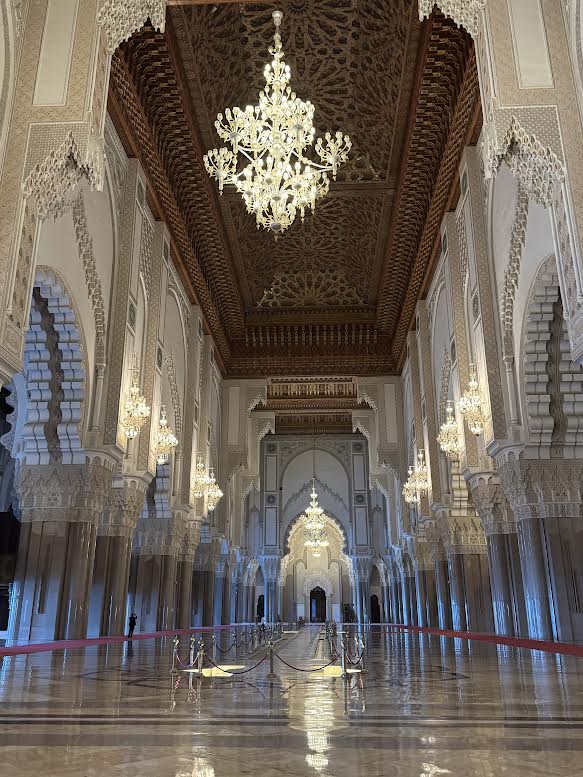 The Hassan II Mosque is grand and impressive. Photo by Debbie Stone
 Textiles of all kinds abound. Photo by Debbie Stone
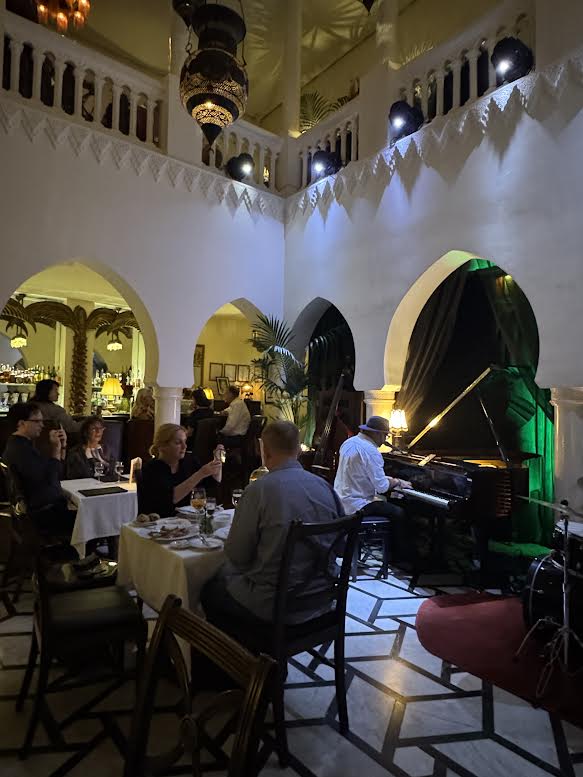 Inside Rick’s Place. Photo by Debbie Stone
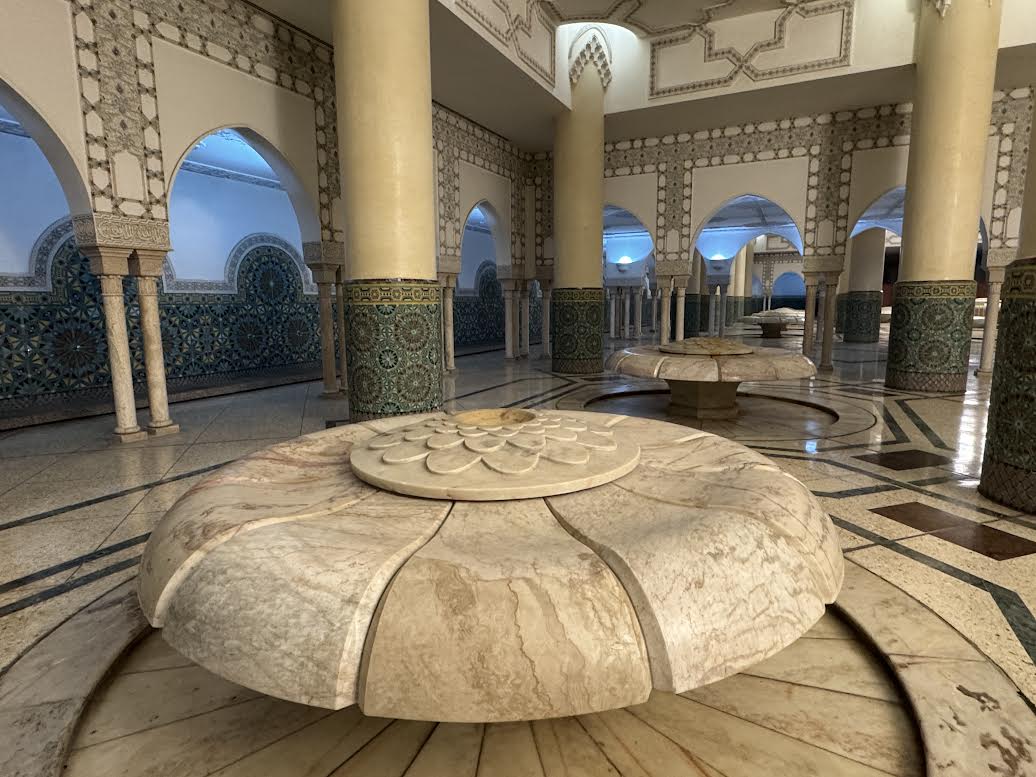 The mosque’s fountains for ablutions. Photo by Debbie Stone
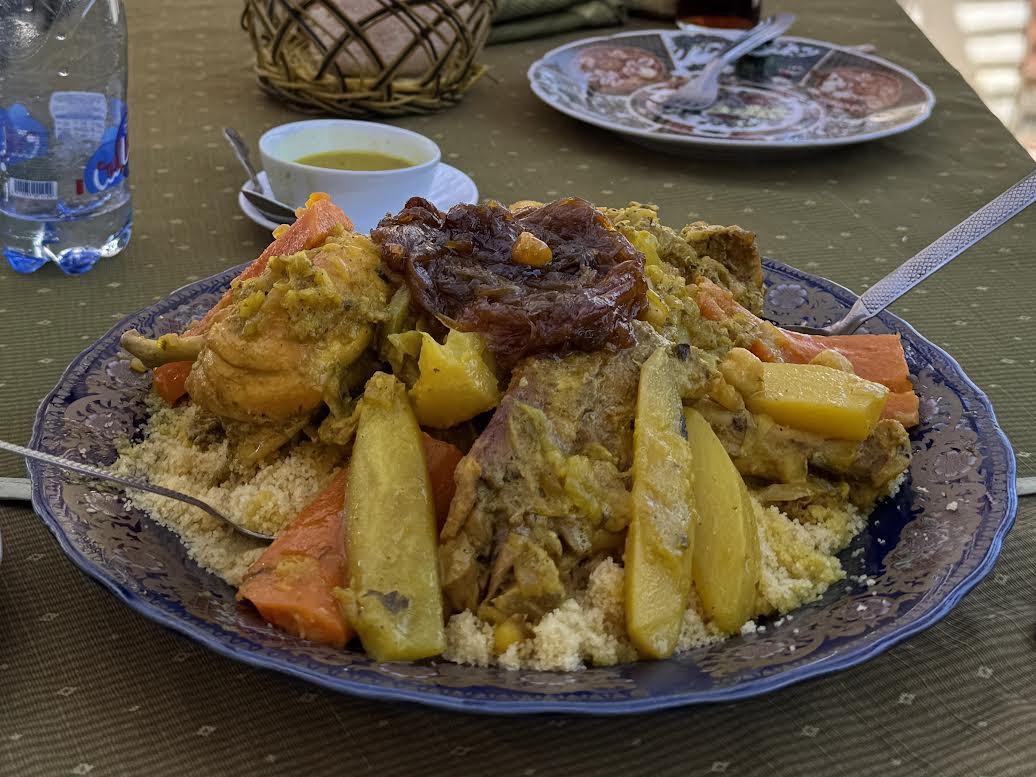 Couscous is a popular dish. Photo by Debbie Stone
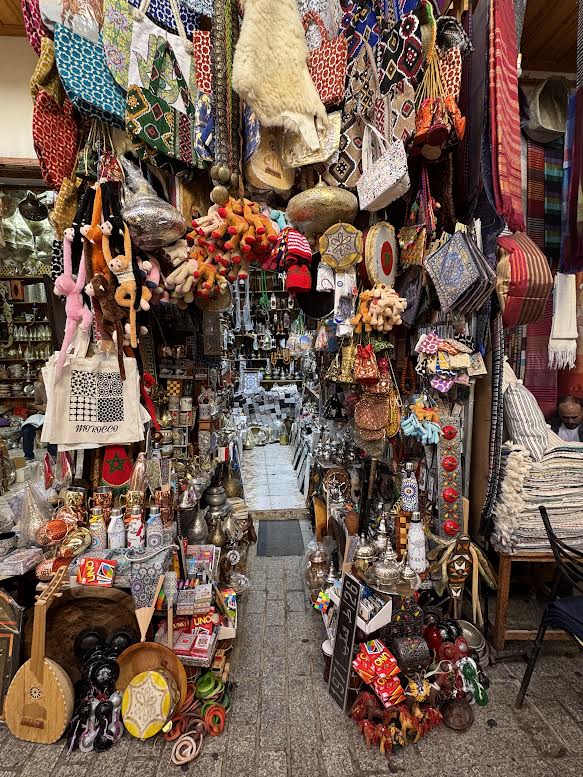 A souk inside the medina. Photo by Debbie Stone