
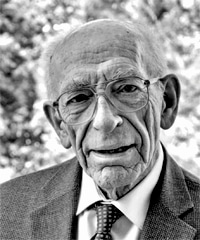
 J. Arthur Freed
By CAROL A. CLARK
Los Alamos Daily Post
caclark@ladailypost.com
Today marks the 50th anniversary of a profound tragedy in the history of Los Alamos. On May 19, 1972, a twin‐engine Beechcraft Queen‐Air, chartered by the Atomic Energy Commission to fly personnel to the Los Alamos Scientific Laboratory, lost an engine and nosedived into an open field.
Along with the pilot, eight Laboratory employees died at the scene, including Dr. Wright. H. Langham, associate division leader for biomedical research.
“Instantly nine widows and more than 20 fatherless children were created,” recalled longtime Los Alamos National Laboratory librarian J. Arthur Freed. “It seemed that everyone in Los Alamos and beyond knew someone on that aircraft – stories about those who perished were told and retold.”
Freed remembered the many church services held for the deceased and that Laboratory Director Harold M. Agnew was reported to have visited the home of every crash victim within 24 hours of the accident.
Those who lost their lives in that horrific accident include Dr. Langham, 60, who was a world‐renowned plutonium scientist and had been a consultant to the Apollo manned flight program on the effects of radiation on astronauts, UPI reported at the time. The other victims were technicians or staff members at the Lab, including Eugene Teatum, 37; Donald A. Larson, 46; Bruce A. Bean, 28; Johnnie E. Gallegos, 41; Richard O. Neithammer, 39; William Paul Frye, 40; and John Allen Gill, 43. The pilot was Richard T. Zittel of Ross Aviation. All of the victims were from Los Alamos except Gill who was from Arroyo Seco.
Eugene Peters, assistant chief of the Albuquerque Air Traffic Center at the time, said that high winds might have affected the airplane if it did lose one of its engines, UPI reported. The winds were not extremely high, but were up to 31 knots … if both engines were operating, there should have been no trouble, he said.
Witnesses described seeing the plane climb about 100 feet and hearing what sounded like one engine had stopped. The plane, owned by Ross Aviation of Albuquerque, crashed into a field near a riding stable and burst into flames, UPI reported.
The National Transportation Safety Board determined that the probable cause of this accident was the inadvertent opening of the forward cargo compartment door and the subsequent discharge of cargo, which caused damage to the plane’s left propeller and additional drag at a critical phase of flight, according to reports at the time.
Freed mentioned his personal involvement with that very plane the day before the tragedy occurred. He had flown down to Albuquerque to visit the library at Sandia National Laboratories.
“My return flight was scheduled on the Ross Aviation Beechcraft, the same aircraft that crashed the next day,” Freed said. “I still vividly recall the shouting between the plane’s air and ground crews about the forward cargo compartment, which is discussed in the ensuing ‘Aircraft Accident Report’ for May 19, 1972, in NTSB-AAR-72-32. That means that on May 18, 1972, it was clearly known that there were safety problems with that hatch. The difference – our fight made it home to Los Alamos, but the May 19 flight did not.”
Following its investigation, the Safety Board stated in its report at the time that had the door-unsafe-indicating system been operational or had the security of the forward cargo compartment door been ensured, the accident would have been avoided.
Freed is the recipient of the 2020 Los Alamos History Award, presented each year by the Los Alamos Historical Society to recognize those who have made a significant contribution to preserving the world-changing history of the community. Through the years he has encouraged local officials at key anniversaries of the May 19, 1972 plane crash to hold some sort of public acknowledgement.