
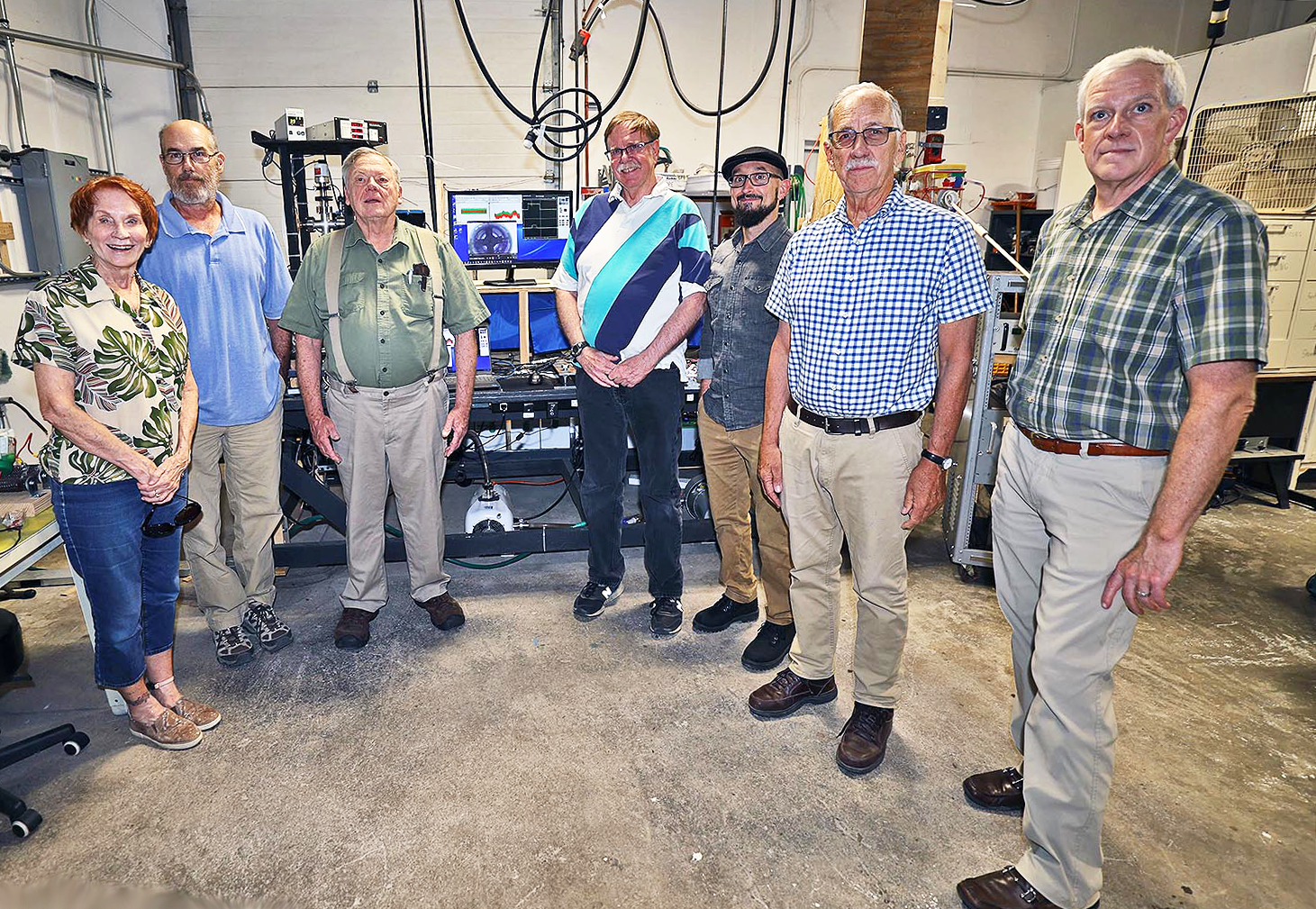
 Tibbar Plasma Technologies, Inc., has filed a patent for a new type of fusion device. The team includes, from left, Illustrator Pam Paine, Dr. Dan Karmgard, Senior Experimentalist Dr. William Gibson, President/CEO Dr. Rick Nebel, Intern Paul Thibodeaux, Senior Plasma Physicist Dr. John Finn and Chief Financial Officer Anthony W. Belletete, CPA. Photo by John McHale/ladailypost.com
By CAROL A. CLARK
Los Alamos Daily Post
caclark@ladailypost.com
Tibbar Plasma Technologies, Inc., (TPTI) headquartered in Los Alamos has filed a patent for a new type of fusion device. TPTI President/CEO Dr. Rick Nebel explained that this is a radical departure from conventional fusion devices in that it uses cold plasmas for fusion rather than hot plasmas. Confinement is also not size dependent, so the size can be small and the physics can be proven at small scale. Experimental results are consistent with the theoretical predictions, he said, adding that a journal article on the device is almost complete and will be submitted for publication shortly. A second publication showing the experimental results is in preparation.
“In the 47 years that I have worked on fusion, including 30 years at Los ALamos National Laboratory, (LANL, this is the most promising fusion concept that I have seen,” Dr. Nebel said. “Not only does it use cold plasmas, the theory predicts that it should work with aneutronic fuels (i.e. it doesn’t produce neutrons or radiation) which makes it suitable for space propulsion as well as terrestrial power production.”
Filing the patent is a major milestone for TPTI in that it gives the company the intellectual property protection needed to more openly discuss this concept with colleagues. Dr. Nebel added that TPTI is seeking to raise $20 million for a three year project to further test the physics and complete the required high voltage engineering.
“Since we don’t have to build large machines requiring large amounts of power for this project, we should be ready to build a demonstration power plant when this work is completed,” Dr. Nebel said.
Dr. Nebel is a recognized expert on Magnetohydrodynamics (MHD). He spent the first 30 years of his career at Los Alamos National Laboratory (LANL) as a Director’s post-doc, staff member, section leader, and group leader. He worked in the Controlled Thermonuclear Research (CTR), Theory (T), and Applied Theoretical Physics (X) Division. He specialized in nonlinear simulations, plasma theory, and electrostatic confinement fusion devices.
Dr. Nebel received his B.S., M.S., and Ph.D degrees from the University of Illinois/Urbana-Champaign. He received honors as a James scholar, an Energy Research and Development (ERDA) trainee, and a University Fellow. His thesis advisor was Professor George Miley.
In 2007, he joined Energy Matter Conversion Corporation (EMC2) as president, chief executive officer, and chairman of the board of directors. He left EMC2 in 2010 and founded TPTI. Since that time he has discovered previously unknown solutions of the MHD equations, which led the company to invent a simple plasma device with helical electrodes that could be used as an electrical transformer. TPTI has demonstrated this plasma-based transformer device in the laboratory and is now developing the concept.
National Science Foundation Grant
In December 2021, TPTI received a Small Business Innovation Research (SBIR) Phase II grant of nearly $1 million from the National Science Foundation to continue development of a plasma heat engine for efficient production of fusion energy. Since February of 2019, Dr. Nebel and colleague Dr. William Gibson have been developing an experimental device, funded by a previous Phase I grant, which makes use of an oscillating plasma concept. The device is comprised of specialized equipment, which TPTI built over the past decade at the Los Alamos headquarters.
“Confining plasma has always been a significant challenge in the development of fusion energy, but our approach is radically different from other fusion systems,” Dr. Nebel said. “The proposed concept, first proposed a decade ago, utilizes a heat engine technique that always maintains the plasma distribution function in thermodynamic equilibrium. The primary focus of this SBIR is to demonstrate that the desired harmonic oscillator potential well can be formed and that oscillating plasma rings can be maintained and oscillated in the desired potential well.”
He explained that the ultimate goal of this project is to produce aneutronic fusion energy in a system that is small, simple and inexpensive. This system will produce power that is as clean as renewable energy while simultaneously removing the need for energy storage that is required for intermittent sources like wind and solar power.
“Since the system is small, axial, and aneutronic (using fuels such as P-B11), it also has applications for manned space flight,” Dr. Nebel said. “The low radiation levels allow for minimal shielding along with high power density. This could enable more direct flights to other planets, which minimizes the exposure of astronauts to the radiation encountered in outer space.”
Direct questions about this project to tibbarqanda@outlook.com.