
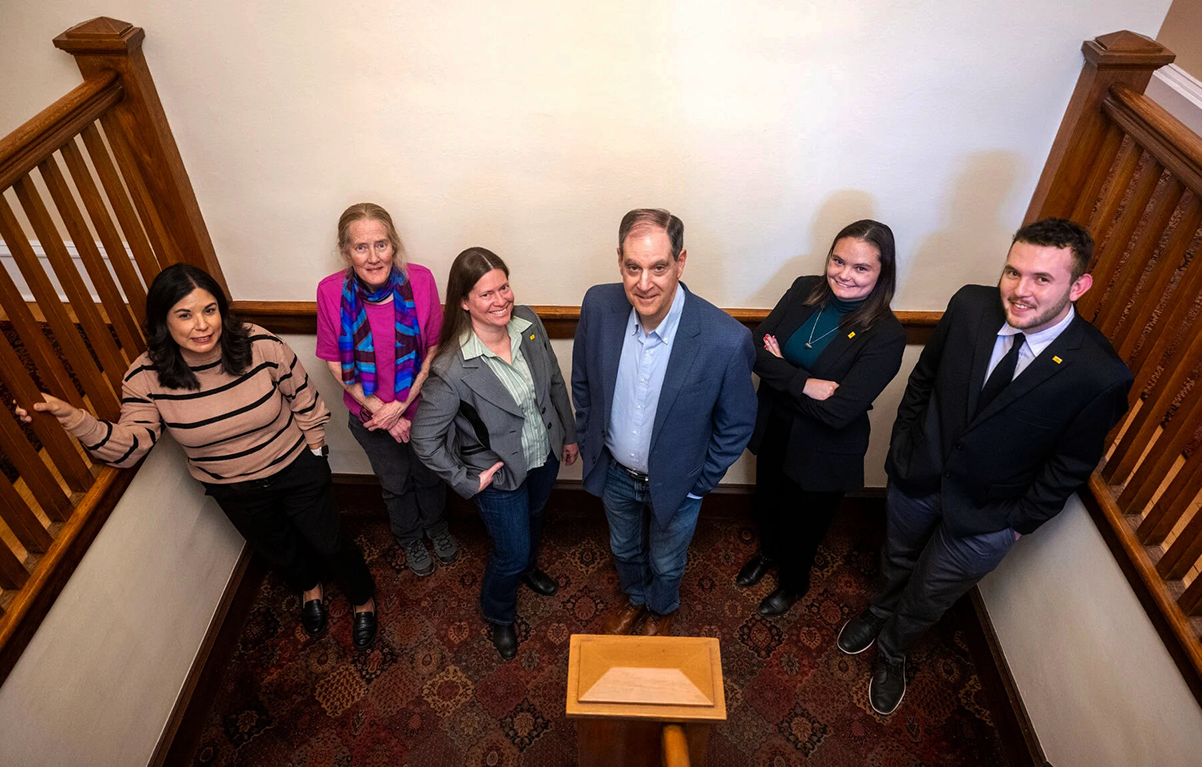
 Staff members of Think New Mexico, from left, Mandi Torrez, Susan Martin, Kristina Fisher, Fred Nathan, Katie Gutierrez and Marcus Lujan seen Thursday in the organization’s downtown Santa Fe office. Photo by Michael G. Seamans/The New Mexican
By Margaret O’Hara
The Santa Fe New Mexican
Fred Nathan remembers the moment when the idea for a nonpartisan think tank popped into his head.
The Santa Fe attorney was in the middle of a yearslong fight to shutter New Mexico’s drive-up liquor windows while working as special counsel to then-Attorney General Tom Udall in the 1990s, pushing Udall’s policy agenda.
In its final moments, the bill changed to require massive payouts to liquor store owners, resulting in a veto from Gov. Gary Johnson, then a Republican.
Nathan said he didn’t understand when one Democratic lawmaker gleefully celebrated the bill’s death and framed it as a harbinger of doom for Johnson’s reelection bid.
“I thought we were in this to save lives,” he recalled thinking at the time.
Think New Mexico — a 26-year-old nonprofit founded by Nathan, its executive director, on Jan. 1, 1999 — was intended to “drain the politics out of issues and put the focus on solutions,” he said.
It has since grown into a consistent voice at the New Mexico Legislature, tackling some of the state’s thorniest issues — including public education, health care, taxes and jobs.
The organization’s approach has broadened in recent years as it has brought on full-time advocates for particular issues. Its most recent comprehensive reports — one in 2023 on education and another in 2024 on solutions for the state’s health care worker shortage — will serve as longer-term plans as the think tank doggedly pursues its policy goals, Nathan said.
“Special interests … that make a lot of money have paid lobbyists representing them; they’re well represented over there. The broad public isn’t,” Think New Mexico Associate Director Kristina G. Fisher said from the organization’s office on Paseo de Peralta.
“Our purview is basically to go across the street and work for issues that benefit the public,” she added.
Early victories
Think New Mexico’s first initiative: a push for full-day kindergarten.
“If you want to lift the state up in the national rankings, the obvious place to start was education, and we wanted to start at the beginning,” Nathan said, referring to New Mexico’s longtime spot at or near the bottom of nationwide education rankings.
After the think tank developed a case for full-day kindergarten and a way to pay for it by trimming government spending elsewhere, lawmakers pushed through a bill to accomplish the task during the 2000 legislative session, and then-Gov. Johnson made a down-to-the-wire decision not to veto it.
“That was an incredible victory,” Nathan said, teary-eyed.
After that, Think New Mexico set its sights on repealing the state’s food tax, a three-year effort Nathan called “our second big victory.” The move ended the state’s tax on groceries starting Jan. 1, 2005.
But the fight against the food tax didn’t end, Fisher noted.
“There have been multiple times when there have been efforts to bring back the food tax,” she said.
The most serious effort was in 2010, as the state reeled from the effects of the Great Recession. After intense lobbying from Think New Mexico and some 15,000 emails from its supporters, then-Gov. Bill Richardson line-item-vetoed what would have been a revival of the tax.
The organization has moved toward tackling bigger and broader issues in recent years.
About three years ago, it reached a “pivot point,” Nathan said.
“We could be more impactful if we could hire people to work on issues full time … because our pattern had been to kind of bounce around,” he said.
“We can’t just parachute in over seven or eight years,” Fisher added.
Mandi Torrez became the education reform director in 2022, when the think tank published a 60-page policy report with 10 major recommendations to put the state’s public education system on a better path. That report, Nathan said, will serve as Torrez’s “work plan” for the next five to 10 years.
Last year, Think New Mexico bought on Dr. Alfredo Vigil as its health care reform director and published a lengthy report focused on solving the industry’s worker shortage — another persistent problem in New Mexico, with providers from behavioral health clinicians to reproductive care workers voicing concerns about a lack of qualified staff.
The report offers an outline for the organization’s advocacy plans in 2025.
2025 to-do list
Think New Mexico’s 10 “big ideas” to shore up New Mexico’s provider workforce include improving pathways to health care careers, expanding student loan repayment programs and establishing a permanent fund.
It won’t be able to cross off every item on its wish list in the 2025 session starting Tuesday. Fisher said the organization will lobby for four initiatives: interstate health care worker compacts; tax policies that benefit providers, the permanent fund and medical malpractice law reforms.
“It’s about what’s ripe. What is there potential opportunities to pass?” Fisher said.
Interstate health compacts are intergovernmental agreements to honor workers’ licenses from other states. To cover a variety of providers, Fisher said Think New Mexico will push for nine bills. Those for speech-language pathologists and audiologists and occupational and physical therapists already have been filed in the House.
Think New Mexico is eyeing two tax changes: a permanent repeal of the state’s gross receipts tax on medical services and an expansion of the rural health care practitioner tax credit, both of which Fisher said would create incentives for providers to work in New Mexico.
The organization is also pursuing medical malpractice reform — shaping up to be one of the major issues lawmakers will face in the upcoming session. Think New Mexico’s proposal, which is distinct from a plan proposed by House Republicans, would cap attorneys’ fees, end lump-sum payments to cover plaintiffs’ future medical costs and partially redirect funds from punitive damages to improve the health care system, Nathan said.
Malpractice cases should do three things, Fisher said: “They should make the patient whole. They should provide reasonable compensation for the attorneys representing the patients. And they should not overly burden doctors.”
But as the system stands, she said, “We’re seeing a very heavy burden on doctors, and we’re seeing attorneys get more than reasonable compensation in many of these cases.” The recommended changes are intended to strike more of a balance.
Finally, Think New Mexico hopes to see the state establish a $2 billion health care permanent fund to pay for other changes, including student loan repayment programs, tax credits and higher Medicaid reimbursement rates. Such investment funds have grown increasingly popular in recent years — allowing the state to use budget surpluses to pay dividends in the future.
“The second biggest cost to state government is health care. We could really use a fund there,” Nathan said.
It’s not yet certain if any of Think New Mexico’s proposals will make it across the finish line during the 2025 legislative session.
What is certain: The think tank will continue to advocate with an eye toward changes that are “broadly beneficial to the public,” Fisher said.
She added, “We’re able to hopefully lift those up and put them on more of an even playing field with the very concentrated special interests.”
Timeline: Key moment’s in Think New Mexico’s 26 years
1999: Santa Fe attorney Fred Nathan officially launches Think New Mexico, which bills itself as a nonpartisan, nonprofit think thank.
2000: Bipartisan legislation the organization supports calling for full-day kindergarten secures the Legislature’s approval and is signed into law.
2004: New Mexico enacts a Think New Mexico-backed bill to repeal the state’s food tax after a three-year fight. The change makes groceries tax-free in the state.
2005: The organization’s push for a Strategic Water Reserve is signed into law, allowing water or water rights in the state to be designated for use for public purposes.
2007: Lottery reform legislation proposed by the group — requiring at least 30% of New Mexico Lottery revenue to go toward the New Mexico Lottery Scholarship fund — is signed into law.
2008: The Legislature enacts title insurance reforms the organization supported that reduced closing costs for homebuyers and homeowners who are refinancing.
2009: Think New Mexico launches its leadership internship program, which has since provided mentorships to nearly 100 interns from all corners of New Mexico.
2012: Voters approve three constitutional amendments to restructure the state Public Regulation Commission. Think New Mexico pushed for the changes.
2015: The Legislature adopts a measure creating a health care transparency website the organization had backed. The site is now live at apcd.doh.nm.gov.
2020: The Legislature approves the Think New Mexico-backed Work and Save Act to increase retirement savings among private-sector workers.
2021: After six years of lobbying by Think New Mexico, the Legislature passes legislation to increase transparency in state infrastructure spending.
2022: The organization celebrates the passage of two laws, one slashing the maximum annual interest rate on small loans and the other repealing the tax on Social Security for middle- and low-income New Mexicans. It also hires Mandi Torrez as its first education reform director, launching a full-time focus on education policy.
2023: Think New Mexico purchases the Greer House, built in 1910 on Paseo de Peralta, as its permanent headquarters. The house is across the street from the Capitol.
2024: Dr. Alfredo Vigil is hired as the group’s first health care reform director. The organization prepares to lobby for its solutions to New Mexico’s health care worker shortage during the 2025 legislative session.