
 Tales Of Our Times
By JOHN BARTLIT
New Mexico Citizens
for Clean Air & Water
History’s Cuyahoga River Fires Turned The Page Late In 2025
The Cuyahoga River in Cleveland caught fire some 13 times. The first time was in 1868; the last was in 1969. The largest fire on the river, in 1952, damaged boats, a city bridge, and a riverfront office building to the tune of $1 million ($12M today).
The river itself is a strange one. How many rivers head out flowing south before they make a wide U-turn and flow north? This strange course resulted from the advance and retreat of ice sheets during the last ice age. Debris left by the final glacial retreat, about 10,000 years ago, changed drainage patterns. New landforms forced the south-flowing river to turn north to the eventual city of Cleveland, where it emptied into Lake Erie.
As populations grew so did fateful events with foul air and water, which helped found the EPA in 1970. Work led to the Clean Water Act in 1972. At long last, the days of river fires were numbered. Major problems are easier to paint in smug slogans than to explain in full. Everyone along the river would have to stop using its waters as the next-door, regional dump for all their semi-liquid wastes. Human nature makes this a hard sell. The long-known wastes in the river were raw sewage, oil, grease, and whatever chemicals.
With work came insights. Further actions entailed dredging to remove the solid wastes settled on the river bottom and removing outworn dams. Time passed. People paid more attention to the importance of what runs off the land into rivers. Ideas for more steps to protect uses of rivers always need to be sorted out.
Only recently did big hopes win out. It was October of 2025 when 2,000 juvenile lake sturgeon were released in the Cuyahoga River. Crowds gathered for the project ceremony. So far, so good. …
To review the changing times, my wife chimes in:
Growing up outside of Philadelphia, I often played by a group of streams that ran in the wooded, hillside park behind our house. We kids had endless fun splashing in the smaller tributaries, which flowed clear. We accepted reliable advice from young and old to stay clear of the largest stream, which was a thick, black mess.
I looked up Nancy’s “Smedley Park” and learned that an old paper mill had stood inside the park until 1991. I told her about my bicycling to the Calumet River near where I grew up outside of Chicago. Among the attractions for us were the shiny gold sunfish we always found dead on the sandy riverbank. We thought that was normal. Only later did we learn about the steel mills upstream.
Today we can hardly imagine that we, too, could have stood by and accepted river fires in 1950. How might our thoughts have fit the mold that was in fashion back then? Can we even guess? Current conclusions do not undo actions taken or neglected for ages. News spreads; norms change. The winding story of improvement gets clearer in the journey.
Generations of leaders have bemoaned the long arc of history even as they celebrated the headway made, however slow. Recent generations have seen such slow, yet worthy, strides made related to ecology. Remember that no one is up-to-date on what is to come.
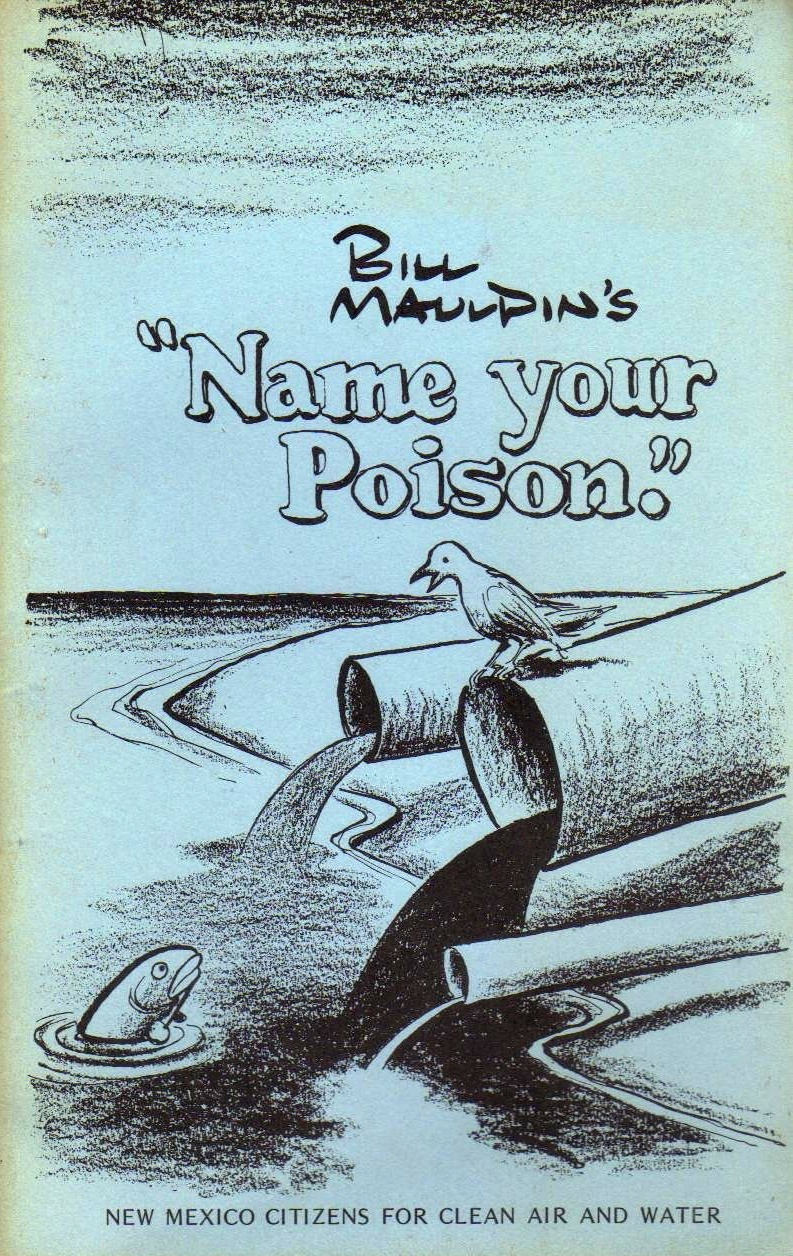
Note: In 1973, New Mexican Bill Mauldin gave permission to us, New Mexico Citizens for Clean Air & Water, Inc., to use his cartoons (copyright Chicago Sun-Times) in a book to raise awareness and fundraising. See, at Goodreads.com, Mauldin, Bill, 1921-2003. Bill Mauldin’s “Name Your Poison”. Citizens for Clean Air and Water, 1973.