
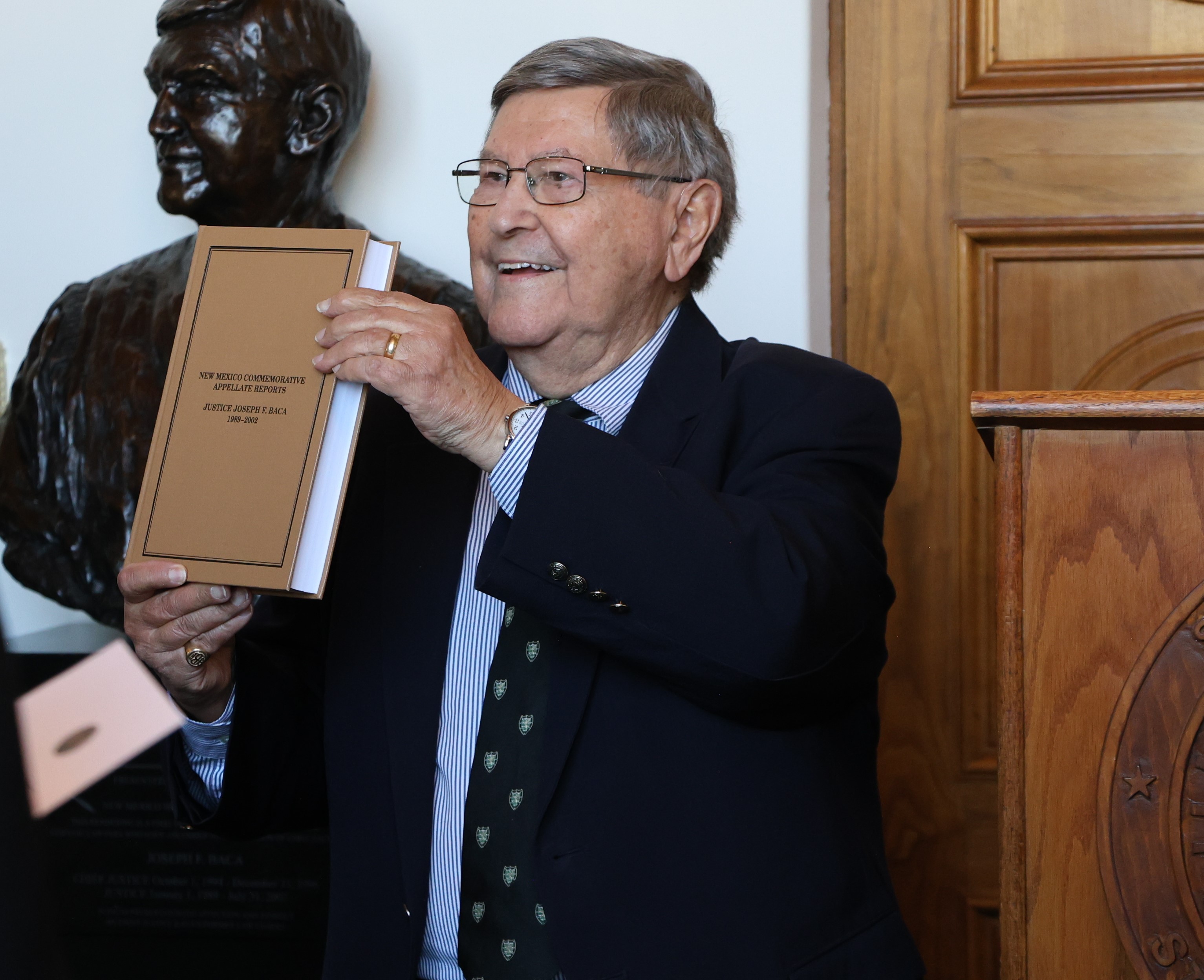
 Justice Joseph F. Baca holds a commemorative volume of his opinions during a ceremony in the Supreme Court Building. Courtesy/Administrative Office of the Courts
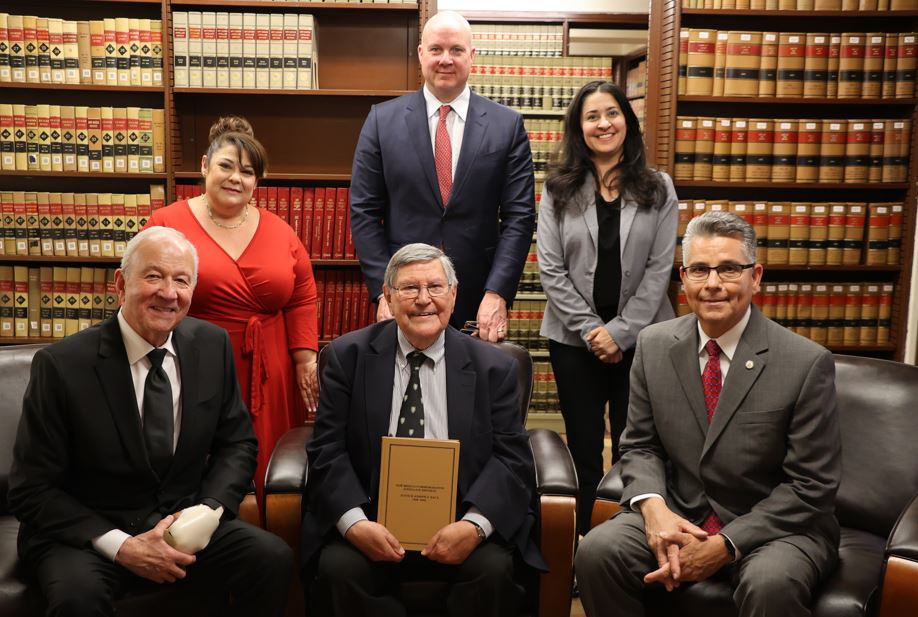 Retired Justice Joseph F. Baca (seated in the center) in the Supreme Court Law Library with Justice Michael E. Vigil (front left) and Chief U.S. District Court Judge Kenneth J. Gonzales, a former law clerk of Justice Baca (front right), and Justice Julie J. Vargas, standing at left, Chief Justice David K. Thomson and Justice Briana H. Zamora. Courtesy photo
NMSC News:
SANTA FE – The state Supreme Court celebrated the career of retired Justice Joseph F. Baca, presenting him on Monday with a commemorative volume of opinions he wrote while serving for over a decade on New Mexico’s highest court.
“In this age of impersonal technology, it is truly fitting that former justices should be honored with a vintage book of their opinions,” said Justice Baca, who joined the Court in 1989, after serving as a district court judge in Bernalillo County for 16 years.
He was Chief Justice from October 1994 to April 1996, and then from June 1996 to January 1997. The justice retired from the bench in 2002. He performed mediations and arbitrations after his retirement until taking inactive status as an attorney in 2022.
“Justice Baca’s life-long dedication to the rule of law serves as an inspiration for judges across New Mexico whose duty is to protect the rights of the people and ensure equal justice for all,” Chief Justice David K. Thomson said.
Justice Baca authored 159 majority opinions and 82 dissenting opinions during his tenure on the Court.
“The impact of these diverse, far-reaching decisions cannot be overstated, and the common thread connecting them is clear: Justice Baca’s unwavering commitment to justice,” U.S. District Judge Kenneth J. Gonzales wrote in a forward to the volume of opinions. He is the chief judge of the U.S. District Court for the District of New Mexico and a former law clerk for Justice Baca.
Chief Judge Gonzales pointed to several of Baca’s opinions that established legal precedents in the state, including one that determined the admissibility of DNA evidence in New Mexico courts. In a high-profile opinion by Justice Baca concerning the separation of powers, the Supreme Court held then Gov. Gary Johnson in civil contempt for refusing to obey an order to halt implementation of a welfare-to-work program after the Court had declared it unconstitutional.
“That this sanction proved effective is a testament to Justice Baca’s sharp-eyed judgment,” Chief Judge Gonzales wrote.
Justice Baca was born in Albuquerque. He received an undergraduate degree from the University of New Mexico and a law degree from George Washington University in Washington, D.C.
Before he became a judge, Justice Baca worked at the state Department of Transportation, as an assistant district attorney and practiced law in two firms in Albuquerque. He was elected in 1969 as a delegate to the New Mexico Constitutional Convention, which recommended a revision of the state’s 1910 constitution.
Justice Baca said he decided at an early age to become an attorney.
“Although I never knew a lawyer or knew what a lawyer did for a living, I always wanted to be one, inspired by a lawyer — the late great Senator Dennis Chavez,” said Justice Baca.
“My life work as a lawyer, public servant, judge and justice have been rewarding beyond belief,” the justice said. “My professional life is only matched by my personal family life. How lucky to have Dorothy as my life partner and my three daughters Jolynn, Andrea and Anna Maria help and support along the way. Supplement this family with three sons-in-law and five grandchildren. I am a lucky man.”
Justice Baca also said he took great pride in the accomplishments of his 20 law clerks “who have become my legal family.”
Chief Judge Gonzales wrote, “As a friend and mentor to his many law clerks, Justice Baca often reminded us that judges and lawyers occupy positions of power to do good. He instructed, though, of the difference between being in a position of power to do good and doing good in a position of power, demonstrating that the latter often requires courage. A study of Justice Baca’s opinions reveals his courage.”