
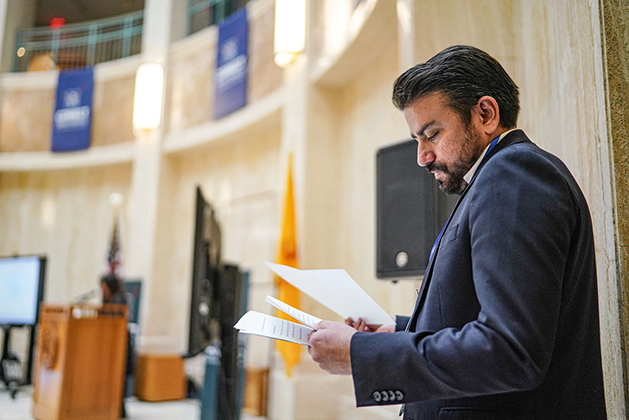
Jeff Lopez, director of the New Mexico Office of Broadband Access, reviews his notes in between presenters during Broadband Day at the state Capitol on Thursday, Feb. 12, 2026. Gabriela Campos/The New Mexican
By MARGARET O’HARA
The Santa Fe New Mexican
Ramah has just a handful of restaurants and few paved roads.
But it’s also home to some 240 miles of fiber internet cables—with plans to add 175 more miles of the connective cables soon, said Margaret Merrill, owner of Oso Internet Solutions, a broadband company that serves Ramah in Western New Mexico and surrounding communities.
Merrill and other internet providers joined lawmakers and state officials in the Capitol Rotunda on Thursday in celebration of Broadband Day at the Roundhouse. With New Mexico set to receive nearly $1 billion in state and federal investments to expand internet infrastructure, state officials have promised 100% of New Mexico homes and businesses will have access to high-speed internet by 2030.
After major infrastructure expansions in recent years, the cost of broadband service is now an obstacle in accessing high-speed internet, said Jeff Lopez, director of the New Mexico Office of Broadband Access and Expansion. State broadband officials are pushing for the passage of Senate Bill 152, which would create and fund an internet affordability program for low-income New Mexicans.
“Now, infrastructure is not the single largest barrier; affordability is the single largest barrier to broadband access today,” Lopez said during the Broadband Day celebration.
The Senate voted 38-0 Thursday afternoon to pass SB 152, sending it on to the House.
“This legislation continues to push us in the direction of affordability,” said the bill’s sponsor, Sen. Michael Padilla, D-Albuquerque.
The bill, Padilla said, gets rid of a sunset clause on access reduction support payments, which were set to end after 2026, “so this work can continue.” He noted the state’s progress in making high-speed internet more broadly available in the 14 years he has been working on the issue—about 90% of New Mexicans now have access.
“We’ve really made this one huge bipartisan thing we can work on in this chamber,” he said.
Broadband internet expansions in Ramah have helped residents access essential services, like education and health care, that are typically located far from home, Merrill said.
“Our network territory is truly frontier—truly,” she said. “The terrain is rough. The trees are tall. Distances are long and people are few.”
But, Merrill added, “In our world, this is real, and it’s very important.”
Too often, internet infrastructure is “not sexy enough” to garner the excitement it deserves, Gov. Michelle Lujan Grisham said during the celebration.
“We take it for granted,” she said. “It is like turning on the faucet when you expect clean, delicious water to flow out: It takes a lot of work.”
But the governor called reliable internet access the “only equalizer” for New Mexico families, since the technology creates equal—if online—access to health care, education, economic opportunities and other services.
New Mexico’s broadband infrastructure isn’t yet equal: The Federal Communications Commission in 2024 designated about 10% of addresses in New Mexico as “underserved” or “unserved” in terms of broadband access—meaning the other 90% of locations have adequate internet access.
However, Lopez said a combination of COVID-19 pandemic relief money, state broadband investments and $675 million in federal broadband infrastructure spending is expected to close that gap completely.
“By the end of this year, we will have those legally enforceable commitments to serve every single location,” Lopez said in an interview, noting the broadband projects must be complete by 2030.
As projects to build out broadband infrastructure move forward, SB 152 will offer up $10 million during the first year from the State Rural Universal Service Fund—which under current law has $40 million available annually for broadband programs—to create a state-funded broadband affordability program.
In future years, the program could use up to $45 million for the affordability initiative.
As the state moves toward physical connectivity and accessible pricing, Lopez said, “New Mexico’s finally on the path to 100% broadband connectivity. This means extraordinary opportunities for New Mexico families, for small businesses, for the future of science and technology in the state. Broadband is now critical infrastructure.”
Assistant city editor Nathan Brown contributed to this report.