
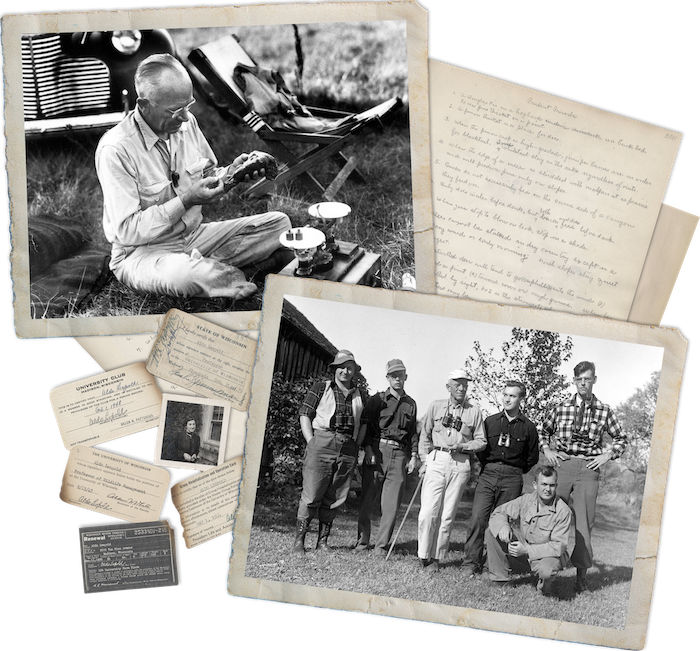
 A collage of documents and photos of Aldo Leopold. Courtesy/Aldo Leopold Foundation
By SHARON SNYDER
Los Alamos
In regard to the recent discussions concerning artist Jeff Segler’s painting of boys in uniforms and on horseback on the Pajarito Plateau, it seems appropriate to begin a series about the Los Alamos Ranch School boys and what they accomplished after leaving the plateau that was their home for a time.
For my readers who have read Aldo Leopold’s Sand County Almanac, you appreciate the man who wrote that book and the pages that carry his belief in a land ethic — “A thing is right when it tends to preserve the integrity, stability, and beauty of the biotic community.”
Recently the Leopold Writing Program called for essays from students grades 6 to 12. I hope that some of our Los Alamos students looked around and put their thoughts about our surroundings on paper for that yearly contest. The mission of the program is to inspire an ethic of caring for our planet by cultivating diverse voices through the spoken and written word. The writing program seeks ways to engage the current and next generations of citizen leaders.
Thoughts on conservation are important to address changing realities brought about by climate disruption, biodiversity loss, growing demand for fresh water, and other global conservation issues. Our next generation is in our schools today.
In 1931, a young student came for a year to the Los Alamos Ranch School. His name was Luna Leopold, the son of Aldo and Estella Bergere Leopold, a member of that historic Santa Fe family. Young Luna was already deeply curious about the natural world. Those days at the school may have been some of the beginnings for Luna, who remained an outdoors man throughout his life.
In years to come, at the University of California Berkeley, Luna Leopold became a hydrologist and authority of river studies. He would also earn a civil engineering degree and influence our national efforts to protect and restore rivers and creeks.
In World War II, Luna saw service as a meteorologist with the U.S. Army Corps of Engineers. After the war, he became an Earth Scientist and Chief Hydrologist for the U.S. Geological Survey.
After earning a master’s degree in physics and meteorology from UCLA and a doctorate in geology from Harvard, he worked with the U.S. Geological Survey in Washington. He was considered an earth scientist, and he worked with the government on decisions for mining, timber, and water quality.
While working with the USGS, Leopold became the chief hydrologist of the Water Resources Division and assessed the plans for the Trans-Alaska Pipeline.
In his life, Luna Leopold edited his father’s Sand County Almanac and published some 200 books and articles, several that are still in use today.
Luna Leopold died at his home in Berkeley, California, in 2006. He was 90 years old. For his accomplishments, he received the National Medal of Science in 1991.
Note: For teachers and parents who might want to encourage their students to enter next years writing contest, visit https://www.leopoldwritingprogram.org.