
 By RICHARD SKOLNIK
Los Alamos
Status of the Pandemic
The table below shows cases, hospitalizations, and deaths for the US, New Mexico, and Los Alamos for the week ending February 14.

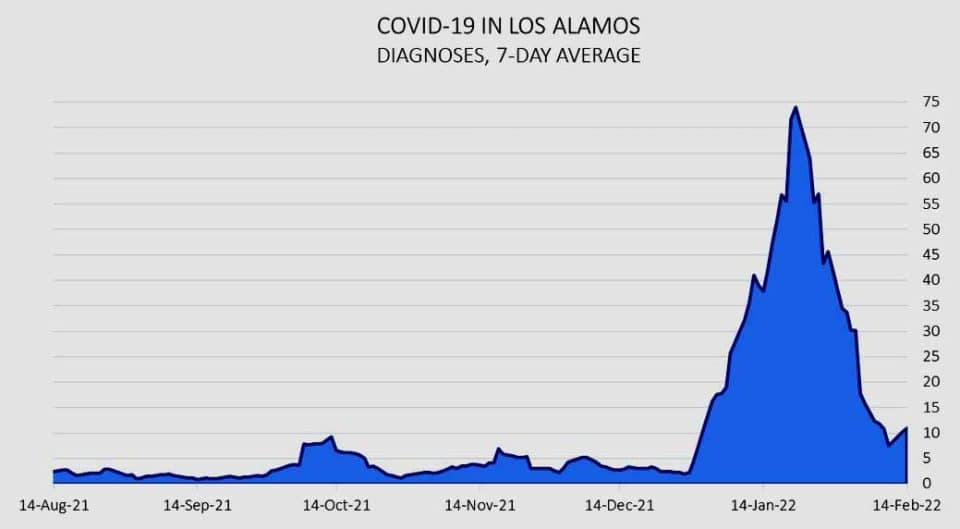
The graphic below (thanks to Eli Ben-Naim) shows the rolling 7-day average of cases in Los Alamos County over the last six months.
 This graphic (also thanks to Eli Ben-Naim) shows the age distribution of new cases over the last two weeks.

Cases in Los Alamos have come down substantially in the last two weeks. However, they remain higher than at any time prior to the Omicron surge. In addition, the number of cases appears to have plateaued in the last week. Hospitalizations of Los Alamos County residents have risen and the New Mexico Department of health last week reported one more death of a Los Alamos resident.
CDC data on “full vaccine coverage” by age group in Los Alamos County is shown below. This data does not take account of booster doses.

New Mexico, however, is now compiling data on risks of infection, hospitalization, and death that does take account of state-wide data on boosters. For the period January 10, 2022 to February 7, 2022, those not fully vaccinated, compared to those fully vaccinated with a booster have:
- 2 times the risk of testing positive
- 6 times the risk of being hospitalized
- 29 times the risk of dying
COVID News of Importance
COVID cases among children in the US have fallen from 1.15 million in the week of January 15, 2022 to about 300,000 for the week ending February 10, 2022. However, the number of cases in the last week remains higher than at any time during the Delta surge. The rates of severe illness and death in children remain very low.
The FDA has postponed consideration for emergency use authorization of the Pfizer vaccine for children from 6 months to 5 years of age. In the clinical trials already completed, two doses of vaccine did not produce the desired immunity. Thus, Pfizer is now carrying out trials on the efficacy after a third dose. However, given the exceptional number of pediatric cases since the arrival of Omicron, the FDA had planned to consider licensing the vaccine before full data were available on its efficacy. The FDA has now dropped such consideration and will wait for data from the ongoing trials before it considers emergency use authorization for the vaccine for this pediatric group. It has been reported that this data will be available in April 2022.
The FDA has given emergency use authorization to another monoclonal antibody, bebtelovimab. This is especially important since two of the existing monoclonal antibodies were deemed not effective against Omicron. The newly approved drug is for use in patients above 12 years of age who have a positive test, moderate to mild COVID-19, and who are at high risk of progression to severe disease, including hospitalization or death.
Numerous studies are being published on the post-infection effects of COVID-19, about which there remain many unanswered questions. Nature reported on a study this week that found rates of a number of conditions, including heart failure and stroke, were substantially higher in people who had recovered from COVID-19 than in similar people who hadn’t had the disease. The risk was elevated even for those who were under 65 years of age and lacked risk factors, such as obesity or diabetes. Nature also had an editorial this week calling for urgently increasing research on “long COVID” in children. It noted that: the few studies done so far suggest that “children’s long COVID symptoms could be similar to those seen in adults” and that “younger people are developing long COVID in significant numbers.”
A number of states have announced that they will be ending mask mandates in the near future. A number of European countries are also walking back some or all of their mitigation measures. Such European countries generally have substantially higher vaccination coverage, less burdened hospitals, better testing programs, and lower deaths rates from COVID than the US.
So?
There is considerable talk about COVID becoming “endemic.” This refers to “a disease or condition regularly found among particular people or in a certain area.” However, endemic does not mean “low level.” TB is endemic but infected about 10 million people and killed about 1.5 million people in 2020. HIV is endemic and 1.5 million people were newly infected with HIV in 2020 and about 680,000 died of HIV-related illnesses that year. Measles is endemic and infected about 7.5 million children in 2020, of whom about 61,000 died.
As we consider our next steps for dealing with COVID-19 in Los Alamos and personally it will be important to consider a number of matters including the social and economic costs of our mitigation measures. It will also be important to consider the level of viral transmission in the community, the extent to which our population is vaccinated and boosted, the extent to which infection with the virus that causes COVID-19 is truly benign, and the potential for new “variants of concern”.
Editor’s Note: Richard Skolnik is the former regional director for health for South Asia at the World Bank. He was the director of an AIDS treatment program for Harvard and taught Global Health at the George Washington University and Yale. He is the author of Global Health 101, the instructor for Yale/Coursera’s Essentials of Global Health, and a Lecturer at the Yale School of Public Health. Skolnik has written this article in his personal capacity.