
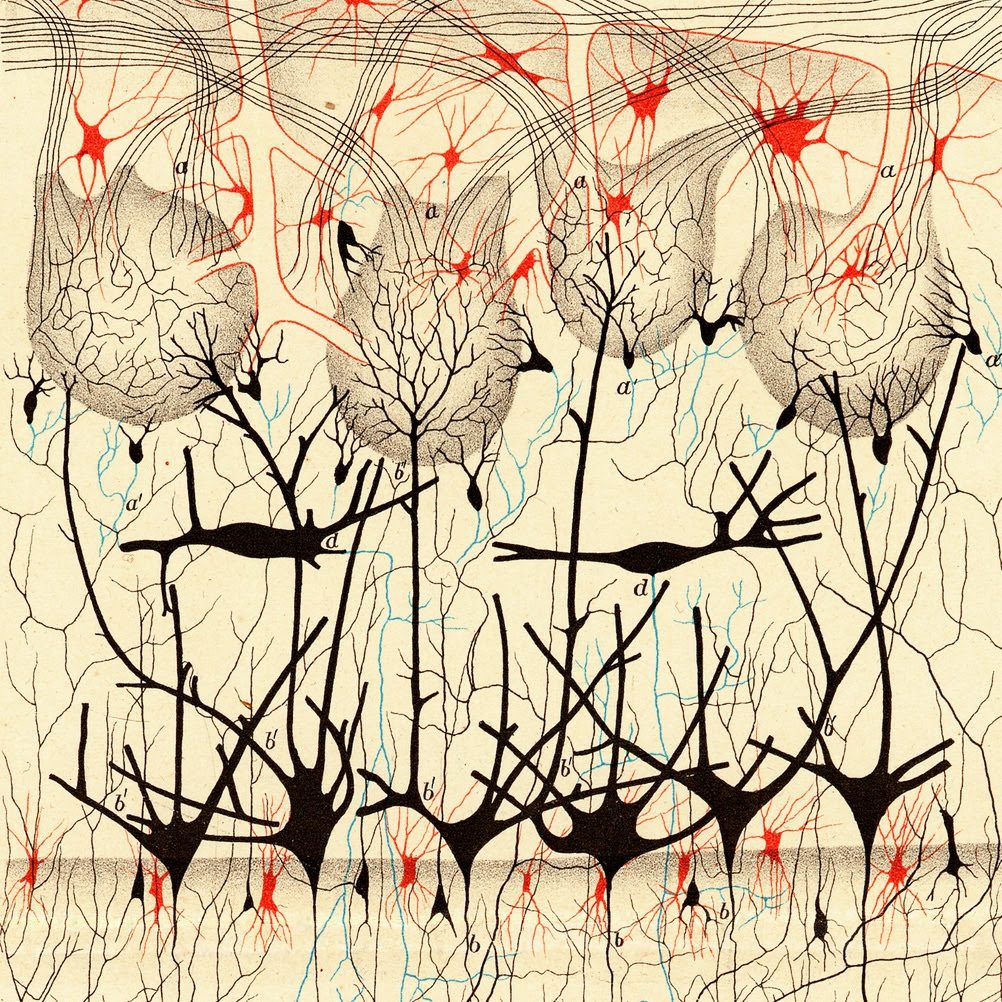
 Camillo Golgi’s “image of a dog’s olfactory bulb (detail)” from Sulla fina anatomia degli organi centrali del sistema nervoso, 1885. Courtesy/SFI
SFI News:
For more than a century, neuroscience has viewed intelligence as a property of individual brains. But brains did not evolve in isolation. Humans are an intensely social species whose minds are continuously shaped by other minds. Increasingly, evidence suggests that our most sophisticated cognitive abilities emerge not from solitary brains, but from networks of interacting people. Human intelligence is fundamentally collective: our brains evolved not simply to think, but to think together.
In this lecture, Thalia Wheatley will explore conversation as a powerful mechanism for coupling minds — aligning attention, beliefs, emotions, and behavior across individuals. Drawing on research from neuroscience, psychology, and network science, she will show how everyday features of human interaction are precision tools that synchronize brains, strengthen social connection, and shape mental health. She will conclude by considering what this means in the age of AI, and how machine intelligence differs from the deeply social intelligence forged over millions of years of evolution.
Wheatley is Professor of Psychological and Brain Sciences and Director of the Center for Social Brain Sciences at Dartmouth. Her research investigates how ideas and emotions are created collectively and how one person can influence another in ways that ripple across the social webs they inhabit.
SFI’s Community Lecture series is presented at no cost to the public thanks to generous sponsorship from the McKinnon Family Foundation, with additional support provided by The Lensic Performing Arts Center and the Santa Fe Reporter.