
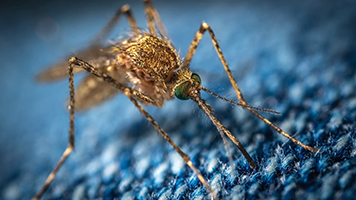
 Егор Камелев/Pixabay via Public Domain
By LILY ALEXANDER
The Santa Fe New Mexican
For Albuquerque Republican Sen. Nicole Tobiassen, the fight against mosquitoes is personal now.
In September, Tobiassen’s husband contracted West Nile virus and spent four and a half months in the intensive care unit “fighting for his life”, she said Thursday during a committee hearing for Senate Bill 79.
The measure would appropriate $2 million to the New Mexico Department of Health for mosquito surveillance, prevention and mitigation in fiscal years 2027 and 2028.
“He survived — against the odds, might I add — but he’s now permanently disabled and receiving neuro-rehabilitation out of state, and our family has been forever changed,” Tobiassen said. “Senate Bill 79 is about preventing that outcome for other New Mexican families.”
The Senate Conservation Committee voted unanimously Thursday to advance the proposal.
The Health Department and the bill’s bipartisan sponsors — Tobiassen and Democratic Senate President Pro Tempore Mimi Stewart, who also represents Albuquerque — say the passage of SB 79 would help curb mosquito-borne illness in the state, which is home to 57 species of mosquito.
“These pathogens tend to peak in mosquitoes before we see the peak in human cases,” Dr. Erin Phipps, state public health veterinarian for the New Mexico Department of Health, said in an interview. “So by conducting pathogen surveillance in mosquitoes, that can give us a bit of an early warning system.”
The bill now heads to the Senate Finance Committee.
There were 51 human cases of West Nile virus — a mosquito-transmitted disease that can cause serious and sometimes fatal illness — in New Mexico in 2025, according to the Health Department. Some local jurisdictions have their own mosquito surveillance programs, but there is nothing uniform for all of New Mexico.
SB 79, if it passes, would allow up to $1.5 million to go toward grants for mosquito surveillance, prevention and mitigation projects at local governments and state educational institutions. Both the University of New Mexico and New Mexico State University have active mosquito research programs, according to a fiscal impact report.
Mosquito surveillance involves trapping the insects, then collecting them and determining their species; different genuses and species can carry different diseases, Phipps said. The mosquitos are then tested for pathogens or viruses, but additional testing — like for insecticide resistance — can also be done.
“This surveillance would enable us to target prevention and mitigation efforts to where they’re most needed, both geographically and in timing of those efforts,” Phipps said.
If SB 79 passes, surveillance would also focus on invasive mosquito species that are new to the state and have been expanding their range “aggressively” over the past decade, said Elizabeth VinHatton, public health entomologist for the New Mexico Department of Health, during the committee hearing. These new invasive mosquito species are capable of spreading diseases New Mexico has not seen before, VinHatton said.
“One of the main goals of this is to just get the baseline information about mosquitoes in New Mexico, because we currently don’t know exactly which kinds of mosquitoes live where in the state, or how abundant they are,” VinHatton said. “So we don’t even know exactly where the mosquitoes live that can spread certain diseases.”
In New Mexico, vector control — the management of insects and mammals that carry disease — is implemented at the local level, Phipps said. The Health Department hopes the bill, if it passes, will enable local jurisdictions to make better decisions to target priority areas where viruses are circulating — and use that data for their vector control activities, she said.
The surveillance data would also support improved risk communication by targeting messaging to locations or periods of higher risk, Phipps said.
“By reaching out to communities and local jurisdictions, people will be able to reduce their risk by understanding how to eliminate mosquito-breeding sites around their property,” she said.
During public comment, several people voiced their support for SB 79 and none spoke against it. Anna Hansen, a lobbyist for Pojoaque Pueblo, told the committee she was concerned the bill does not mention outreach to tribal nations and pueblos.
Camilla Feibelman, director of the Sierra Club’s Rio Grande Chapter, noted the connection between mosquitoes and climate change, which Los Alamos National Laboratory has researched.
“As we are seeing a warmer climate and warmer times lasting longer, the mosquitoes are staying here longer — even through late fall,” Feibelman said. “This is a price of climate change, and we have to decide whether we’re willing to pay that price with our health, with our families’ health, with our communities.”