
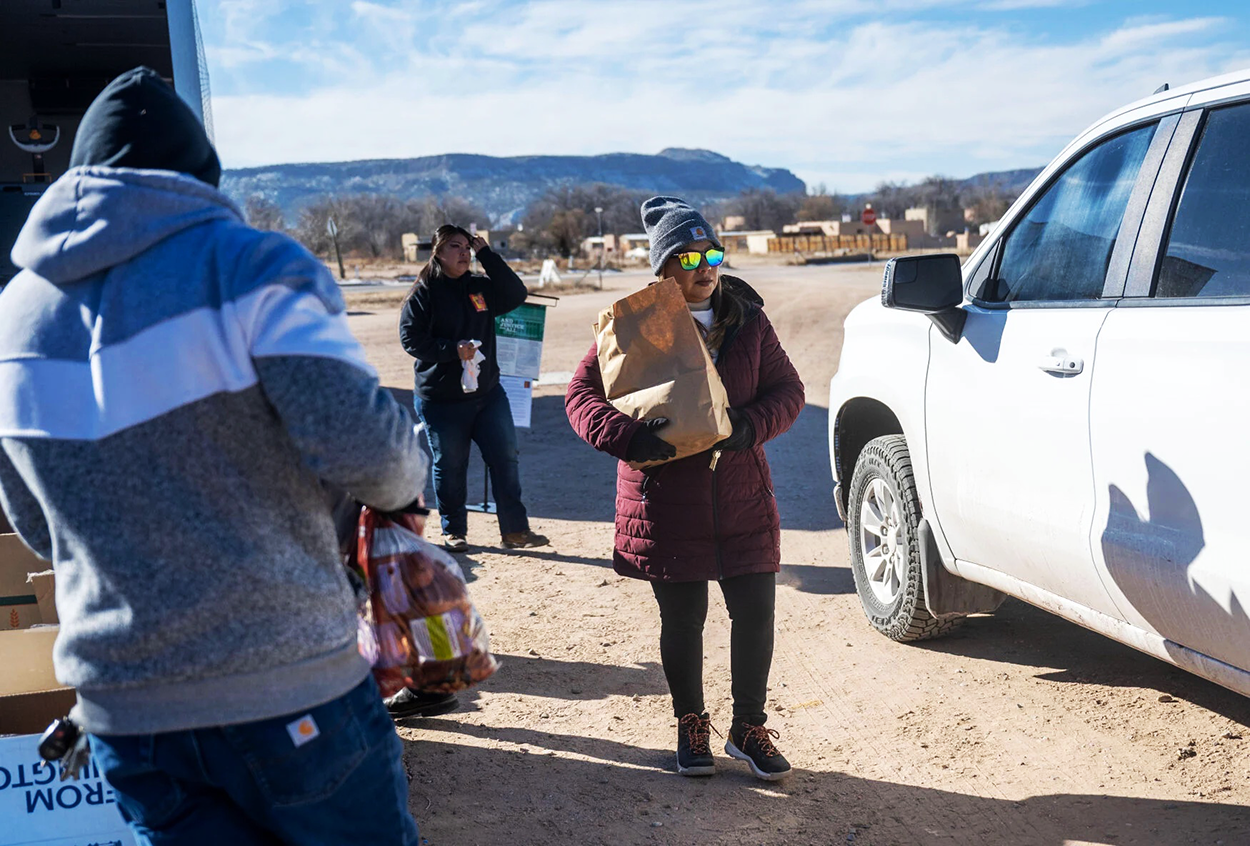
 Health Council Coordinator Raelene Martinez, center, distributes food from the mobile food pantry at the office of San Ildefonso Pueblo Health Council in San Ildefonso Pueblo Thursday. Michael G. Seamans/The New Mexican
By MARGARET O’HARA
The Santa Fe New Mexican
SAN ILDEFONSO PUEBLO — Thelma Gonzales and Raelene Martinez do a little bit of everything.
Technically, the two women work for San Ildefonso Pueblo’s Health and Human Services Department, Gonzales as the community health representative manager and Martinez as the diabetes program manager and health council coordinator.
But their jobs come with plenty of “other duties as assigned”, Gonzales joked.
They make home visits to residents with diabetes and high blood pressure. They coordinate appointments with outside providers, like dentists and optometrists. They organize health education programs, health screenings and food distributions. They distribute the opioid-overdose antidote naloxone. And during one recent home visit, they fixed somebody’s doorknob.
“I think the only thing we probably don’t do is probably fix a car,” Gonzales said. “With everything else, I think, ‘You need it, I think we can probably do it.’”
“We’re not just there all the time to collect vitals, you know. We’re just making sure that we’re checking on whatever it may be,” Martinez added.
Health councils like the one in San Ildefonso Pueblo work to address local health needs, particularly in tribal and rural communities. The councils’ staff provide boots-on-the-ground care — whether testing blood sugar or fixing doorknobs — before conveying important trends to state government and other entities.
During this year’s legislative session, health councils are looking for more state money.
‘They need funding’
The New Mexico Alliance of Health Councils is pushing for a $43 million appropriation to the state Department of Health to be distributed to health councils across New Mexico — a sum equivalent to $1 million per health council, said Gerilyn Antonio, the alliance’s tribal liaison.
As she has in previous sessions, Rep. Liz Thomson, D-Albuquerque, has already filed House Bill 75 to accomplish that task.
“They need funding, bottom line. … We’ve been starving them for years,” Thomson said Wednesday in an interview.
When Interim Health Secretary Gina DeBlassie in December presented the Department of Health’s fiscal year 2026 budget request to the Legislative Finance Committee, lawmakers voiced just one major concern: It lacked recurring funds for community health councils. Instead, the department’s request included $3 million in one-time money for the councils.
Lawmakers from both parties worried about the small and singular appropriation.
“The health councils are the only ones that really understand the root problems in the rural and the Native communities,” then-Rep. Anthony Allison, D-Fruitland, said during the December committee meeting.
“They perform a very important function out where we live. … I think they do a good job, and I encourage you to give them the support that they need,” added Rep. Jack Chatfield, R-Mosquero.
That’s what makes health councils special, Thomson said: In addition to providing hands-on health care services, they provide the “eyes and ears” in often far-flung communities.
“We really depend on them to take care of their communities and to provide us with the information we need to make good policy,” she said.
‘You can’t just ignore it’
Thomson was involved in bills for health council funding in 2019, 2023 and 2024, all of which died during the legislative process.
That’s not to say the state hasn’t put any money toward county and tribal health councils. In 2024, the state’s budget bill included a one-time $3 million appropriation for the councils, with Gov. Michelle Lujan Grisham’s budget recommendation for fiscal year 2026 including the same amount in funding.
“Governor Lujan Grisham and the New Mexico Department of Health (NMDOH) support funding increases for health councils statewide,” Department of Health spokesperson David Morgan wrote in an email to The New Mexican.
The department is currently reviewing Thomson’s bill, Morgan added.
However, the earliest version of the state’s fiscal year 2026 budget — which will be altered throughout the session — does not include a line item for health councils.
Though similar bills have failed, Thomson, who chairs the House Health and Human Services Committee, said she’s hopeful this session will be “a good time” as her legislative colleagues devote more attention and resources to health care.
In one sense, health care policy is like a lingering illness.
“You can’t just ignore it,” Thomson.
‘Space for our own way of life’
For San Ildefonso Pueblo’s health council, more and more consistent funding would make a difference not only in the council’s ability to deliver care but as a way to express tribal sovereignty in health care, said Tracey Cordero, the pueblo’s health and human services director and a member of Cochiti Pueblo.
The funding, she said, would allow tribal health councils to identify the major health challenges facing their communities and develop culturally appropriate solutions.
“It creates space for our own way of life. … We’re the only people who know us best, so let us do what we know how to do, what we’ve done for generations — because that’s why we’re still here as a people,” Cordero said.
Sometimes, Martinez doesn’t have an easy answer for what her clients are experiencing.
On those occasions, Martinez, a self-described proud member of San Ildefonso Pueblo raised with traditional beliefs, promises to pray that they overcome what’s ailing them.
She noted it’s something they may not hear often, something they might not do for themselves.
But each day, Martinez prays, “May the people that leave the pueblo today return home safely to their family.”