
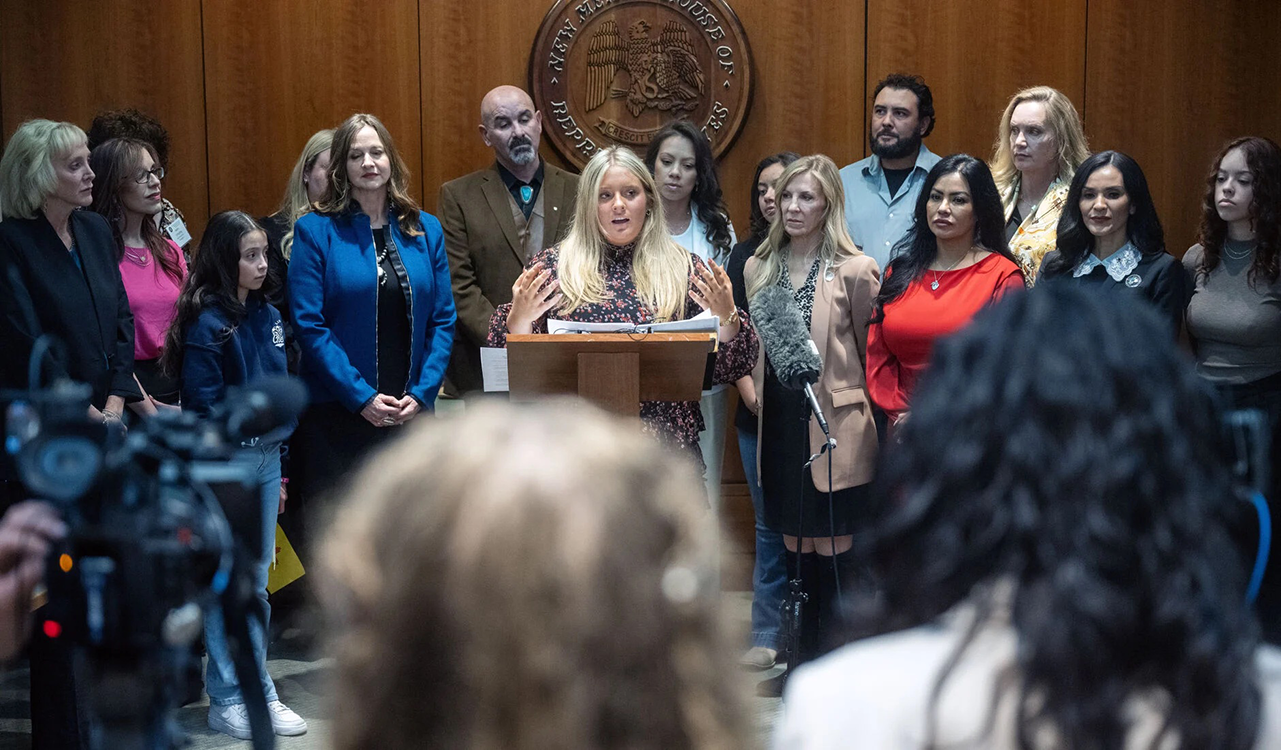
 Payton McNabb, 19, of North Carolina, who was injured during a high school volleyball game by a transgender teen on the opposing team, speaks to reporters at the state Capitol in Santa Fe during a news conference held today by Republican lawmakers backing a bill that would prohibit transgender athletes from competing against girls. Photo by Michael G. Seamans/The New Mexican
By DANIEL J. CHACÓN
The Santa Fe New Mexican
A bill that would prohibit transgender athletes from participating in girls’ and women’s sports at schools.
A bill that would get rid of the requirement for concealed carry licenses.
A bill that would repeal New Mexico’s seven-day waiting period for the purchase of firearms.
Those are among the polarizing pieces of legislation Republicans have introduced during the 60-day session.
Note to Republicans: Good luck with that.
Both chambers of the New Mexico Legislature are controlled by Democrats, who chair all the legislative committees and whose ranks have grown more liberal … err … progressive in recent years.
While some of the more controversial bills sponsored by Republicans have started to get hearings or will be up for consideration, the measures are unlikely to gain traction, much less make it all the way to the governor’s desk.
All three of the bills listed above have been tabled on 4-2 party-line votes by the House Consumer and Public Affairs Committee, also known as CPAC, which has long been called the “kill committee.”
The two sole Republicans on CPAC — Reps. Stefani Lord of Sandia Park and John Block of Alamogordo — consistently clash with the chair, Rep. Joanne Ferrary, D-Las Cruces.
Thursday was no exception.
“They’re out of order a lot of times. They don’t respect the decisions of the chair and don’t follow what should be proper decorum,” Ferrary charged.
After Rep. Andrea Romero, D-Santa Fe, read a statement against the so-called Protection of Women’s Sports Act, which opponents describe as an anti-trans youth measure, Lord objected.
“I also had a statement, and I was cut off because I had to turn it into a question, so that’s not fair,” Lord protested.
“Excuse me,” Ferrary snapped back, “you had plenty of time to make plenty of statements.”
Lord continued to assert she had been cut off during the meeting, prompting Ferrary to declare she was the chair and to accuse Lord of being “arbitrary”.
Power of committee chairs
Committee chairs have wide latitude over which bills to consider in both chambers of the Legislature.
Ferrary said she typically schedules bills in the order they are referred to her committee, regardless of whether a Democrat or a Republican is the sponsor. There are exceptions, though, such as when a lawmaker has several bills before a committee, and it’s more efficient to have the lawmaker present them during the same meeting.
“We go mostly in order as we get the referrals and just go down the list,” Ferrary said.
She’ll hear bills even if she knows they’re unlikely to pass, she added.
“Yes, for the most part, we just take everything that comes to our committee,” she said, noting every committee chair has the prerogative not to take up a bill.
Camille Ward, a spokesperson for the House Democratic caucus, said House Rules allow committee chairs to use discretion in scheduling, “so that related bills may be grouped and heard together and so that committee business takes place during reasonable hours,” she said.
“Occasionally,” Ward added, “due to the short duration of New Mexico’s legislative sessions, some bills run out of time to make it through the process.”
In the Senate, committee chairs have broad discretion on how they organize and run their committees, said Chris Nordstrom, a spokesperson for the majority caucus.
“They typically work together with the committee’s ranking member to set meeting agendas and determine parameters related to public testimony and debate,” he said. “There is no Senate rule specifying the order in which bills are presented.”
No fair shake for GOP?
In an interview before Thursday’s CPAC meeting, Lord said she’s continually seen GOP bills “marginalized” during her five years in the Legislature.
“We are never treated fairly,” she said. “There are a few bills that get through, but not many.”
If a Republican bill doesn’t have a Democratic co-sponsor, “it’s pretty much dead on arrival,” said Lord, who was among the proponents of the bill to repeal the seven-day waiting period for gun purchases; it was tabled after a contentious hearing Tuesday night.
Asked why Republicans were even bringing such bills forward, Lord said the proposed pieces of legislation reflect their constituents’ demands.
“We work for the people of New Mexico,” she said. “They want that seven-day waiting period repealed, so we bring that forward, no matter what the Democrats want.”
Block echoed the sentiment, saying lawmakers represent different areas of the state with different priorities.
“My priorities in Alamogordo are probably a little different from the priorities of communist China — I mean, Las Cruces,” quipped Block, who voted against Tuesday’s tabling motion along with Lord. “I put my bills forward because my constituents asked me to do them.”
Block said every bill should get a chance to be heard, but Republican bills don’t always get a fair shake.
“I don’t care if they’re going to save the world or if they’re just going to make a tweak to state statute, they all matter,” he said. “I don’t think we should discriminate based upon party affiliation of a member.”
‘Protecting girls in sports’
Before Thursday’s vote, Rep. Andrea Reeb, R-Clovis, who was among the sponsors of the proposed Protection of Women’s Sports Act, agreed Republicans are introducing bills that reflect the requests of their constituents, as well as those of residents across the state.
Reeb said polling shows most people agree biological males shouldn’t participate in women’s sports but acknowledged her bill’s first stop was the so-called kill committee.
“I think it’s going to be a challenge to get Democrats to understand that … we don’t have any issue with how anybody identifies, what their sexual orientation is,” she said. “This is not about that. This is about protecting girls in sports, so I’m hopeful it will get through, but I’m not naive.”
The bill “requires that participation in single-sex school sports be restricted to those of the same biological sex assigned at birth,” according to a fiscal impact report. “The prohibition affects public primary and secondary schools and institutions of higher learning, as well as private athletic clubs.”
Reeb noted the bill comes on the heels of Trump signing an executive order banning transgender women from competing in women’s sports.
“Federal law trumps state law, and they can not pass it all they want and then deal with whether they’re going to get the federal funding in these universities, these higher education institutions, if they go against the executive order,” she said, adding the sponsors are getting calls from both Republican and Democratic voters who support the bill.
“I think it’s time that Democrats start listening to what the voters want,” Reeb said. “It’s all about protecting Title IX and what we fought for, for so long, to make sure that girls could have fair opportunities in education and at the podium.”
Rep. Rebecca Dow, R-Truth or Consequences, a co-sponsor of the bill, said Republicans will push for legislation their constituents want.
“Just because the progressives are out of touch with New Mexicans doesn’t mean we are,” she said in a statement. “I will continue to push forward and propose solutions to our most pressing issues. Families across the state have made it clear to us what they need.”
Rep. Jenifer Jones, R-Deming, another co-sponsor of HB 185, agreed, saying Republicans are in Santa Fe to represent their districts and propose “commonsense solutions” for all New Mexicans.
“We know that bills like HB 185 are proposals that our families across the state want,” said Jones, who is among the sponsors of a bill mandating medical care for all infants born alive, including during an abortion, which is also unlikely to make it out of CPAC.
“I will always fight for my community’s needs and represent the people that sent me to Santa Fe,” she said.