
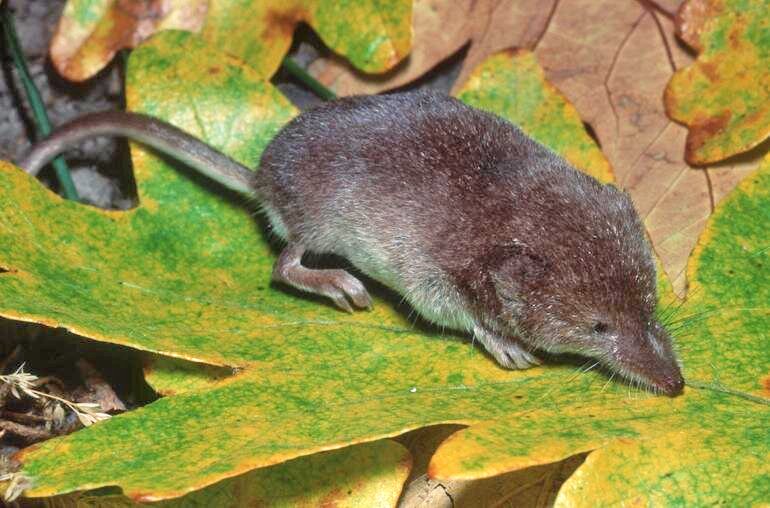
 Tiny Vagrant Shrew. Photo by William Leonard
NMMNHS News:
ALBUQUERQUE — A new scientific study co-authored by New Mexico Museum of Natural History & Science (NMMNHS) Curator of Biosciences Dr. Jason Malaney reveals new secrets about a lineage of tiny mammals that dwell in New Mexico’s high mountain peaks.
“The story of these shrews reminds us that even the smallest animals can teach us big lessons about evolution, resilience, and vulnerability,” NMMNHS Executive Director Dr. Anthony Fiorillo said.
Published in the Journal of Mammalogy, the study evaluated genetic differences plus climatic and habitat preferences of different populations of shrews: 5-gram, insect-eating mammals with voracious appetites that hunt their prey with echolocation – the only terrestrial mammals to do so. While they resemble small, long-nosed mice, they are not actually rodents.
The research reveals that the montane shrew (Sorex monticola), once thought to be a single widespread species from Mexico to Alaska, in fact includes several evolutionarily distinct lineages—one of which is found only in the isolated mountain ranges of the American Southwest, including New Mexico’s own sky islands. But while researchers better understand this unique group of mammals, the research also shows that these tiny mountain-dwellers face an uncertain future.
Based on genetic, climatic, and habitat differences documented in the study, the authors suggest that taxonomic names should be updated, with the Southern Clade shrews found in New Mexico and surrounding states retaining the name Sorex monticola. The Northern Clade, which are from the intermontane west including the Sierra Nevada of California, Wyoming highlands, and the Alaskan interior should be renamed Sorex obscurus. Finally, researchers conclude that the Coastal Clade, found from Oregon’s coastal mountains to Alaska’s Alexander Archipelago, should be renamedSorex pacificus.
“This Southern Clade is a living relic,” Dr. Malaney said. “It’s been evolving separately from its northern and western cousins for hundreds of thousands of years, surviving the last Ice Age and persisting in pockets of cool, wet habitat high above the desert floor.”
These high-elevation habitats—from the Sacramento and Sangre de Cristo mountains to ranges in Arizona and northern Mexico—act as climatic refuges for cold-adapted species like the montane shrew. But as the planet warms, these safe havens are shrinking fast. Using predictive models, the study shows that by 2070, the Southern Clade could lose over 40% of its suitable habitat, with no new areas available for expansion. That means some of New Mexico’s most ancient lineages may be at real risk of disappearing in the coming decades.
This research aligns with the museum’s mission to collect, preserve, study and interpret the natural history heritage of New Mexico through scientific inquiry and public education. The montane shrew’s journey—from glacial survivor to climate-threatened species—underscores the importance of protecting biodiversity hotspots in our own backyard.
“Understanding New Mexico’s unique evolutionary legacy isn’t just academic—it’s essential,” Dr. Malaney said. “These shrews are part of our state’s biodiversity story, and if we don’t act, that story could lose a critical chapter.”
The museum hopes this research will spark renewed interest in high-elevation conservation, citizen science efforts, and greater support for long-term biodiversity monitoring across New Mexico’s mountain ranges. More information about the NMMNHS Bioscience program is available HERE.
About the New Mexico Museum of Natural History and Science
The New Mexico Museum of Natural History and Science is a division of the Department of Cultural Affairs, under the leadership of the Board of Trustees of the New Mexico Museum of Natural History & Science. Programs and exhibits are generously supported by the New Mexico Museum of Natural History Foundation, through the generous support of donors. Established in 1986, the mission of the New Mexico Museum of Natural History & Science is to preserve and interpret the distinctive natural and scientific heritage of our state through extraordinary collections, research, exhibits, and programs designed to ignite a passion for lifelong learning. The NMMNHS offers exhibitions, programs, and workshops in Geoscience, including Paleontology and Mineralogy, Bioscience, and Space Science. It is the Southwest’s largest repository for fossils and includes a Planetarium and a large format 3D DynaTheater.