
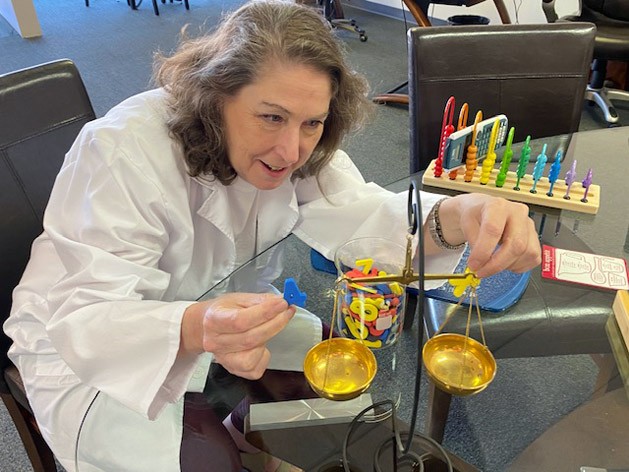
 Los Alamos resident Linda Anderman ‘weighs’ the benefits of the U.S. fully implementing the metric system versus continuing to use U.S. Customary Units. Photo by Kirsten Laskey/ladailypost.com
By KIRSTEN LASKEY
Los Alamos Daily Post
kirsten@ladailypost.com
Los Alamos resident Linda Anderman is on a mission – to ignite a discussion for implementing the metric system in the U.S.
On Monday, Anderman sent a 10-page concern to the House Subcommittee on Science, Space, & Technology regarding the U.S. lack of adoption of the metric system. She requested a Congressional hearing and tried to lay out a case for why this issue is vital to the country.
This has been a long-term mission; Anderman jokes that she has invested 10 years and $25,000 in this project.
“If I can get the attention of a few people, I can move the needle on this issue,” she said. “The goal is to get the topic back on the table for discussion.”
Anderman already shares her thoughts and information on the metric system on her blog, https://milebehind.wordpress.com/, which is archived by the Library of Congress.
She also was interviewed on VOX: https://podcasts.apple.com/us/podcast/how-to-kill-a-gram/id1346207297?i=1000438888730 and KSFR: https:////traffic.libsyn.com/thelastword/lw022020.mp3?dest-id=351241
Why discuss the metric system? Anderman said there are multiple reasons.
“This is more than a commerce issue,” she said. “It’s a public safety issue; it’s an education issue.”
Peter Goodyear, an Australian citizen who assists Anderman on her project since he experienced his own country’s conversion to the metric system, agreed. He also monitors a sub-Reddit that promotes the metric system.
Goodyear pointed out that while instituting a new measurement system would be a big change, it is nothing that people couldn’t handle.
“I think one of the things that helped the Australian metric conversion was in 1966, we changed our currency … that went very smoothly and it was very widely accepted by the Australian public,” he said during a telephone interview from Australia with the Post.
Due to this success, Goodyear said the Australian Government was encouraged to make changes knowing that people would accept them.
He further pointed out a lot of different entities in the U.S. already use the metric system. For instance, the National Weather Service and National Aeronautics and Space Administration both use the metric system internally. Many U.S. manufacturers use the metric system as well as the American medical industry.
“There’s a lot of metrication done where it’s necessary …,” Goodyear said.
Physical Scientist Elizabeth Benham with the National Institute of Standards and Technology (NIST), which is part of the Department of Commerce, explained the risks behind the U.S. allowing itself to implement the metric system voluntarily rather than making adoption mandatory. For the health care issue, she pointed out that errors can occur in converting measurements between the metric and U.S. Customary Units for medicine and determining a patient’s weight.
On the commerce side, Benham said one of the things NIST is advocating is amending the Fair Packaging and Labeling Act.
The focus is identifying the net quantity of a product on its label. Benham said labels will often show the quantity in metric units and U.S. Customary Units or just metric units. Since quantities impact prices, the manufacturers and then the consumers get hit with increases, she said. Maintaining two product inventories with different labeling formats, one for domestic sales (where dual units are required) from those destined for export (where metric alone is required) reduces manufacturer’s agility to meet shifting marketplace demands, Benham explained. This cost of doing business is incorporated into the product price.
“Working in hybrid … (is an) expensive risk…, Benham said, adding, “It comes down to trade and commerce.”
She pointed out this problem arose when the U.S. faced a shortage in baby formula and was importing formula from overseas. Since it was labeled in the metric system, the U.S. had to grapple with converting recommended dosage as well as net quantity.
The goal of updating the act, Benham said is to add some flexibility and remove some of the barriers regarding identifying the net quantity in a product.
Using the metric system also will have effects in the education sector, Benham said.
Teaching the metric system in classrooms allows students to be better prepared for pursuing careers in STEM (science, technology, engineering and mathematics), she explained.
“We need to make sure we have students going into STEM careers who are able to enter positions that use the metric system,” Benham said.
To help with this effort, she said NIST provides teacher kits and free webinars to educators. Click here to request a kit.
Anderman said she is hoping to open the discussion on all these issues.
Her interest in this subject started while working at Los Alamos National Laboratory. Anderman said she was talking to someone in Information Technology (IT) about replacement computer parts when the subject of the metric system was brought up.
It reminded her that as a child in school, Anderman said she was told that the U.S. would be implementing the metric system, but it never happened.
When she looked up the number of countries that have made the transfer to the metric system while the U.S. “stubbornly” stayed with its U.S. Customary Units, which are unnecessarily complicated, Anderman said, “it embarrassed me as an American.”
While Anderman has taken on this mission herself, she said she has received assistance. A few people have donated to her cause and Anderman credits NIST, Goodyear and Benham for their help. Being a government agency, NIST and Benham promote voluntary metrication and support Anderman with resources and information.
“I could not have taken any of this on if I hadn’t been taken in with open arms by NIST more than 10 years ago,” she said.
Anderman emphasized it is an important topic to address.
“This is such an untouched topic for decades,” she said. “Ninety-five percent of the world has figured out how to do this.”
And now it is time for the U.S. to become aware of the problem, Anderman said.
“Until you know there is a problem, you can’t fix it.”
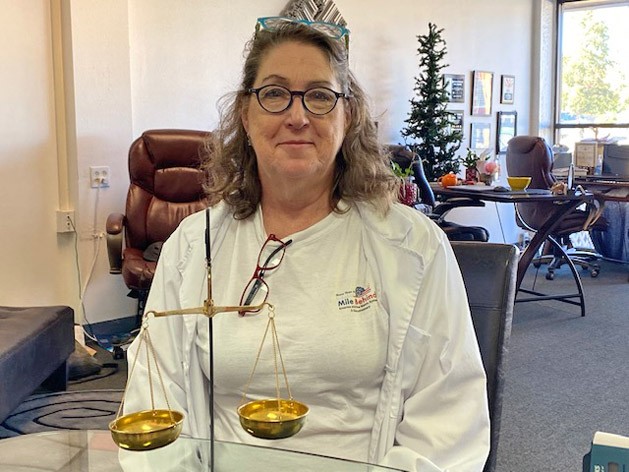 Linda Anderman sports a t-shirt with a logo of her blog, More than a Mile Behind. Photo by Kirsten Laskey/ladailypost.cm