
 By KIRSTEN LASKEY
Los Alamos Daily Post
kirsten@ladailypost.com
Public reception toward the proposed Downtown Metropolitan Area (MRA) for East Downtown Los Alamos during a community forum Dec. 16 could be summed up in one word: skeptical.
Many seemed to wonder what the benefit would be, what role, if any, Columbus Capital, the owner of the former Mari Mac plaza that covers a good size chunk of the east downtown area, has in the MRA and how funding provided through a MRA works.
Amy Bell and Maren Neldam with Anthropopulous, which assists with MRAs and is funded by New Mexico MainStreet, attempted to answer these questions and provide a clearer picture as to what a MRA would be during the Dec. 16 meeting.
Bell kicked things off by describing the area the MRA would cover. She said the focus is on the east gateway to downtown where Trinity Drive and Central Avenue split.
“Really looking at that experience that people have right when they enter Los Alamos from the east and thinking of ways that the County could support reinvestment, support redevelopment and really creating a nice gateway entry experience while boosting local economy and quality of life for folks living in Los Alamos,” Bell said.
To provide some background, Bell said in May 2023 the boundary for MRA was started to be evaluated. Since MRA can be tricky to understand, educational sessions about what it is and means were held. In February, the designation report was completed, and it was approved in May by County Council. The draft plan is expected to be finalized in January and its adoption and public hearing is scheduled for either February or March.
In drafting the plan, Bell said community input was taken into consideration as well as the downtown master plan. Input from the public was sought through social media, a town hall meeting in June and two surveys – the latest survey was initially scheduled to be open through December but due to the holidays the MRA partners recently announced that the deadline has been extended to 5 p.m. Jan. 7. The survey can be accessed at https://lacnm.com/EDLAMRAFeedback.
Additionally, she said other documents were reviewed and, “We always like to build on community input that we read in those plans as well.”
Based off the downtown master plan, Bell said goals and strategies were identified. The top three goals are: expanded local businesses and a strong economy, pedestrian-oriented, mixed-use downtown with retail, residential and office development, a variety of housing options at increased densities. The top three strategies are: enable, foster and direct quality downtown development to address vacant and underutilized structures and land, expand opportunities for financial assistance to local businesses such as grants and façade improvement programs, improve street life and walkability.
Based off of the survey, Bell said the types of development people said they wanted to see are: entertainment, retail, affordable housing, open space and parks, sidewalks, bike lanes, trails and paths. The types of businesses desired are: restaurants, entertainment, clothing and gift stores, outdoor stores or rentals, bookstores and bike shops and repair.
Additionally, the public indicated their concerns on the survey as well as during the town hall. They are: rent affordability and barriers to development and viability of small local businesses, need for additional housing particularly high density and affordable housing, transparency, public accountability, MRA administration and County process, use of property for laboratory office space, parking garage development and protection of scenic and natural beauty.
With all this information, “The vision and the development framework from the master plan are the foundation for the recommendations in the East Downtown MRA plan,” Bell said. “The MRA identifies challenges specific to the designated area within the MRA boundary, highlights relevant redevelopment goals and recommends revitalization strategies. The redevelopment tools that are enabled by the MRA increase the County’s ability to implement the strategies of the downtown master plan.”
Bell listed elements within the downtown master plan and corresponding goals in the MRA:
Element: Vitality
Goal: Create private partnerships that redevelop properties and provide opportunities for small businesses to thrive while furthering downtown economic vitality goals and council strategic goals.
Element: Housing
Goal: With a focus on affordable and workforce housing, support development projects that will increase housing opportunities within the MRA and/or preserve existing attainable housing units whenever possible.
Element: Infrastructure
Goal: Prioritize projects that will upgrade or modernize public infrastructure within the MRA area.
Element: Public Space/Street
Goal: Create a welcoming, vibrant, pedestrian-friendly downtown that includes public gathering spaces.
Element: Sustainability
Goal: Foster and promote sustainability practices in MRA-designated projects both in private and public.
Element: Transportation
Goal: Create safe, efficient, and convenient pedestrian and bicycle infrastructure, and convenient parking options.
It is not just listing goals and strategies in the MRA; Bell said a MRA comes with tools to achieve those objectives.
These tools include:
- A MRA agency, which is responsible for implementation and funding of MRA plan projects.
- A MRA fund, which is a dedicated fund for MRA projects. It can be contributed directly from the County.
Tax increment financing (TIF); this is something enabled by the designation and plan. A TIF doesn’t raise taxes but captures a percentage property tax or gross receipt tax as the area is redeveloped. For example, the property value of vacant property that is now redeveloped will increase so the County can capture those funds and reinvest them in the MRA. - Public/private partnerships, which is a cooperative agreement between the government and one or more private entities. These are typically used in situations where the project is too costly or too high risk for the private or public sector to handle on its own.
- Direct contributions and development incentives, which support business improvement or redevelopment without violating the anti-donation clause.
The public had questions for the MRA. One speaker questioned if the MRA was what was needed or if the County should direct its attention elsewhere – to affordable housing.
“We need a council that understands that we need affordable housing downtown to supply businesses with workers that can actually afford to live here and work at our small businesses and Smith’s … the main problem now is most of the workers come from Española and Pojoaque and they get tired of making that drive …,” he said.
Another person asked if the MRA would enable the County to determine what a landowner can and cannot do with property inside the MRA.
“Only if the County is providing them incentives or direct contributions … the County can work with a private developer … you guys have development code, there’s things developers can and cannot do that are already in place due to the code set in place for the County but with the MRA, if the County is going to use these tools and incentives through direct contributions with a developer or public/private partnership, then yes there is more control over what that development is,” Bell said.
Going back to affordable housing, another speaker asked if the County could require a developer to set aside a percentage of housing units for affordable living.
Bell said yes.
“If the County is going to support any private entity … whatever that project is, whatever work is going to be done, whatever the County is applying public funds towards, (it) needs to meet the goals set forth in the MRA.”
When asked if other communities are specifying rent for commercial properties, Bell said they are not specifically setting rents but there are communities that built into development agreements the types of businesses that are allowed into buildings located in MRAs. For instance, she said in Albuquerque, a motel property was being redeveloped and part of the agreement was any businesses offered space would be small, local businesses.
Los Alamos Chamber of Commerce Director Sandy Jones asked about financing options. Jones said from what she understands, TIF is not available at the front end of the project, so what financing options can be utilized on the front end?
For the TIF, County can leverage its bonding authority to make funds available at the beginning of a TIF, Bell said. TIFs can be established for 20-year periods. She recommended the County pursues a feasibility study to determine if enough funds would be generated through a TIF to warrant bonding against potential revenue.
Optometrist Lisa Shin, who runs her office in the Mari Mac plaza, asked about the plaza’s owner, Columbus Capital. She said the company asked the County for $31.9 million. She also asked about representation on the possible MRA commission.
Bell said she can’t speak to Columbus Capital’s funding request and while the MRA commission is an option, no decision has been made on how to move forward with it.
County Manager Anne Laurent added that Columbus Capital has not submitted a formal request for funds and no plans are moving forward at this point.
Bell was asked if there has been any discussion between landowners and the developers located in the proposed MRA as well as any potential projects. She said there had been multiple discussions, but no specific projects were addressed.
Boomerang Owner Anna Dillane wondered what is a MRA’s benefit.
“…generally, the reason for MRA designations and plans in the state is to allow local government to have more flexibility to support redevelopment projects and we have seen that the anti-donation clause can be a significant barrier to government support of downtown redevelopment so that is our understanding of why the state has the MRA statute,” Bell said. “Again, it is meant to be set up so that through the MRA planning process and the administration that those funds can only be given to private entities for projects that have clear community benefit that align with the goals in the plan.”
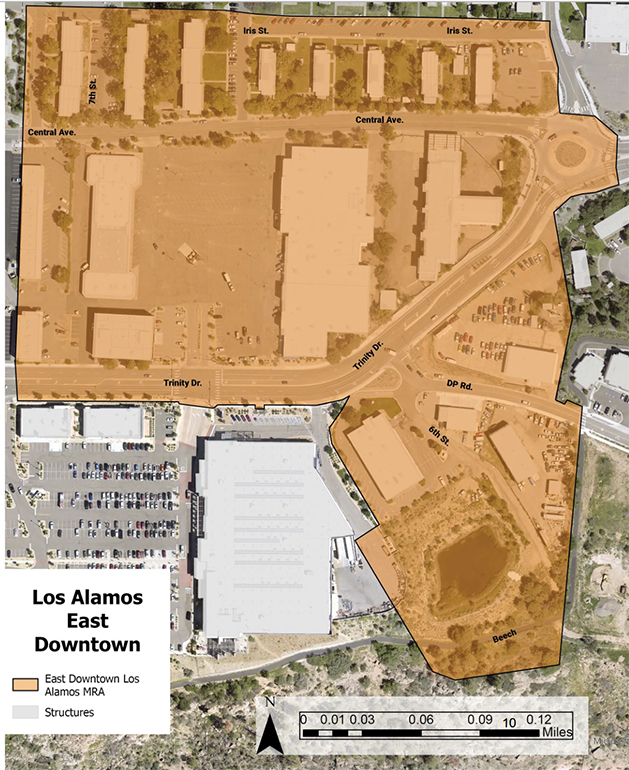 The boundary lines of the proposed East Downtown MRA. Courtesy/LAC