
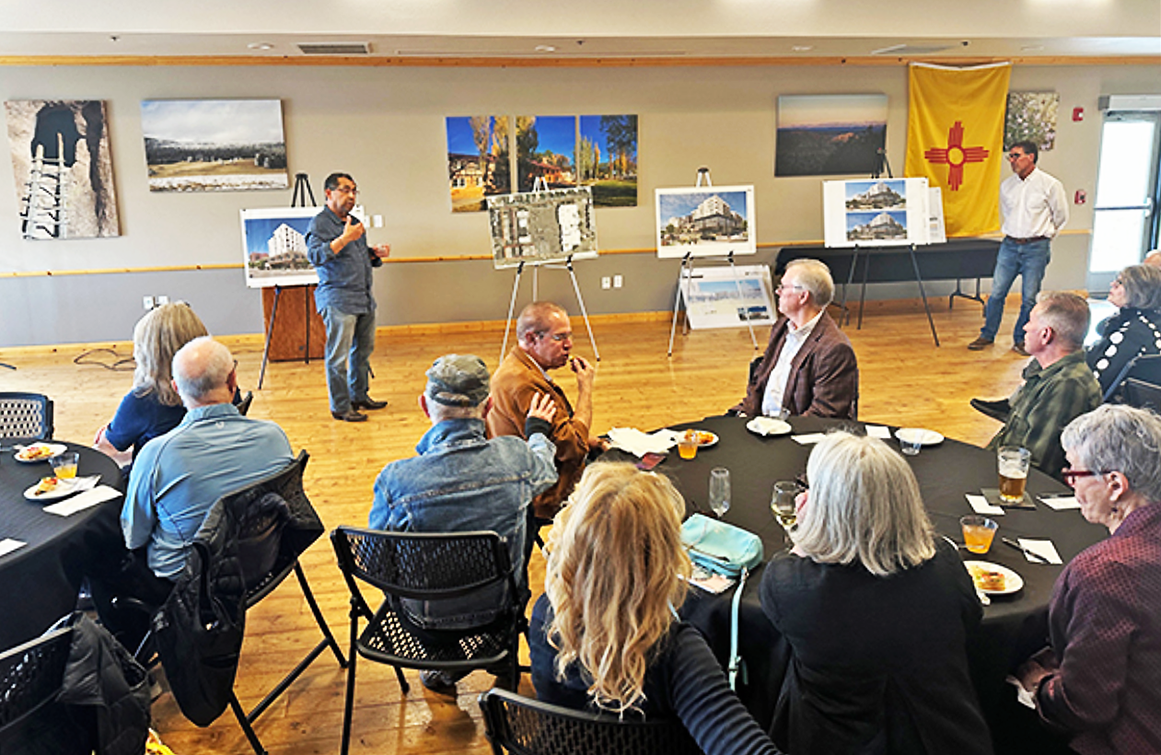
 Columbus Capital’s Jeffrey Branch, left, and Greg Gonzales update a crowd on their plans for development of the Mari Mac Shopping Center during a public meeting May 8 in the community room at the Los Alamos Golf Course. Photo by Kirsten Laskey/ladailypost.com
By KIRSTEN LASKEY
Los Alamos Daily Post
kirsten@ladailypost.com
In 2023, Columbus Capital purchased the Mari Mac Shopping Center from Kroger and the developer had big ideas for the property.
The plan was to lease portions of the property to Los Alamos National Laboratory as storage space for five years. After that, the property would mostly be demolished and from the rubble brand-new housing and retail spaces would arise.
During a public meeting Thursday, May 8, at Los Alamos Golf Course community room, Columbus Capital owners Jeffrey Branch and Greg Gonzales reported their big ideas are now facing some big issues.
Firstly, interest rates have soared since purchasing Mari Mac. Branch said when Mari Mac was bought, interest rates were 3.75 percent. Now, he said they are 7.25 percent or as high as 8.25 percent.
Initially, Branch said they thought by the time they are ready to begin phase one of the project, the interest rates would fall to the “fours” but that hasn’t happened.
Another wrench thrown at the project was construction costs, he said.
“Our construction costs came in extremely high,” Branch said. “This is our first large project that we have even attempted to do in Los Alamos, and we’re flabbergasted with the cost to build here versus even in Santa Fe and Santa Fe is higher than Albuquerque. The reason for that is the lack of labor – everybody is coming from Albuquerque and the trucking costs – all of those components – it just stacks and stacks.”
Despite the roadblocks, Branch and Gonzales said they remain committed to the project.
“We are still here,” Branch said. “We are committed. We are doing everything we can to make this economic deal actually pencil.”
One way they are doing this is pursuing modular housing.
Branch said they partnered with an engineering firm and learned about modular construction, which he said involves building individual apartment units in a warehouse, shipping the fully constructed units to the site and installing them like Lego blocks.
Gonzales said a crane will be used to stack the modular units and it is expected that 420 modular structures are needed. This dramatically cuts down the construction time, he said; it is estimated it would go from three years to 24 months.
Another avenue being considered is public funds. Branch said there have been discussions with Los Alamos County on what tools would be allowed to finance the project such as bonds or LEDA grants.
He emphasized nothing has been requested.
“We haven’t done anything in terms of any applications,” Branch said. “We haven’t pursued that quite yet, but our plan is to at some point do that, but we need our costs first. That’s our big thing at this point.”
“Hopefully we don’t (need to ask for public assistance) but my sense is in order to make this thing work, the County may have to participate or we ask them to participate,” he added.
If public funds are asked for and received, Branch said it would not cost the taxpayer due to all the projected revenue that could be reaped from property taxes, gross receipt taxes and lodger’s taxes. Branch and Gonzales shared what all this effort would produce in phase one of their project. Details of phase two are not yet known, Branch said.
The plan is to offer 240 apartments that would include one bedroom, two bedrooms and studio units. Branch said the apartments would be rentals, and the plan is to rent 10 percent of the apartments at 80 percent of the area median income. Townhouses will also be offered. A hotel with a community room, meeting rooms and retail space will be constructed. There will also be a parking structure.
When asked about the scope and size of this project in such a small town, Branch said, “the demand analysis we have in terms of housing – this is just a drop in the bucket. This is actually not enough … hotels – we have a market study for hotels (and) when you start approaching 80 percent of occupancy there’s a demand for it … so the demand is here for this type of project (and) because of its size it does create an incredible income stream of property tax for the County and an incredible revenue stream for gross receipt taxes and lodger’s taxes.”
Mari Mac is not the only property Columbus Capital owns in Los Alamos.
It also owns the properties at 991 Central Ave., where the Department of Motor Vehicles is located, as well as on 820 Trinity Drive, and portions of 800 Trinity Drive and 3500 Trinity Drive, where the Bilingual Montessori School operates.
Branch said the existing tenants in these properties, except for 3500 Trinity Drive, have had their leases extended for six months at a time and the plan is to help them relocate.
As far as the lease Columbus Capital has with Los Alamos National Laboratory, Branch said there is three-and-a-half years left on it and Columbus Capital could be returning to the County to ask for an extension on their special use permit to lease longer to the laboratory.
There are a lot of variables with this project, but Branch said they are optimistic about its future.
“This project will create a significant economic opportunity …,” he said.
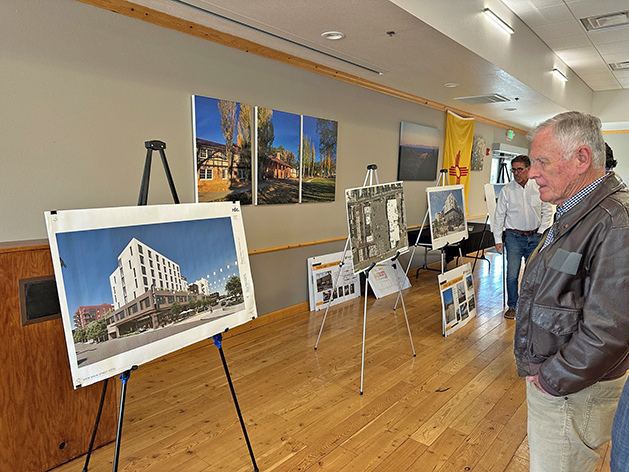
Los Alamos Board of Public Utilities Chair Robert Gibson studies one of Columbus Capital’s renderings of its plans for the Mari Mac Shopping Center during a public meeting May 8 in the community room at the Los Alamos Golf Course. Photo by Kirsten Laskey/ladailypost.com
 Columbus Capital’s Jeffrey Branch, left, speaks with County Assessor George Chandler during the May 8 public meeting to update the community on Columbus Capital’s development plans for the Mari Mac Shopping Center. Photo by Kirsten Laskey/ladailypost.com