
 General Store: The Red Oak General Store was operated by Lowell Davis’s father. Davis spent many hours in the store and this is where he learned to paint and sculpt. The store was moved to Red Oak II and restored in 1987. The interior has many features of the original store, but also contains several tables that can be used for a meeting or gathering space today. Photo by Gary Warren/ladailypost.com
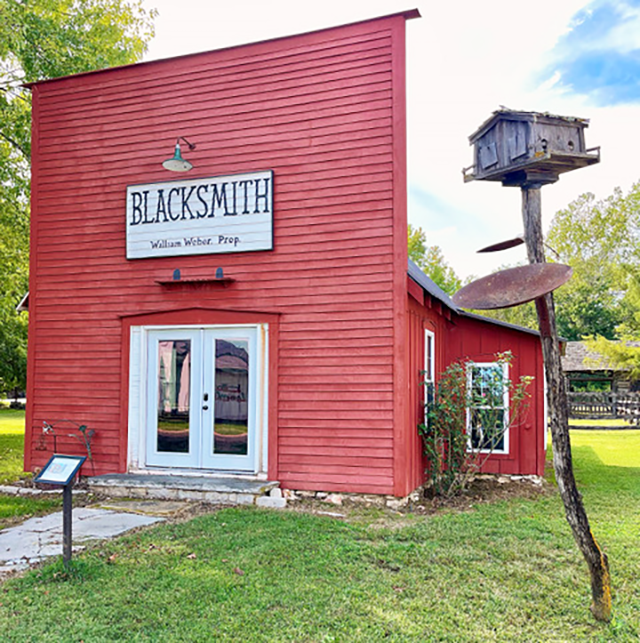 Blacksmith Shop: The Blacksmith Shop is another Red Oak structure that played a part in Lowell Davis’s early years. The shop was operated by Lowell’s great-grandfather and there is no doubt where Lowell learned some of the skills used in creating sculptures and other art pieces. Photo by Gary Warren/ladailypost.com
By GARY WARREN
Photographer
Formerly of Los Alamos
Part history, part outdoor art project, or perhaps an open-air museum are just a few ways to describe Red Oaks II near Carthage, Mo. Why is it named Red Oak II? Who owns this place and why is it here? Is Red Oak II a ghost town? Maybe, but not really.
Red Oak, Mo., the original Red Oak, was located about 20 miles to the northwest of Red Oak II. As a youngster, Lowell Davis lived and grew up in Red Oak in the 1930-40s. It was a simpler time. Red Oak was very typical “small town America” during that era.
Lowell Davis flunked out of high school art class and later joined the Air Force and eventually settled in Dallas, Texas where he was an art director for an advertising agency. Davis did not like city life – his small town home in Missouri is where he wanted to live.
Lowell Davis became an artist focusing on several art mediums. Primarily a painter, Davis was also a cartoonist, sculptor, metal artist, and folk artist. He became known as the “Norman Rockwell of Rural Art”. In the 1980s, when Davis was creating Red Oak II he was quoted, “I don’t believe that an artist should be restricted to use only paint or clay. It can be anything, including junk, wood, or even an old building. To me, Red Oak II is a combination of a painting and sculpture, and it is just made from things that someone else threw away.”
In the 1970s, Davis returned to his hometown of Red Oak only to discover that the town was dying and becoming a ghost town. Davis owned a farm near Carthage, Mo., which he named “Foxfire Farm”. After seeing Red Oak fade into a ghost town, he decided to build a new Red Oak on his farm property, thus the name Red Oak II.
Beginning in the mid-1980s, Davis began to purchase businesses and houses in Red Oak and had them moved to his property, which was the beginning of Red Oak II. He moved the General Store, the Blacksmith Shop, a gas station building, and some houses and had each structure placed in Red Oak II. Also included was a cottage-style Phillips 66 gas station that sat on Route 66 near Red Oak.
Davis also purchased and relocated a church and other buildings in addition to the original Red Oak buildings. He added the building that housed the first Jasper County court sessions, the Salem County Church, located a few miles north of Red Oak II, and several other historic buildings from the 1930s to 1940s to enhance Red Oak II.
All of the structures in Red Oak II were carefully renovated to their original glory and line the street in the tiny village. The property where Red Oak II is located was subdivided and several of the homes moved into Red Oak II were sold and are now private residential houses, which are located in the middle of this quaint, colorful, and fun community. Lowell Davis and his wife, Rose, lived in Red Oak II, and Davis’s sculptures and artwork can be seen all around the Red Oak II grounds.
As he aged, Lowell Davis sold all of the properties in Red Oak II to various individuals except for the house where he lived. He wanted to enjoy Red Oak II and watch others as they enjoyed his created town of Red Oak II.
Lowell Davis loved to sit on the front porch of his house in Red Oak II and gaze at the visitors who came to see and appreciate his artwork. Unfortunately, Davis died at his home in 2020, but his wife, Rose, and other residents have continued to maintain the community and keep the art project alive.
Red Oak II is free to visit, but donations are accepted. Several of the houses are privately owned and are marked as such. Visitors should not enter those lots. Many of the buildings are open and staged as they appeared in the 1930s. Some buildings may not be open if you are visiting off-season like we did, and other times there may be a festival or event when almost everything is open.
If driving in southern Missouri, one should take some time and explore Red Oak II located near Carthage, Mo. The community/art project/open-air museum is located near I-44 and Route 66. This art project of Lowell Davis is truly a treasure where many types of art can be found. It was a pleasure to visit and Red Oak II is a photographer’s paradise.
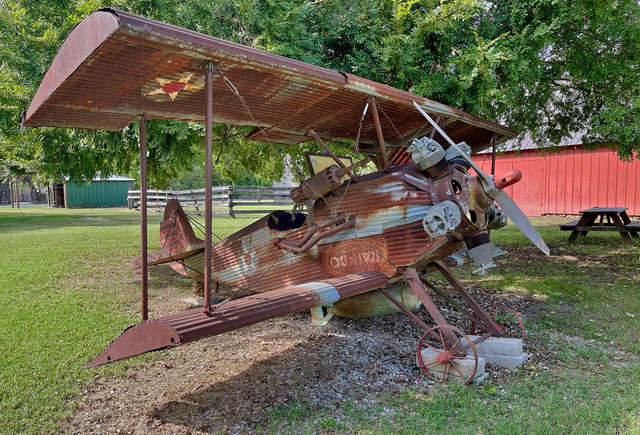 Airplane Sculpture: There are numerous signs of Lowell Davis artwork scattered about on the grounds of Red Oak II. This sculpture of an airplane was created from scrap metal and various other pieces repurposed by Davis. Photo by Gary Warren/ladailypost.com
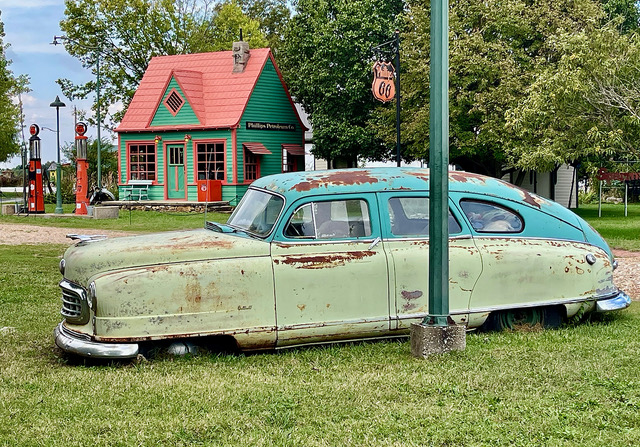 Phillips 66: A cottage style Phillips 66 station originally stood on Route 66 not far from Red Oak. Davis had the station moved to Red Oak II and was one of two former gas stations on the property. The cottage style structure was used extensively by Phillips 66 in the 1930-40s and several of the stations have been saved and restored. Several vintage cars and trucks can be seen throughout Red Oak II. Photo by Gary Warren/ladailypost.com
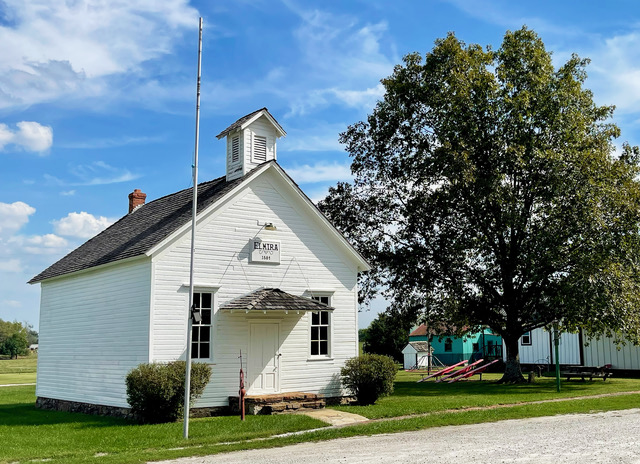 Elmira School: The Elmira School was moved to Red Oak II from a nearby community. The school is staged as it would have looked like in another era but the building was not open on the day that we visited Red Oak II. Photo by Gary Warren/ladailypost.com
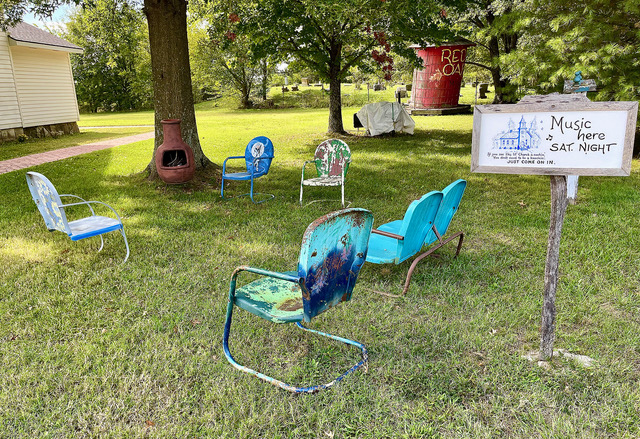 Music Here: A sign stands in the lawn next to the Salem County Church, where on Saturday nights there are music jam sessions featuring bluegrass, country or gospel music. Church services are held in the church every Sunday. Other days you may find visitors sitting on the lawn in chairs or picnic tables located around the property. Photo by Gary Warren/ladailypost.com
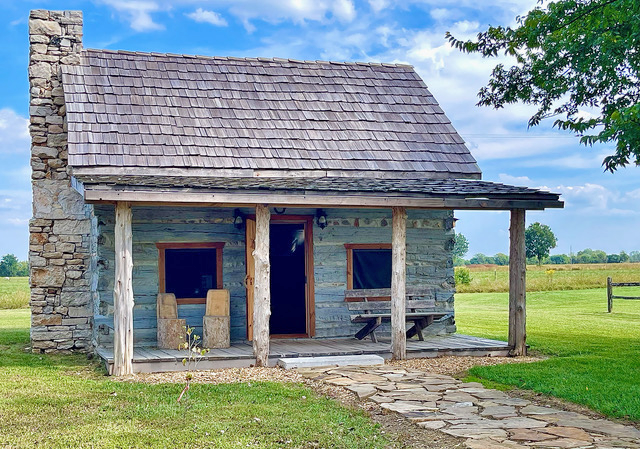 Hornback Cabin: The Hornback Cabin originally sat in Jasper Village to the west of Carthage, Mo. The one-room cabin not only served as home to George Hornback, it also served as the Post Office and general store for Jasper Village. In 1841 when Jasper County was being formed, the small cabin became a temporary county seat and courthouse until a permanent building could be built. County government sessions and court sessions were held in the cabin for several months until the new facility was completed. Photo by Gary Warren/ladailypost.com
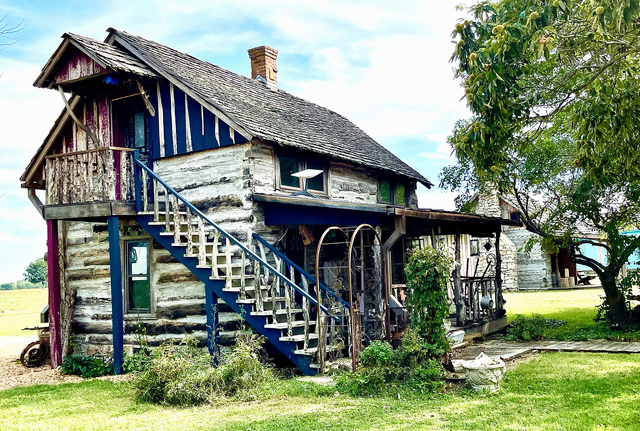 Garfield Wiley Cabin: This house known as the Garfield Wiley Cabin, originally sat on Route 66 not far from Red Oak. The house dates back to 1860 and was moved to Red Oak II in 1989. The home was a private residence for many years, but it has recently been sold. The new owners are renovating the structure and hope to open it as a bed and breakfast so that visitors can enjoy longer stays at Red Oak II. Photo by Gary Warren/ladailypost.com