
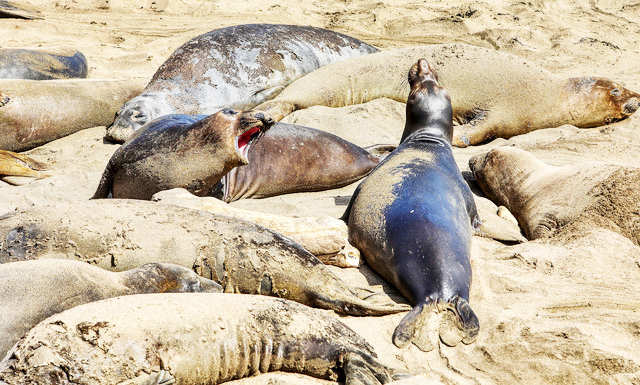
 Listen To Me: A female elephant seal appears to be barking orders at a young male seal that does not seem to be hearing much! The male elephant seal has a nose that resembles a short elephant trunk called a ‘proboscis’ – thus the name elephant seal. Photo by Gary Warren/ladailypost.com
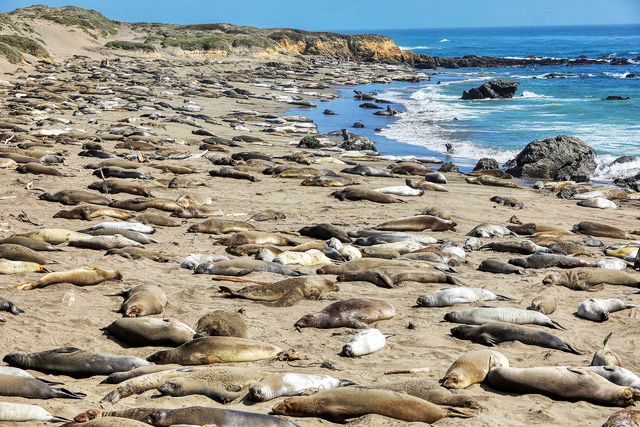 Just Another Day At the Beach: Elephant seals lie in groups scattered about the beach at Piedras Blancas Elephant Seal Rookery when we visited the area in May. These are almost all female seals with a few younger male seals mixed in during the molting season. Molting takes about a month, and then the female seals will depart for the sea. The adult male seals will begin molting in June. Photo by Gary Warren/ladailypost.com
By GARY WARREN
Photographer
Formerly of Los Alamos
Our travels have taken us to many unique and diverse locations and events through the years. One of the most unique events took place in May when we stopped at the Piedras Blancas Elephant Seal Rookery near San Simeon, Calif.
We were aware of the area, but until we arrived and observed these odd creatures, we had not known how intriguing, enjoyable, and educational this experience would be. As it turned out, we ended up spending far more time watching and photographing these massive mammals than we ever imagined.
Elephant seals were hunted and killed for their oil-rich blubber, which was used in various ways in the 1700s and 1800s. The seals were hunted to the point of near extinction by the early 1900s, as there was only one colony of about 25 seals remaining. That is when restrictions were put in place by the U.S. and Mexico, where these Northern Elephant Seals lived and migrated up and down the waters of the Pacific Ocean.
The protection efforts proved effective, and today there are estimates of 250,000 Northern Elephant Seals in the Pacific Ocean. The seals began arriving at Piedras Blancas in 1990. Today this rookery will host over 25,000 seals annually. The seals are continually migrating, and not all are at the beach at the same time. During the peak seasons, there may be as many as 17,000 seals present within the area.
The seals spend about eight to 10 months every year in the ocean. They will dive 5,000 feet deep at times for up to two hours underwater, continually searching for food while at sea. The remaining months of the year are spent onshore.
There are three peak seasons during the year: January, late April, and late October. During time spent onshore, the animals give birth, mate, molt, and rest. In November, adult males will come ashore to prepare a place for mating.
In December through March, the female seals arrive and most are expecting. Birth usually occurs shortly after the females arrive on the beach, with January being the top birthing month. Males stay on the beach during this time as well, before returning to sea.
Molting season begins in April when the females and the young seals return to molt. Molting is a process where the animal sheds its outer layer of hair and skin while growing new outer skin and hair. The process takes about a month, and the seals can be seen as they lie close together while molting. The female and young seals will return to the ocean after the molting process is completed. Adult males will begin their molting season in June and July, which also lasts about a month before they return to sea. In the fall, the process starts all over again.
The Northern Elephant Seal is a fascinating creature. The male seals will grow to 14-16 feet long and weigh 4,000-5,000 pounds. The female seals are 9-12 feet long and weigh 900-1,800 pounds. The animals are huge when they arrive at Piedras Blancas Elephant Seal Rookery at their top weight. Pups measure 3-4 feet at birth and weigh about 70 pounds.
However, the animals do not eat while at the beach except for the new mothers after birth. The seals will lose up to 25 percent of their weight while on shore. They search for food and eat continuously while at sea.
These fascinating animals are entertaining to watch as they move about on the beach between sleep periods. They will also spend some time in the shallow waters along the shore.
We visited the rookery in May during the molting season for females and some young male seals. While the molting process is not the most beautiful, it is very interesting to see. There were thousands of seals present during our visit and since it was molting season, the seals were often stretched out side by side as they snoozed on the beach.
The nonprofit, Friends of the Elephant Seals in San Simeon, Calif., does a wonderful job of educating the public about the elephant seals and their life cycle during the year. They have docents at the rookery most days and are very knowledgeable and helpful, answering questions about the seals.
They also have a visitors center in the town of San Simeon, just a few minutes from the Piedras Blancas Elephant Seal Rookery.
There were many highlights during this trip along the central California coast, but the most unique was our day at Piedras Blancas Elephant Seal Rookery. The rookery is on Highway 1 and has a large parking area for vehicles of any size. A boardwalk with viewing points stretches down the beach, making the up-close viewing easy for all ages. The best part is that it is open every day of the week and is free to all. Don’t miss this stop if you are anywhere close on the California coast!
Editor’s note: Longtime Los Alamos photographer Gary Warren and his wife Marilyn are traveling around the country, and he shares his photographs, which appear in the “Posts from the Road” series published in the Sunday edition of the Los Alamos Daily Post.
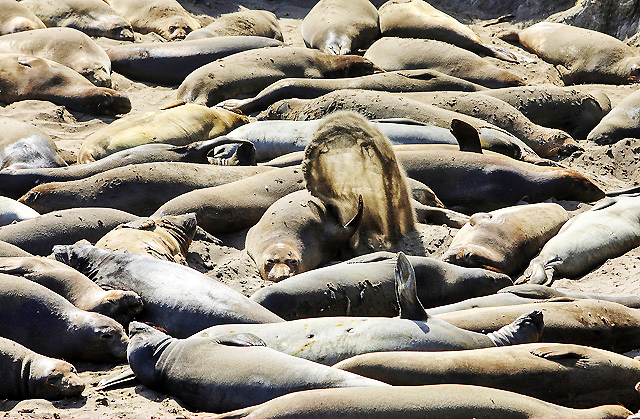 Flipping Sand: The seals tend to gather in groups and sleep on the beach together during molting season. Several seals are seen in a group, but one seal in the center can be seen flipping sand into the air and onto her back. This is done with the flippers by all to keep cool when the sun is warm in the middle of the day. The seals also move about and even dip into the water for a time to cool off during this season. Photo by Gary Warren/ladailypost.com
 Moving On: Northern Elephant Seals can move about on the beach with the use of their front flippers. The flippers move the enormous body as it slides across the sand. The seals can move about 4-5 miles per hour for a short distance before stopping for air and resting. Photo by Gary Warren/ladailypost.com
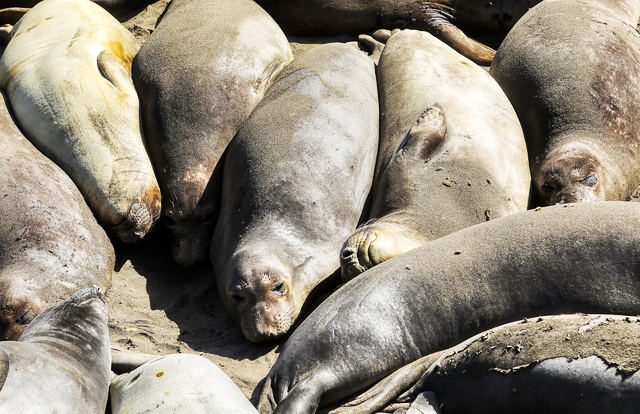 Snoozing: While most of the seals are sleeping back to back in rows, some of the groups were arranged in a more circular pattern. The result was all the same: a lot of sleep and rest! Photo by Gary Warren/ladailypost.com
 Cool: The seals will move to the water and cool down in the shallow waters along the shore before moving back onto the beach for another nap. The younger pup seals use this time to learn to swim and navigate through the water. Photo by Gary Warren/ladailypost.com
 All Together Now: Dozens of elephant seals are grouped on the beach at Piedras Blancas Elephant Seal Rookery. A closer look will reveal seals in various stages of the molting process. The light gray skin is the new skin after molting. Those still in the molting process will have a darker brownish skin, and the skin and hair can be seen as it molts away while being replaced with the new lighter skin. A seal in the back of the group can be seen flipping sand to stay cool. Photo by Gary Warren/ladailypost.com