
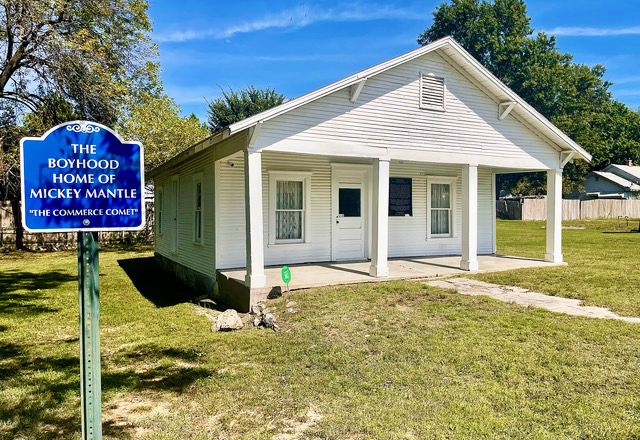
 Boyhood Home: The modest white wood-sided house at 319 S. Quincy Street in Commerce, Okla., is where Mickey Mantle spent his early years from age three until he signed a pro baseball contract after high school. Photo by Gary Warren/ladailypost.com
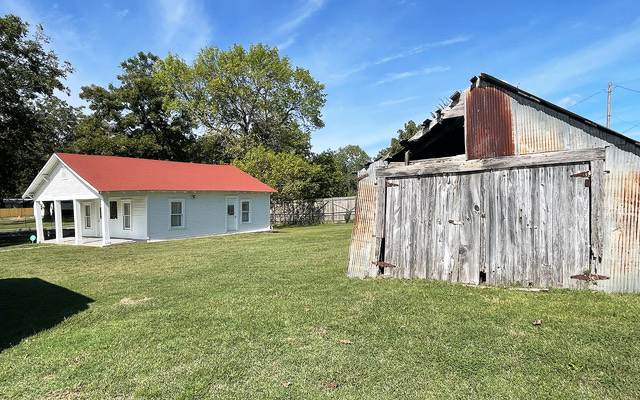 Mantle Homestead: The Mantle homestead included the house and a tin garage or barn on the side of the property. The open grassy lawn between the two structures is where Mickey Mantle spent every afternoon practicing his hitting skills. His father and grandfather served as his pitchers. Photo by Gary Warren/ladailypost.com
By GARY WARREN
Photographer
Formerly of Los Alamos
While traveling Route 66 through Oklahoma earlier this month, we stopped in the small town of Commerce. Indeed, Route 66 does pass through Commerce and features a couple of interesting Route 66 stops. However, this tiny northeastern Oklahoma town is home to an American sports legend, Mickey Mantle.
Mickey Charles Mantle was born in Spavinaw, Okla., but the family moved to Commerce when Mickey was 3 years old. Mantle lived his boyhood life in Commerce until he signed a contract to play professional baseball after graduating from high school.
The Mantle homestead at 319 S. Quincy featured a modest white wood-sided house typical of other houses in the area. A tin metal garage or small barn sat to the right of the house near the edge of the property, leaving a good-sized grassy lawn between the two structures.
Mickey Mantle learned how to hit a baseball shortly after moving to Commerce. Mantle’s dad and grandfather served pitches to the youngster every afternoon, helping Mickey develop into the hitter that would be his trademark for the rest of his life.
Mantle’s dad pitched right-handed and Mickey batted left-handed. His grandfather was a left-handed pitcher, and Mickey would bat right-handed. After years of practicing this way, becoming a switch-hitter came naturally as he progressed in his baseball career.
The “backstop” during these daily batting practices at the Mantle household was the tin garage/barn. When visiting the homestead, it was surreal to gaze at the wall of that old tin barn and rub my hands over some of the dents in the tin wall. Knowing that these blemishes were created during Mickey Mantle’s early batting practices was an amazing feeling.
Mickey Mantle grew to become an all-star baseball player in high school and earned the title of “The Commerce Comet”. He began playing semi-pro ball for the Baxter Springs Whiz Kids, a team in Baxter Springs, Kan., just a few miles north of Commerce.
The day after high school graduation in 1949, a scout for the New York Yankees who had followed Mantle offered him a professional baseball contract. After a brief stint in the minor leagues, Mantle joined the Yankees in 1950 as a shortstop because the Yankees had a veteran centerfielder named Joe DiMaggio. Mantle hit .402 in the spring of 1950, including nine home runs. Yankee Manager Casey Stengel knew a year in AAA minor league would help his fielding, but his hitting and base running skills were superior. He did, however, begin the season in AAA. By 1951, Mantle was a New York Yankee for years to come.
By 1952 Mantle Mantle batted .311 with 23 home runs and had become a star. In the World Series that season Mantle hit .345 with two home runs as the Yankees won the Series over the Brooklyn Dodgers.
During his 18-year career with the New York Yankees, Mantle hit 536 home runs, won seven World Series titles, and numerous other honors and awards. Mickey Mantle retired after the 1968 season and was inducted into the National Baseball Hall of Fame in 1974.
Quite the career and accomplishments for “The Commerce Comet”.
Today Mantle’s boyhood home is available to visit and explore the grounds, but the home’s interior is not open to the public. It was the icing on the cake for me to visit this legend’s hometown and boyhood home.
A larger than life statue of Mickey Mantle stands just off Route 66 by the high school baseball field. The water tower that stands tall near the center of town acknowledges the Commerce Tigers (the high school team), Route 66, and number 7 in blue and white with blue and white pin stripes lining the base of the tower in honor of Mantle.
This was a great Route 66 stop, but it was another trip down memory lane as we visited the Mickey Mantle boyhood homestead and other sites honoring the baseball legend from Commerce, Okla.
Editor’s note: Longtime Los Alamos photographer Gary Warren and his wife Marilyn are traveling around the country, and he shares his photographs, which appear in the “Posts from the Road” series published in the Sunday edition of the Los Alamos Daily Post.
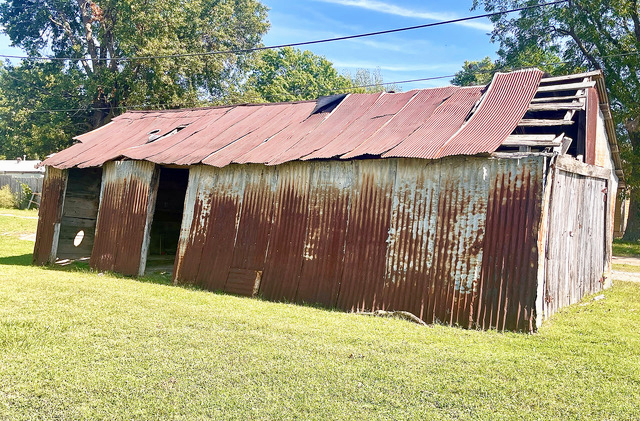 The Backstop: This tin barn structure played an important role in Mantle’s daily batting practices. The tin wall on the barn served as a backstop for Mantle during the practices. There are small dents in the tin that are a result of those practice days decades ago. Photo by Gary Warren/ladailypost.com
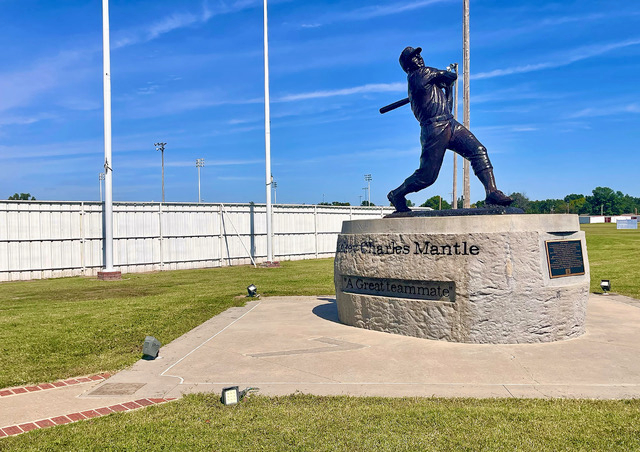 Mantle Statute: A statute of Mickey Mantle that stands nine feet tall, including the base, stands along Route 66 in Commerce, Okla., by the high school baseball field. The statue, as well as the Mantle boyhood home, is free for visitors to stop and see and enjoy. Photo by Gary Warren/ladailypost.com
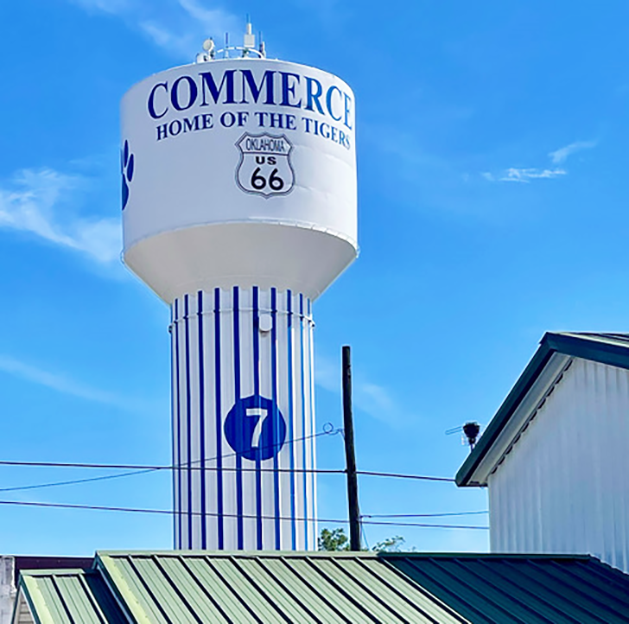 Water Tower: The water tower near downtown Commerce honors the high school team, the Tigers, Route 66, and Mickey Mantle. The blue and white number 7 and the blue and white pin stripes on the base of the tower honor Mickey Mantle. Photo by Gary Warren/ladailypost.com