
 Route 66 Sign: A beautifully lit neon sign spans Central Avenue NW welcoming travelers to Route 66 in Albuquerque. Photo by Gary Warren/ladailypost.com
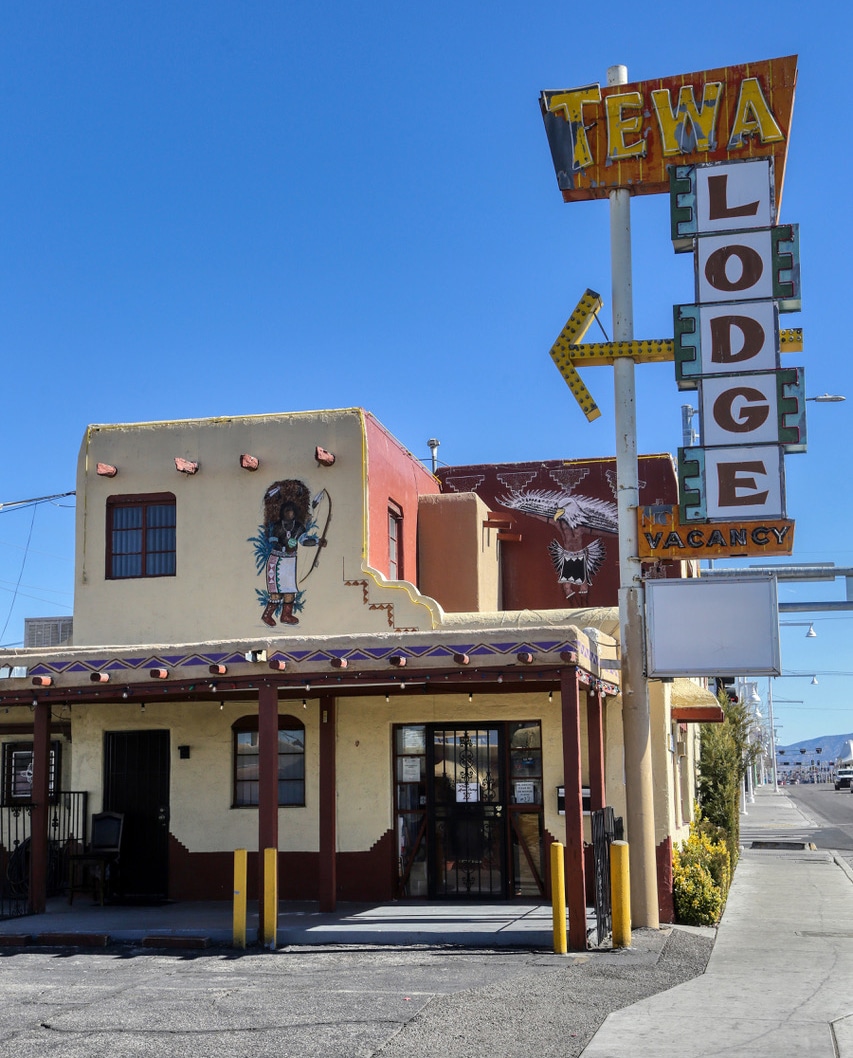 Tewa Lodge: The Tewa Motor Lodge at 5715 Central NE opened in 1946 and features Pueblo Revival style of architecture and is listed on the National Register of Historic Places. This is one of many motels along Historic Route 66 in Albuquerque. Photo by Gary Warren/ladailypost.com
By GARY WARREN
Photographer
Formerly of Los Alamos
Route 66, The Mother Road, The Main Street of America and now Historic Route 66 is the iconic highway route that opened up the American west for travel in the mid-1900s. Route 66 led travelers from Chicago, Ill. to Los Angeles, Calif. through eight states along the way. The route was realigned over the years and eventually replaced by the Interstate Highway System before being decommissioned in 1985.
This Post From the Road features a local attraction for Los Alamos residents; Historic Route 66 in Albuquerque. Route 66 remains a very popular route for a road trip today and Albuquerque has one of the longest stretches of the highway of any city on the route. While there are two variations of Route 66 in Albuquerque, this post will feature the more popular of the routes which runs east/west through the city along Central Avenue.
Route 66 leads travelers through several significant areas of Albuquerque including Nob Hill, University of New Mexico, downtown, and Old Town. Central Ave. is 18 miles long and still features many of the motels, restaurants, and other structures which make for an interesting drive across the city.
The eastern end of Central Ave. features several motels and motor lodges as well as several restaurants from the Route 66 era. Some of the motels have been demolished but a few remain as motels or apartments. One example is the Tewa Motor Lodge at 5715 Central NE. The motel opened in 1946 and features Pueblo Revival style of architecture and is listed on the Register of Historic Places.
The Nob Hill and UNM area feature several prominent buildings from the Route 66 era including M’tucci’s Bar Roma at 3222 Central SE, which opened in 2022. This was formally Kelly’s Bar and Pub for many years. The structure was built in 1939 and is noticeably a former gas station. However when it opened it was a gas station and a Ford car dealership known as Jones Motor Company and was a very modern and upscale facility during that era.
Another building in this area, which has an interesting history, is the Triangle Park Police Substation at 2901 Central NE. This is a small, prefabricated building built by Valentine Manufacturing in Kansas. The original use for the building was a restaurant called Little House Diner, a small diner with a counter and eight bar stools. Valentine Manufacturing built several of these small restaurants during the era but very few remain today. The small structure was about the size of a rail car and built for easy transportation by train or by truck.
The 66 Diner at 1405 Central NE began as a restaurant in 1987, just a couple of years after the original Route 66 was decommissioned. It was built in the 1940s Phillips 66 gas station and still displays several signs and artifacts from that era. The building burned in 1995 but was restored and reopened in 1996. It remains a popular eatery featuring retro 1950s decor.
In downtown Albuquerque there are several structures from the Route 66 days including the Kimo Theatre and Lindy’s Diner. The Kimo Theatre at 423 Central SE was built in 1927 and remains one of the most recognizable buildings along Route 66 in Albuquerque. The Pueblo Deco style of architecture has been beautifully maintained and the theatre continues to host various events today.
Near the Kimo Theatre is Lindy’s Diner at 500 Central SW, which is in the 1906 Bliss Building. The diner opened in 1929 and is the longest continuously operating diner on New Mexico Route 66 and one of the oldest on all of Route 66. The diner is easy to spot with its colorful turquoise and purple exterior.
Just west of downtown at 1256 Central SW is the Dog House Drive In, one of the city’s oldest drive ins. The tiny drive in may look familiar to fans of the TV show Breaking Bad as it was featured on the show. The drive in offers hot dogs, burgers, fries and shakes and has operated by its current owners for over 50 years.
Moving west on Central Avenue travelers pass by Albuquerque Old Town, which is the site of the early village that became Albuquerque. Today the area is home to many shops and restaurants as well as a cultural hub within the city of Albuquerque.
The El Vado Motel at 2500 Central SW is another very recognizable stop on Route 66 in Albuquerque. The motel was built in 1937 and operated until its closing in 2008. The motel was renovated and reopened in 2018 featuring a 22 room motel, plaza, shops, apartments and eateries.
The iconic 1937 neon sign was also restored and makes the landmark property easy to spot on Central Avenue. The facility is listed on the National Register of Historic Places.
Before driving out of town on Central Avenue, travelers cannot miss the neon Route 66 sign in the 6400 block of Central NW. The beautifully lit sign spans Route 66 in one of the wider sections of Central Avenue and is a welcoming sign for Route 66 travelers.
One new feature, which was not open yet when we last visited Albuquerque in January 2023, is the Route 66 Visitors Center and Museum. The new facility is at 12300 Central SW on Nine Mile Hill. The 21,000 square foot building will house the visitors center and gift shop, a Route 66 Museum, and will be used for other events such as car shows as well. This new facility will be a hub for Route 66 travel within the state as well as Albuquerque when it opens. I cannot wait to visit the facility.
This post contains highlights of Historic Route 66 in Albuquerque. There are many other motels, restaurants and businesses located along the route. I encourage anyone interested in this part of New Mexico history to take a day and explore Route 66 as it passes through the city. There is so much to see and learn about the route as well as the city of Albuquerque along the way.
Editor’s note: Longtime Los Alamos photographer Gary Warren and his wife Marilyn are traveling around the country, and he shares his photographs, which appear in the “Posts from the Road” series published in the Sunday edition of the Los Alamos Daily Post.
 Police Substation: This Police Substation at 2901 Central NE is housed in a prefabricated building with an interesting history. The building was delivered to Albuquerque in the 1940s and originally housed a small diner. Photo by Gary Warren/ladailypost.com
 Route 66 Diner: The 66 Diner opened in 1987 in a former Phillips 66 gas station. The diner displays many signs and artifacts from the Route 66 era and features 1950s diner decor. Photo by Gary Warren/ladailypost.com
 Kimo Theatre: One of the most iconic structures on Route 66 in Albuquerque is the Kimo Theatre. The theatre opened in 1927 and continues to host events today. Photo by Gary Warren/ladailypost.com
 Lindy’s Diner: Located in downtown Albuquerque near the Kimo Theatre is Lindy’s Diner. The diner opened in 1929 and is the longest continuously operating diner on New Mexico Route 66 and one of the oldest on all of Route 66. Photo by Gary Warren/ladailypost.com
 The Dog House: The Dog House on west Central Avenue is one of the oldest drive ins in Albuquerque. The popular small eatery was featured on the TV show Breaking Bad, which was filmed in Albuquerque. Photo by Gary Warren/ladailypost.com
 El Vado: The El Vado Motel stood on Central Avenue SW from 1937 until it closed in 2008. The facility was renovated and reopened in 2018 giving this Route 66 icon a second life. Photo by Gary Warren/ladailypost.com