
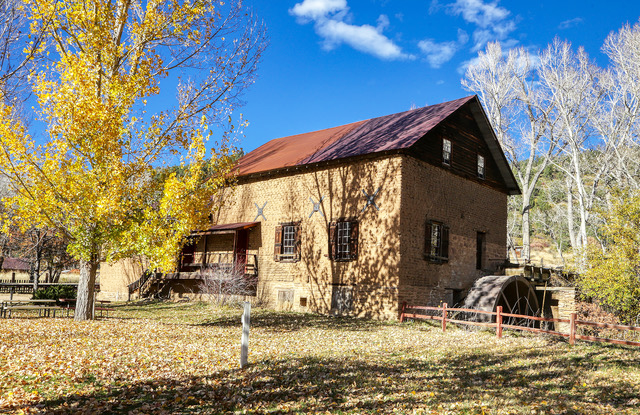
 Cleveland Roller Mill: The Cleveland Roller Mill is in the tiny village of Cleveland in Mora County. The three story adobe structure still contains all milling equipment. At the end of the building is a cast iron water wheel 18-feet-6-inches high, which powers the milling equipment. Photo by Gary Warren/ladailypost.com
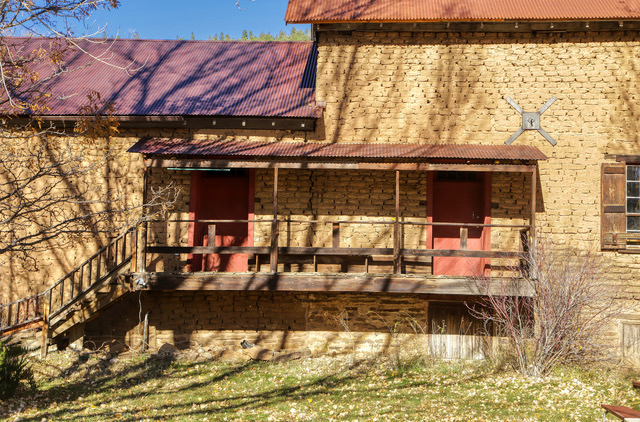 Mill Entrance: The Cleveland Roller Mill is now a private museum. The entrance to the museum looks much like it has for decades when the mill was in operation. The museum is a 501(c)(3)organization that provides history of the mill, wheat farming in Mora County and the history of the county through photographs and tours of the mill. Photo by Gary Warren/ladailypost.com
By GARY WARREN
Photographer
Formerly of Los Alamos
We departed from Los Alamos on a beautiful November day a couple of years ago and decided to take a different route through the Sangre de Cristo Mountains on our way back to Colorado.
Rather than driving north through Taos we drove through Nambe to Chimayo where we made our first stop. We had not visited the Santuario De Chimayo since moving to Colorado more than a decade before. After spending a good portion of the morning in Chimayo we moved along to the village of Las Trampas where we stopped and I photographed the San Jose de Gracia Church and the surrounding area.
However, one of the reasons that we decided on this route was that years before I learned of a grist mill in Cleveland, which is in Mora County and I wanted to see if it still existed. Since this route was a last minute change in plans I did not do any research to learn anything more about the mill before making the trip.
The Cleveland Roller Mill does indeed still exists but we were a couple of weeks too late to tour inside the mill. The Cleveland Roller Mill was one of seven wheat mills within a seven-mile stretch in Mora County when wheat and corn farming were the heart of the local economy. The Cleveland Roller Mill is the only mill remaining with all equipment still intact.
I learned that between about 1860 and 1940 wheat farming and milling were very prominent in Mora County, which is why there were seven mills in the area. The Cleveland Roller Mill was a more advanced mill with machinery that made it capable of milling more wheat and more varieties of flour on a given day.
We found the mill with no problem as it sits on the main highway through the village on N.M. 518. The grounds were open to walk around and enjoy but the mill building was closed. It was converted to a private museum in 1989 and is only open Memorial Day weekend through October on weekends only. We enjoyed browsing around the grounds as it was a beautiful fall New Mexico afternoon. After our stop of about an hour or so we moved on down the road.
I have since done research on the museum to learn of its limited hours but also more details about the museum and the events at the mill. The machinery at Cleveland Roller Mill is still operational for demonstration purposes only every Labor Day weekend during the Millfest event. The festival attracts large crowds of visitors for the special weekend.
The mill and building had fallen in disrepair but restoration began in the late 1970s when the mill was listed on the National Register for Historic Places. I have marked our calendar for Aug. 30-31, 2025, to visit the mill again and truly get to not only see the museum but also the mill in operation.
I love finding these historical gems along the way during our travels. There are times when we are on long distance trips that I may not be able to return for events such as the Cleveland Roller Mill operation. There are other times when we stumble across special events as they are taking place and those are special times.
I plan to see other local events this Labor Day weekend while visiting this tiny remote area of northern New Mexico. I have not researched scheduled events but if there is anything else going on it will be on our schedule!
Editor’s note: Longtime Los Alamos photographer Gary Warren and his wife Marilyn are traveling around the country, and he shares his photographs, which appear in the “Posts from the Road” series published in the Sunday edition of the Los Alamos Daily Post.
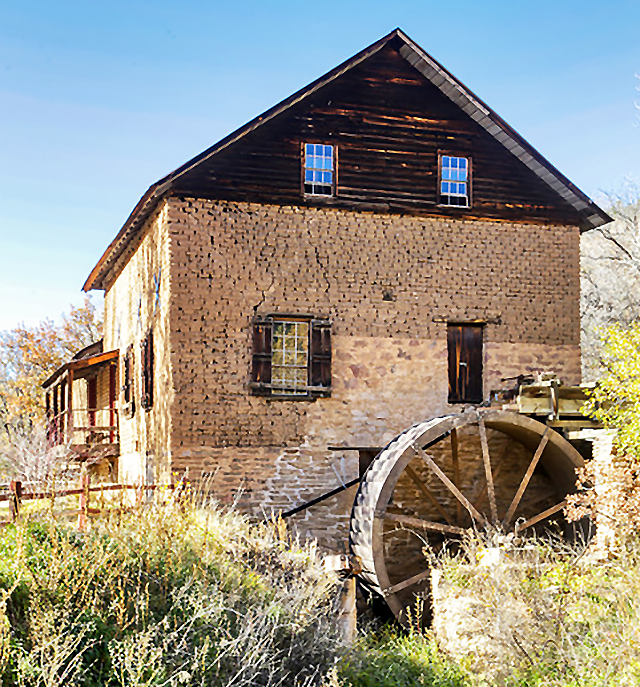 Big Wheel: On the east end of the Cleveland Roller Mill building is the large water wheel which turns continually when the mill is operating. The mill and building had fallen in disrepair but restoration began in the late 1970s when the mill was listed on the National Register for Historic Places. The 18-foot-6-inch wheel as well as the mill equipment have been restored and are operational during the Millfest, which takes place every Labor Day weekend (Aug. 30-31 in 2005). Photo by Gary Warren/ladailypost.com
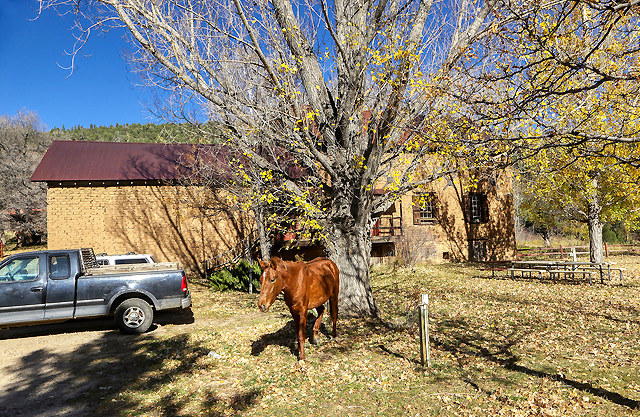 Local Visitor: A horse was passing through the grounds of the Cleveland Roller Mill the day we visited. The grounds offer picnic tables and a very pleasant setting. Earlier in the year the grounds would be covered in grass with ample shade from the cottonwood trees on site. We visited the mill in November just as the last of the fall leaves were about to drop to the ground. Photo by Gary Warren/ladailypost.com