
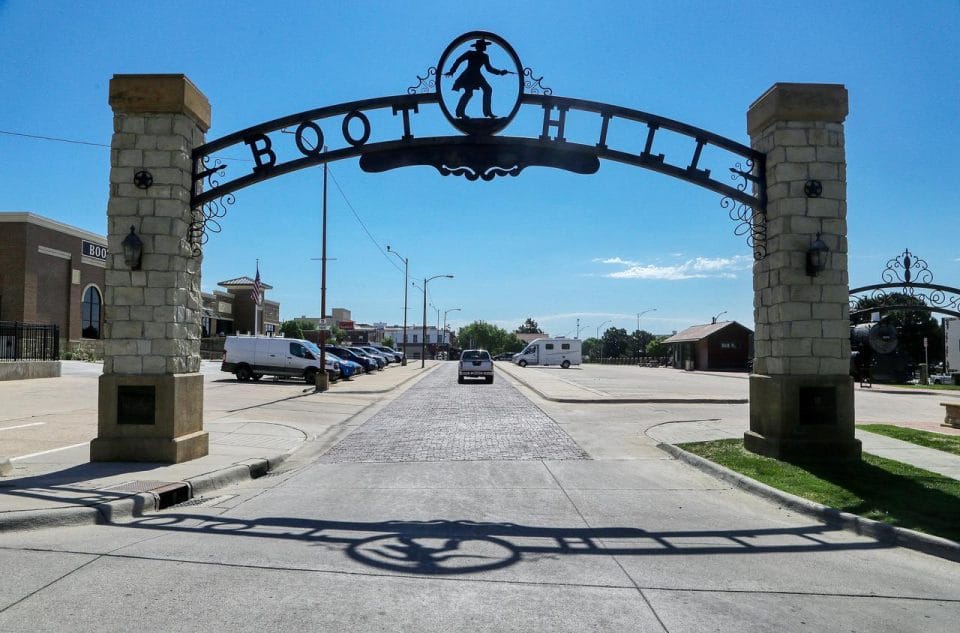
 Boot Hill: The entrance area to the Boot Hill Museum in Dodge City, Kan. More than 100,000 visitors visit the museum each year. The museum preserves the early history of Dodge City’s wilder days. Photo by Gary Warren/ladailypost.com
 Front Street: Businesses are lined up on Front Street in the Boot Hill Museum. A couple of blocks of the original Front Street from the 1880s were recreated as a part of the museum. The facades and business names in the set are the same as 1880s photos of the original town. In place of the dusty Front Street is a blanket of green grass, which is used for outdoor activities at the museum. Photo by Gary Warren/ladailypost.com
By GARY WARREN
Photographer
Formerly of Los Alamos
We have passed through Dodge City, Kan., a few times in our RV travels. Three summers ago, we spent some time in the town known for its wild history during the frontier era of the U.S. Famous frontiersmen such as Wyatt Earp, Doc Holliday and Bat Masterson are among those who have called Dodge City home.
The rough and tough early history of Dodge City attracted the attention of Hollywood when TV westerns were popular. The TV series Gunsmoke, featuring Marshall Matt Dillon played by James Arness was based in Dodge City. A radio version of Gunsmoke ran prior to the TV series.
Dodge City, Kan., is not the oldest town in the wild west era of United States history, but it may be one of the best known towns of that time because of its storied past. Dodge City was established in 1871 about five miles from Fort Dodge, a U.S. military fort on the Santa Fe Trail. As the country moved west, thousands of wagon trains used the Mountain Branch of the Santa Fe Trail to navigate their way westward. In addition, the Santa Fe Railroad was under construction and reached Dodge City in 1872.
Due to the popularity of the Santa Fe Trail and the railroad now in the area, Dodge City grew quickly. Within a year of its beginning, Dodge City had a general store, dance halls, numerous saloons, gambling halls and brothels. What was missing during that first year was any form of law enforcement and the “wild west” was born. The makeup of early Dodge City was buffalo hunters, railroad workers, cowboys who held cattle drives which brought thousands of longhorns from Texas, and drifters.
The combination of these groups in a lawless town led to a lot of fist fights, gunfights, and other forms of violence. There were so many fights and shoot-outs in the streets of Dodge City, a cemetery was created on the hill just out of town that became known as Boot Hill. Dodge City Kansas earned the title of “the wickedest town in the west” as a result of the lack of law enforcement and the gunslingers who passed through the town.
Town Marshalls were hired but didn’t stay or were killed. Finally, in 1876, the Town Marshall hired lawman Wyatt Earp. Not long after, four other lawmen were hired including Bat Masterson. Some law and order was established in the late 1870s and by 1880 the railroad had reached Santa Fe and the use of the Santa Fe Trail was greatly reduced. By the mid-1880s, the cattle drives from Texas ended and this era of Dodge City, Kansas was drawing to a close.
Today, Dodge City has preserved the early history of the wild days in Boot Hill Museum which sits next to the original site of the Boot Hill Cemetery. The city replicated a portion of Front Street (the main street) just as it looked in the 1870s. Thousands of artifacts from the frontier era have been collected and are included in the museum.
As visitors pass through the Front Street portion of the museum, some areas are used to sell water, sodas, and some gift items to visitors and the remainder of the area is a series of display spaces from the frontier days. These rooms contain exhibits that portray life during the frontier days and are furnished with items from that era. Visitors can also visit Boot Hill Cemetery, which is on a hill just beyond the recreated Front Street.
A modern city surrounds the historic district and Boot Hill Museum today. We were happy that we chose to stay in the area and learn about its place in the frontier era of the U.S.
Editor’s note: Longtime Los Alamos photographer Gary Warren and his wife Marilyn are traveling around the country, and he shares his photographs, which appear in the “Posts from the Road” series published in the Sunday edition of the Los Alamos Daily Post.
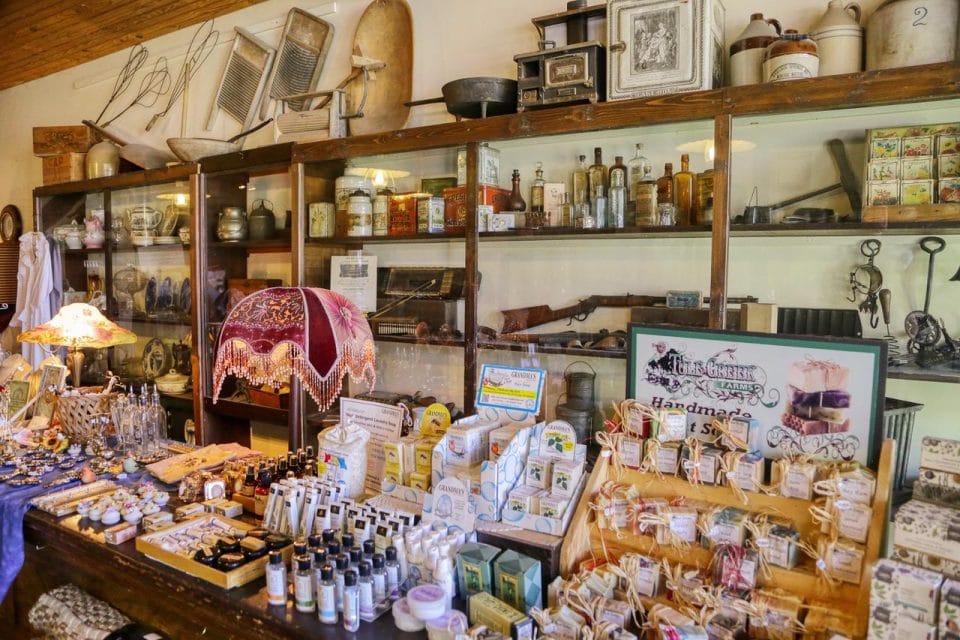 Shop and Museum: Behind the reconstructed Front Street facade are several of the Boot Hill Museum’s display spaces. In this space, the, counters offer goods for visitors to purchase while the walls are lined with items from the early days of Dodge City, Kan. Photo by Gary Warren/ladailypost.com
 Post Office: One of the spaces in the Boot Hill Museum depicts the Post Office from the 1880s. Other spaces include a dental office, a print shop, a clothing store, and more. Many guns and other weapons also are on display in the museum. Photo by Gary Warren/ladailypost.com
 Wagon Wheel: A detailed look at one of the wagons on display at the Boot Hill Museum in Dodge City, Kan. The museum has thousands of artifacts from the frontier era of the U.S. Photo by Gary Warren/ladailypost.com
 El Capitan: A life-size sculpture of a Texas Longhorn stands in a park area in Dodge City, Kan. The sculpture commemorates the Texas longhorns that cowboys brought to Dodge City in the 1800s. Several million head of cattle were driven from Texas to Dodge City in the 1870-1886 era. The cattle were loaded onto the railroad and transported from Kansas to points in the east. Also shown beyond the sculpture is a portion of the historic downtown Dodge City. Photo by Gary Warren/ladailypost.com