
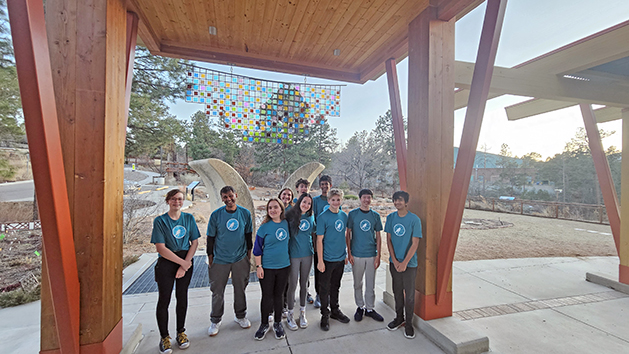
 Members of the PEEC Nature Youth Group. Photo by Ryan Rainmaker
PEEC NATURE YOUTH GROUP News:
The friendly neighborhood PEEC Nature Youth Group, is made up of nine high schoolers including Phoebe Reid, Zoe Bent, Celia Pesiri, McKenzie Gerlicher, Aditya Viswanathan, Suchir Jha, Tate Plohr, Sebastian Koglin and Adis Bock, who all share an interest in preserving the great outdoors in this amazing town. The group started working on several projects centered around solving environmental problems on both a local and global scale. From testing water quality in burnt areas to developing an effective way to deter wildlife and livestock interactions at our local stables, the group have many projects that apply science to societally impactful problems.
Here’s an overview of those projects:
Preventing Conflict with Predators:
The conflict between mountain lions and domestic animals poses a major challenge to Los Alamos County. Mountain Lions existed on the Pajarito Plateau long before the town of Los Alamos existed. With large populations of deer and other native wildlife, the mountain lion plays a critical role as the apex predator in the area. Unfortunately, if dogs and domestic cats are left outside unattended or other easy prey is available, conflict occurs. Either pets or livestock are killed along with the offending mountain lion. This conflict has occurred over the years at the local stables, where an abundance of accessible food is sometimes too tempting for mountain lions to ignore. The youth group met with Lisa Reader at the stables to better understand the problem. What initially sounded like a difficult problem to solve due to the size of the stables, and the number of open pens with easy prey, became a more manageable problem. Reader informed the group that attacks at the stables primarily occur on the canyon side, often only in pens with smaller livestock such as goats.
The youth talked to the Mountain Lion Foundation about potential mitigation ideas for this problem. A solution needed to be found that wouldn’t scare the livestock, or disturb people who often walk nearby while still deterring predators. They described a case in California where playing talk radio was quite effective in preventing lion attacks since they do not approach when human voices are nearby. For our stables, playing talk radio all night long did not sound practical. The group thought they would try to find a mitigation effort that would be more targeted. To do that the group would need to only play the talk radio when a lion approached. PNYG is trying to use a combination of critter cams to check when a lion is in the area, then use machine learning to analyze the photos in real-time to detect the lion and then activate the talk radio. This is a work in progress.
The youth have obtained 1000s of trail cam images of mountain lions and other wildlife from mountain lion expert Mark Peyton who worked for NPS at the Valles Calderas. This is perfect for training the group’s machine learning algorithms to pick out lions from all the other activity that occurs at the stables. If successful, the group would have a more targeted mitigation approach than currently exists. In short, mountain lions are being killed far too often in the county, and the hope is to improve the situation. Because of this, the group decided that creating an effective deterrence system to keep both livestock and the cougars safe was a solution that would greatly benefit our town.
In addition to this project, there are two others that the youth want to begin working on as spring approaches. These are fairly ambitious projects, so they will likely continue next year.
Fire project:
In recent years, wildfires have been getting more severe and frequent. Nine out of 10 wildfires are human-caused due to a lack of awareness about prevention. The PEEC Nature Youth Group is working to inform the public to help preserve our ecosystem. One important aspect of fire prevention is researching the effects of fire on wildlife. The plan is to use trail cameras to determine the difference in wildlife populations in burnt and unburnt areas. By releasing this data to the public, the group will help people understand the effects of wildfires on the local ecosystem. The youth also plan to publish an article with tips on preventing accidental fires.
Water Quality Testing Project:
Due to human use of natural lands and forest fires, water quality in the area has the potential to be detrimentally affected. The PEEC Nature Youth Group is working to find and test local water quality to identify potential problems, where they are, and where solutions need to be found. The group will then work to identify possible locations that may need physical water cleanup and work to do so.
In conclusion, the PEEC Nature Youth Group aims to better the Los Alamos ecosystem with science-informed innovative solutions. Wildfire prevention, water quality testing, and protecting wildlife are all important goals we are striving to achieve. By combining service projects with STEM-based research, it is protecting the community.
About PEEC
PEEC was founded in 2000 to serve the community of Los Alamos. It offers people of all ages a way to enrich their lives by strengthening their connections to our canyons, mesas, mountains, and skies. PEEC operates the Los Alamos Nature Center at 2600 Canyon Road, holds regular programs and events, and hosts several interest groups, from birding to hiking to butterfly-watching.
If interested in learning more, visit the PEEC website at Peecnature.org for all the details on our projects and the Nature Youth Group.