
 By NICHOLAS THOMPSON, Ph.D.
R&D Engineer
Los Alamos National Laboratory
Los Alamos County is implementing two changes to how electricity will be billed. Both of these changes are aimed at reducing the peak grid demand, which is an important goal given how electricity demands are increasing. However, these changes can also result in higher bills for consumers and one of these changes is at odds with the County’s Climate Action Plan.
The first change is known as “Time of Use” rates. The idea here is to reduce demand as much as possible during peak usage times. In general, electricity grids need to be designed to meet electricity demands at all times, including the absolute peak demand. However, most of the time, the utilization is much lower than the peak demand, as the peak demand in a year might only happen for a few hours.
Figure 1 below is a graph from the US Energy Information Agency showing what this demand curve looks like at different months of the year by region. This results in a grid that is over-built for most normal conditions, which costs a lot of money. Reducing peak demands can help to reduce the amount of investment needed in the grid, while also reducing the likelihood of a blackout.
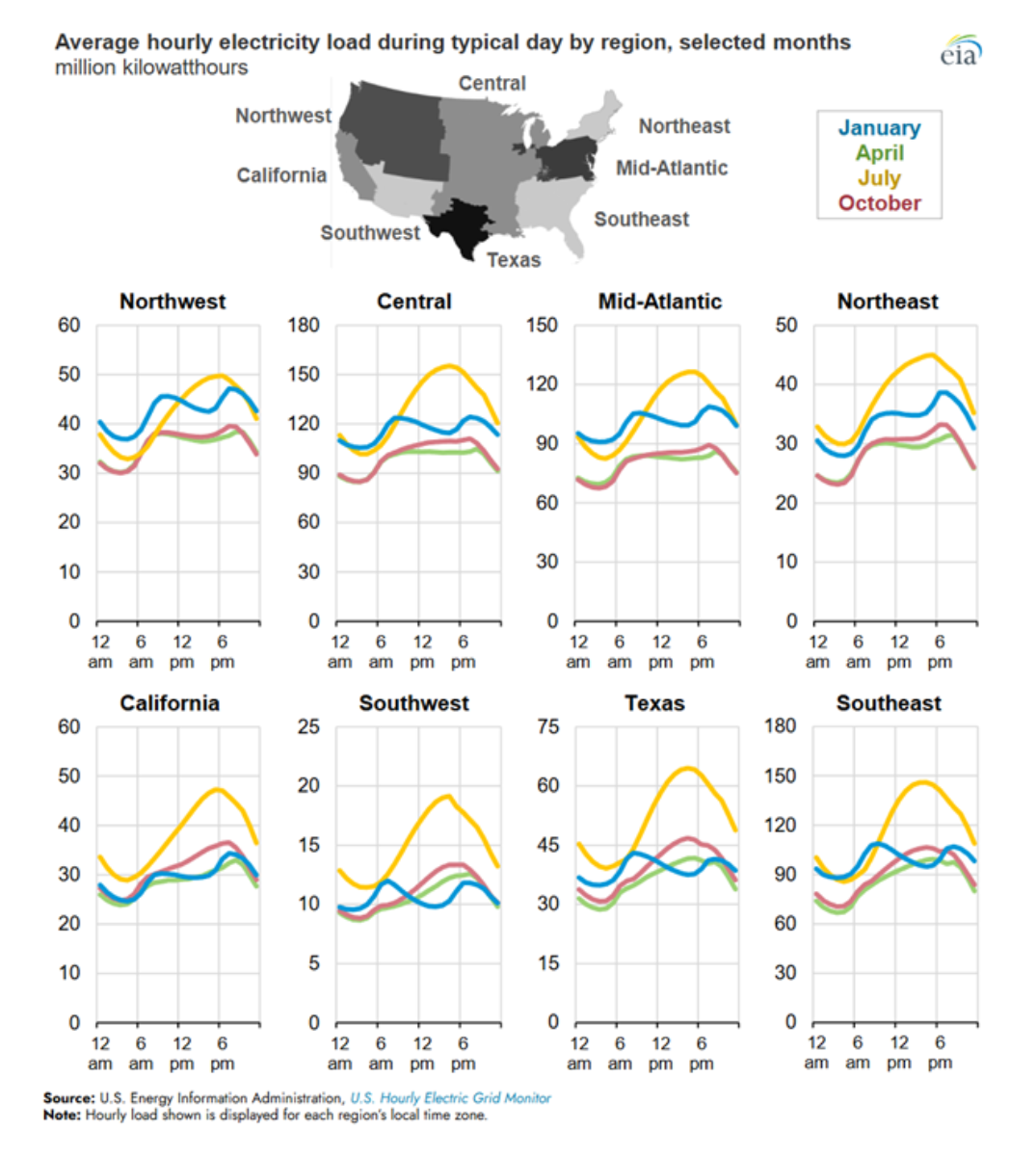
Figure 1: Average Hourly Electricity Load by Region – US EIA
The way Time of Use rates will work is electricity consumed during “On Peak” hours (5-11 p.m.) will be charged a higher rate than electricity used during “Non Peak” hours (any other time). The difference in price will be pretty large – 11 cents/kWh for “Non Peak” and 19.7 cents/kWh for “On Peak”. For comparison, the current electricity rate is 14.63 cents/kWh. Depending on your usage pattern, this may actually lower your electricity bills, or it could raise them substantially (for example, if you get home from work and start your dishwasher and laundry machines during peak hours). In general, I’m supportive of Time of Use rates as it can help to smooth out the load profile on the grid and reduce peak demand.
The second change is known as “Residential Demand”. Instead of being based on when the electricity is being used, this just looks at the highest single hour of electricity demand that month and adds a charge based on that. The idea here is to discourage “appliance stacking”, or running multiple appliances at once. In the County’s examples, they compared two houses, one with a highest hour demand of 3 kW and one with 6 kW. The charge will be $1 per kW (based on the highest hour of demand), so the house where 3 kW was the highest will get an extra charge of $3 and the house with 6 kW would have an extra charge of $6. This might not sound like a lot, but consider someone with an electric vehicle. Many EV owners have installed a “Level 2” charger at their house, some of which can pull a continuous load of 11.5 kW. I happen to be one of those people. My EV charger is by far the largest electrical load I have for my house.
Just to see how big of a hit this was, I downloaded my hourly data for the last year and analyzed it. I got my EV at the end of October, so this gives a nice comparison. As is shown in Table 1, before I got an EV, my highest single hour of utilization for a month was between 4.8 and 5.9 kW (average of about 5.5 kW). But after I got an EV, my highest single hour of utilization was consistently above 13 kW, with a peak of 16.78 kW in January (average of about 14.5 kW). This means the new demand charge, which would be $5.5 a month if I didn’t charge my car at home will now be $14.5 a month. Over the course of a year, that’s over a $100 difference (from $66 to $173).
It should be noted that most months, there were only a few hours in the highest kW bracket. For example, in May of 2025, my highest hour was 16.16 kW, but that was the only hour above 16 kW. It was a similar situation in January, where my highest single hour was 16.78 kW, but that was the only hour that month above 16 kW. This is represented in the second data column in Table 1 and can be seen in Figures 2 and 3. It also should be noted that even if I turned off all my other breakers, just using my car charger would result in a higher Residential Demand charge than before I had my EV – so this isn’t a case of appliance stacking.
Table 1: Highest Hourly Usage by Month
| Highest Hourly Usage [kW] | Hours at highest kW | |
| Aug-24 | 5.75 | 2 |
| Sep-24 | 4.87 | 5 |
| Oct-24 | 5.93 | 1 |
| Nov-24 | 13.35 | 5 |
| Dec-24 | 16.58 | 1 |
| Jan-25 | 16.78 | 1 |
| Feb-25 | 13.61 | 4 |
| Mar-25 | 15.96 | 3 |
| Apr-25 | 13.79 | 11 |
| May-25 | 16.16 | 1 |
| Jun-25 | 14.02 | 2 |
| Jul-25 | 13.05 | 2 |
| Aug-25 | 13.85 | 6 |
Figures 2 and 3 are histograms of the number of hours there was a certain demand, split by increments of 1 kW. In Figure 2 below, you can see most of the time my utilization was 2 kW or less, but a few hours in the month it was above that, and one hour it reached 5.93 kW, so the Residential Demand fee would be based on that one hour. This also demonstrates how charging an EV can lead to a few hours of very high utilization – Figure 2 is from before I had my EV and Figure 3 is from when I was charging at home regularly. As you can see, the shape of the two distributions is pretty similar, except that once you add the EV charging, there is a long tail out to 16 kW.
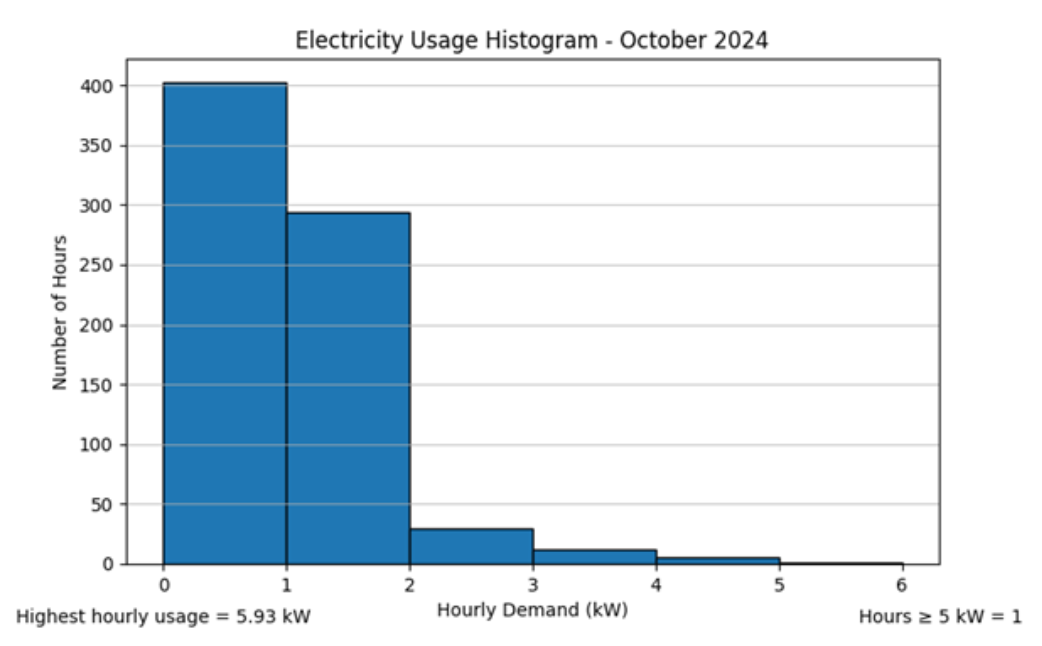 Figure 2: Electricity Usage Histogram, October 2024
 Figure 3: Electricity Usage Histogram, May 2025
On average, I use about 250 kWh charging my car at home each month, which (with the new “Non Peak” rate) translates to about $27. This new Residential Demand charge will effectively add $9 to the cost of charging my car per month, which basically means it’ll now be 33% more expensive to charge my car at home (since if I didn’t charge my car at home, I wouldn’t have the additional Residential Demand charge).
Now, it is possible to reduce the charging rate of my EV charger (which I might do) but there are times when being able to charge my car ‘quickly’ is very useful. For example, there are weeks when I drive to Albuquerque and back every day. For my car, which is relatively efficient, this uses about 67 kWh for the 200 mile round trip drive in the winter. If I wanted to charge my car back up for the next morning, right now it would take about 6 hours at 11.5 kW. If I want to charge my car back up within 8 hours, I would need to charge at 8.33 kW, slightly lower than the 11.5 kW, but would still result in an increased Residential Demand charge.
As I said before, Time of Use rates are designed to shift utilization to “Non Peak” hours. This would change when I decide to charge my car – for example, I might plug in my car after 11 pm or set it to start charging at 11 pm. If the Time of Use rates work in reducing peak demand, then the Residential Demand charge is not necessary. Put another way, charging my car might be the largest single load at my house, but that additional 11.5 kW is far too small to cause any issues to the overall electrical system. The only time this could be an issue is at times of peak demand, which is the point of Time of Use rates.
The Residential Demand charge will also be difficult for people to act on. Time of Use rates are simple – electricity costs more during these set hours of the day. So someone may decide to do laundry on a weekend morning instead of a week night, or may use the ‘delay’ option on their dishwasher to start it after 11 pm. But people trying to lower their Residential Demand charge will have a much harder task – it requires knowledge of the power draw for every appliance and system in their house. Would running the dishwasher at the same time as the washing machine trigger a higher hourly demand than just running the clothes dryer? What about the induction stove? If the heat pumps are running on a cold morning, should I wait until later on in the day to take a shower? Should I wait until halfway through the hour to start the dryer, because then the utilization will technically be split over two hours? Without careful study and analysis of each appliance, it’s very difficult to know how much power is being used and when.
According to the County, the combination of Time of Use rates and Resident Demand charges is designed to be revenue neutral. If this is true, then owners of EVs and homeowners who have electrified their houses (who will be paying higher Residential Demand charges) will effectively be subsidizing everyone else (since the system is revenue neutral).
So not only is the Residential Demand charge not necessary and difficult for homeowners to act on, but it punishes people who have bought EVs and made other steps to electrify their houses (like installing heat pumps and induction stoves), which runs counter to the County’s Climate Action Plan. The Climate Action Plan explicitly calls for an increase in EV adoption and electrification as ways to reduce air pollution and emissions. We should be incentivizing people to electrify their houses, not penalizing them for using more electricity.
There is another side to this story though – people who have installed solar and/or batteries at their house. Time of Use rates are a recognition that it’s effectively more expensive to produce and deliver electricity during “On Peak” hours. So people who’ve installed solar and/or batteries should also be compensated at a higher rate for the electricity they sell back to the grid during those peak times. This is not currently in the County’s plans, but could be a nice incentive to install solar and/or batteries at home. If the rate for energy supplied during “On Peak” hours higher than the “Non Peak” rate for consumption, this would allow for arbitrage (eg charging batteries during “Non Peak” at 11 cents/kWh and selling at “On Peak” for 14 cents/kWh) and could really bring down net load and further reduce the stress on the grid.
I must admit I’m a little late to this party – I only recently found out about this change last week, even though it was discussed at the Board of Public Utilities on April 16, 2025, and the County Council on June 10, 2025 (and apparently has been in the works for two years). However, I doubt I’m alone in not knowing about this, and since the implementation is still many months away (implementation is scheduled for no sooner than July 2026), I’m hoping changes can still be made to the rate structure. The same votes that approved these changes also included rather large increases in the electricity rates and service charges for this year and next year – these increased rates are required due to the budget shortfall the DPU Electric Fund has (it lost money in three of the last four years). So I understand that changes are necessary, especially ones like Time of Use, which will help reduce the amount of additional infrastructure needed. But Residential Demand charges do not seem like a good solution and are not aligned with the other goals of the County.
To summarize:
1) The new Time of Use rates are a useful tool to shift demand to “Non Peak” hours. This is good because it reduces the need to overbuild the grid (which is expensive and the costs get passed onto us).
2) The new Residential Demand charge is not a useful tool for shifting demand to “Non Peak” hours, and penalizes people who have EVs and/or have made steps to electrify their homes while subsidizing those who haven’t made those investments. This is counter to the county’s Climate plans of increased EV utilization and electrification. It’s also difficult to act on as homeowners typically do not know how much power each appliance is using and what combinations will lead to a higher fee.
3) Time of Use rates should also apply to electricity supplied to the grid – during “On Peak” hours, energy supplied should be compensated at a higher rate. This would also incentivize people to get batteries, which would help the grid.
4) My proposed plan would be to keep the Time of Use rates, remove the Residential Demand charge, and create a higher “On Peak” rate for electricity supplied to the grid.