
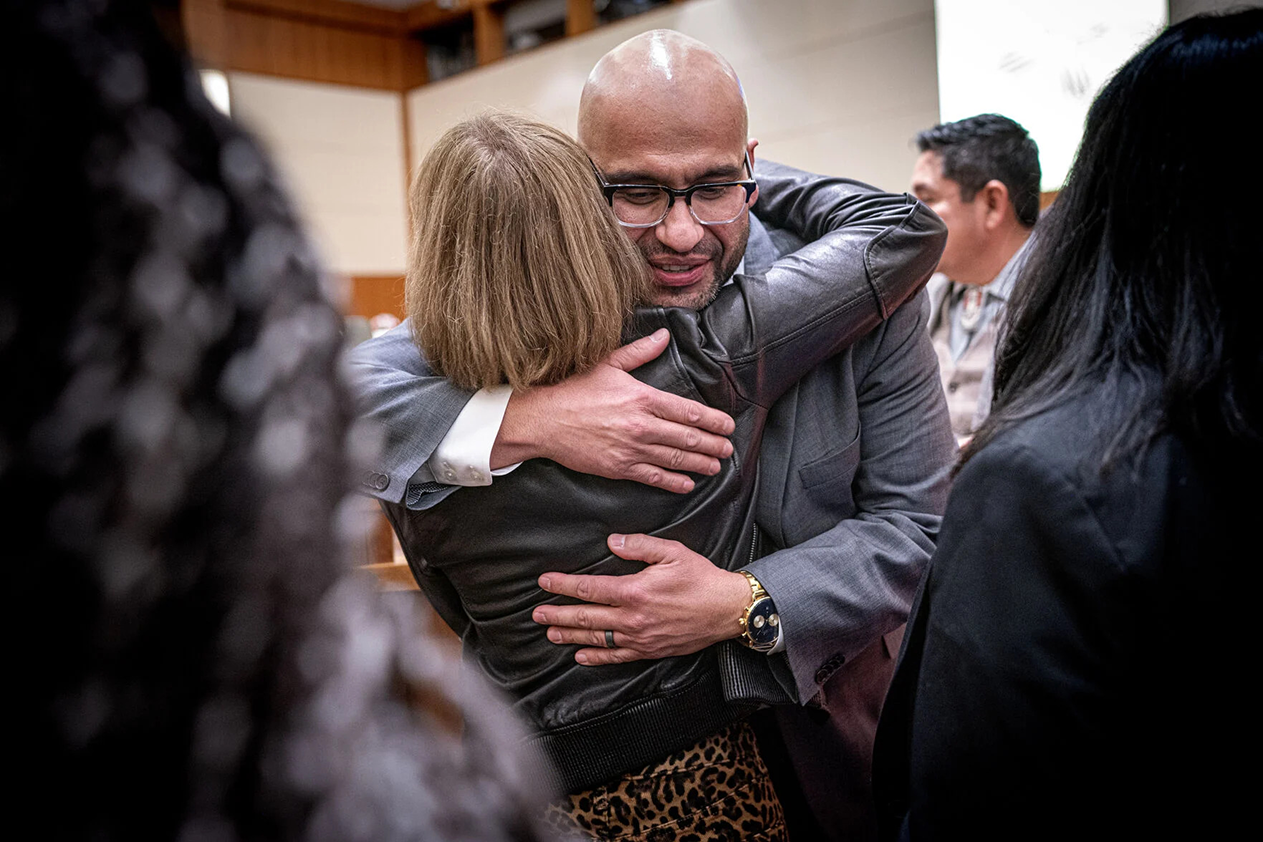
 State House Speaker Javíer Martinez, D-Albuquerque, and Rep. Christine Chandler, D-Los Alamos, embrace following a Democratic news conference at the Capitol after the 2026 legislative session ended Thursday, Feb. 19, 2026. Gabriela Campos/The New Mexican
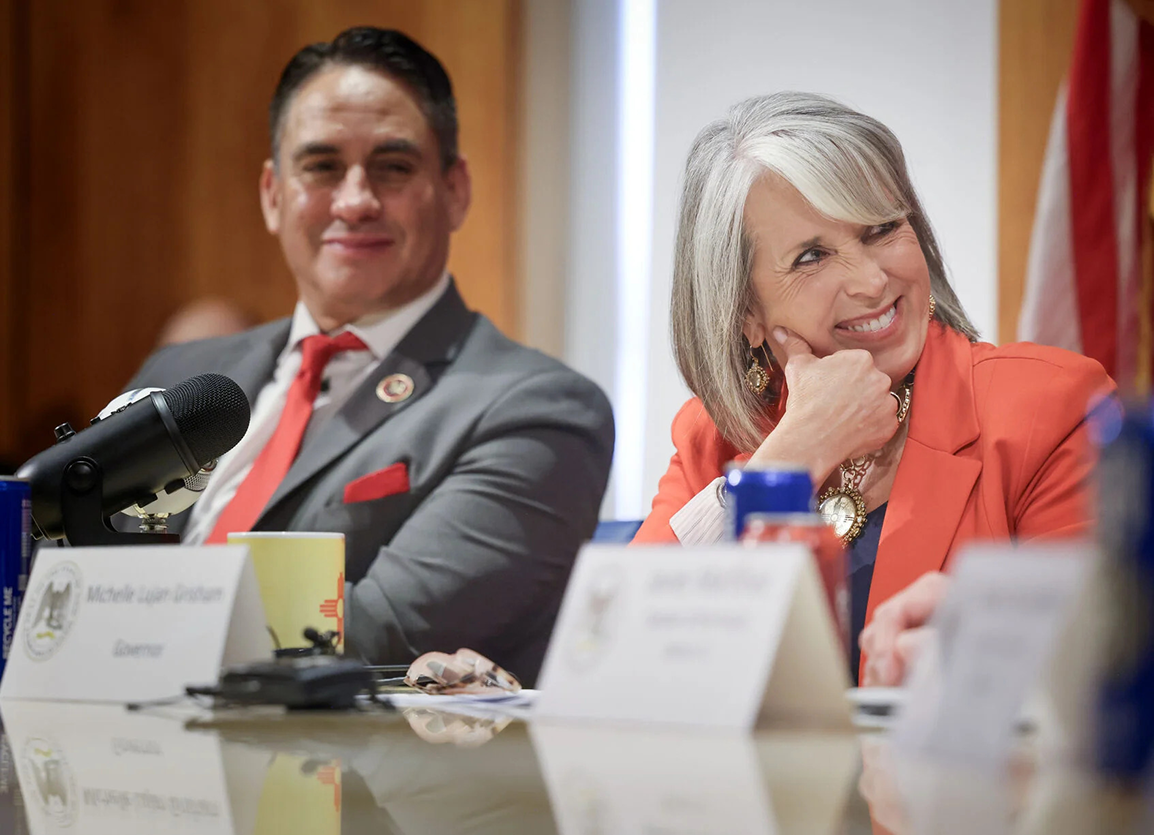 Gov. Michelle Lujan Grisham laughs while listening to final comments made by members of the House of Representatives during her final news conference to conclude the 2026 legislative session on Thursday, Feb. 19, 2026. Gabriela Campos/The New Mexican
By DANIEL J. CHACÓN and CLARA BATES
The Santa Fe New Mexican
In years past, Gov. Michelle Lujan Grisham has made no qualms about her disappointment in the New Mexico Legislature for failing to deliver on her priorities during a legislative session.
Not Thursday.
At the end of the last 30-day session of her tenure, Lujan Grisham sounded a celebratory tone after scoring several major victories, including an overhaul to the state’s medical malpractice law, designed to reduce costs and risks for doctors and keep more of them in the state; a ban on local governments contracting with the federal government for immigrant detention; and her marquee bill: no-cost child care for all.
“We kid about how the last session for any governor and any body of legislators is zero fun, that there’s just a lot of tension. There’s no appetite for big, new initiatives, and this session was not like that at all,” the governor said during an end-of-session news conference in her Cabinet room at the Capitol, flanked by Lt. Gov. Howie Morales and Democratic leaders from both chambers.
Lujan Grisham credited lawmakers, saying it “has nothing to do with” her and “everything to do with the way in which these legislators keep delivering for New Mexico.”
“I want to be in a position in front of every New Mexican to tell them thank you because it’s not easy,” she said. “I’m not easy.”
To be sure, Lujan Grisham didn’t get everything she wanted.
The governor said she was disappointed her public safety agenda — including a proposed ban on certain types of semiautomatic guns — and environmental protections under a contentious proposal to codify emission reductions goals she set for the state didn’t make it across the finish line.
“I think there’s a lot more public safety that we have to do,” she said, including cracking down on juvenile crime.
A proposal that would have expanded the definition of a “serious youthful offender” — a legal category under which juveniles are automatically sentenced as adults — passed out of the Senate Judiciary Committee but didn’t get a vote on the Senate floor.
But the governor’s top priority of the session — taxpayer-funded universal child care — is set to become law.
‘For children and families’
At the start of the session, lawmakers predicted a battle with the executive over universal child care, which wasn’t fully funded in the budget recommendation issued by the Legislative Finance Committee. But as the session went on, the two sides developed a proposal to fund the governor’s highly touted initiative.
The proposal will allow the Legislature to spend an additional $700 million from the Early Childhood Education and Care Fund over the next five fiscal years to shore up the initiative — without requiring any copays for wealthy families, unless certain triggers, such as a recession or a big drop in oil prices, kick in.
“I leave tonight to D.C. because counties and cities want to know exactly how we did it,” said Lujan Grisham, who is scheduled to speak at a National Association of Counties legislative conference in the nation’s capital about New Mexico’s child care initiative.
“They want to start looking at their economic opportunities to do the very same thing,” she said.
At the end of her news briefing, Lujan Grisham lauded New Mexico’s status as the first state in the nation to enshrine taxpayer-funded universal child care into law.
“It’s the combination and the wisdom from both chambers that built universal child care, so that I get to say I’m the first governor of the first state in the nation to truly deliver for children and families,” she said.
“That’s a beautiful place to end this great press conference,” she said, generating applause.
‘Crying out for action’
Ever a jokester, Lujan Grisham capped off the briefing with humor.
“Champagne downstairs in Peter Wirth’s office!” she announced jokingly.
Wirth, the Senate majority leader, described the 30-day session as “hard charging” and “very productive.”
“We came … right out of the gate with a $1.5 billion road bonding package, two [interstate] medical [licensure] compacts and a bill to close ICE detention facilities, and we did it in the first two weeks,” said Wirth, a Santa Fe Democrat.
Wirth noted the emphasis on health care, including medical malpractice law changes, money for a new medical school at the University of New Mexico and a $10,000 tax credit for physicians.
“Taken together, I think we really responded to constituents throughout New Mexico that were crying out for action on health care,” he said. “The universal child care, a signature accomplishment of this administration, to get that done with appropriate guardrails, I think, is part of the legacy that you will leave with.”
Wirth also noted the Legislature passed an $11.1 billion budget that kept recurring spending under 3% “and yet we accomplished what we needed to do.”
The Legislature also passed a tax package that reinstated 1% raises for state workers that had been stripped from the proposed budget by the Senate, which Lujan Grisham called “kind of an odd vehicle to do that.”
“The tax package in general has a lot more good than things that give us giant concern,” she said when asked whether she would line-item veto any provisions. “But we’ve got to read it and look at it and think about it.”
Mixed results on crime
Many of the governor’s priorities were measures that had failed to make it across the finish line in previous sessions.
Entering her final 30-day session, Lujan Grisham made clear public safety would again be a priority.
The Legislature passed a proposal that will make it easier to force people into mental health treatment under the involuntary civil commitment process, something the governor had pushed in recent years, citing concerns about rising levels of mental illness and families’ frustration about their lack of options. Advocates have raised concerns about the implications for New Mexicans’ constitutional freedoms.
Lawmakers also removed the statute of limitations for certain child sex crimes.
But, as has been true in previous sessions, many of Lujan Grisham’s other public safety priorities stalled.
Senate Bill 17, which would have increased regulations on gun dealers and banned certain types of semiautomatic weapons, including AK-47s and AR-15s, passed the Senate but died earlier this week in the House Judiciary Committee.
The Legislature failed to increase the penalties for being a felon in possession of a firearm and reckless driving.
Another crime bill, one inspired by the overturning of a Santa Fe murder conviction last year, appeared poised for passage — but died in the Senate on Thursday morning amid a flurry of last-minutes debates.
Senate Bill 100 would have changed the definition of “structure” in the state’s burglary statute to include an outdoor portal on a home. The measure stems from the 2023 conviction of Joseph Jones in the 2018 killing of Robert Romero of Santa Fe, who prosecutors said was fatally shot on a back portal.
Jones’ first-degree murder conviction was overturned in 2025 when the state Supreme Court found that entering the portal did not constitute aggravated burglary, an element of Jones’ murder charge.
The Senate passed SB 100 and sent it to the House, which approved an amended version after midnight Thursday that didn’t sit well with senators when they convened later in the morning. They declined to concur with the changes, arguing the House’s definition would go too far, potentially exposing anyone in a fenced or gated area to a burglary charge.
‘Leadership is about service’
House Speaker Javier Martínez, D-Albuquerque, called this year’s session “one of the most consequential legislative sessions in my time, 10 years here in the Roundhouse.”
Martínez hailed the Legislature’s accomplishments on health care as well as the passage of House Bill 9, which bans local governments from contracting with the federal government to hold immigration detainees or to help with civil immigration enforcement.
“It’s actually going to make our communities safer, because it reassures our immigrant brothers and sisters and family members that they don’t need to be afraid to seek support from local law enforcement,” Martínez said.
Martínez also heralded the bipartisan passage of punitive damage caps in medical malpractice cases, funding for universal child care and the House’s work to add 1% raises for state employees back to the budget.
“It was your House Democrats who stepped up to figure out how to get it done. Props, Chairman [Derrick] Lente, Chairman [Nathan] Small, for their quick and thoughtful work to reinstate those well-vetted and much-needed raises,” Martínez said.
House Majority Leader Reena Szczepanski, D-Santa Fe, lauded the passage of two interstate licensure compacts — one aimed at making it easier for out-of-state doctors to practice in New Mexico and one for social workers — but said it was “disappointing” eight others for a range of medical professionals, from physical therapists to psychologists, didn’t make it through the Senate.
“With all of the work that we have put in, we are now in a strong starting place to come back next session and hopefully get these over the finish line,” she said.
After gaveling out at noon, the Senate ended the session by sharing well-wishes — notably for Morales, who this year presided over his last regular legislative session. Republicans gifted Morales, a Los Angeles Dodgers fan, some baseball cards and a ball.
“You don’t have to throw us any more curveballs now,” joked Senate Minority Leader Bill Sharer, R-Farmington. “This one is just a straight fastball.”
In a speech reflecting on his tenure, Morales recalled how, when he first assumed the position, some people worried he would be too nice to serve as president of the Senate.
“Leadership isn’t about pounding your chest and conquering others,” he said. “Leadership is about service and providing that support whenever it’s needed.”
‘Disappointing things’
Republicans in a news conference Thursday celebrated successfully blocking a pair of gun and climate change bills.
House Minority Leader Gail Armstrong, R-Magdalena, called blocking SB 17 “one of the biggest wins” for the party this session, crediting “the many New Mexicans who stepped forward to help kill the gun legislation.”
Sharer called SB 17 “one of the most — the most — unconstitutional bills to come before us.”
As for the Clear Horizons Act — which would have codified the governor’s emission reduction targets and was voted down in the Senate when seven Democrats joined the GOP to oppose it — Sharer called it “one of the most economically devastating bills that’s ever come before us.”
Republicans also praised the medical malpractice overhaul.
“Republicans have been touting for five years that the medical malpractice [law] was broken, and I want to make sure that everyone knows who broke it,” Armstrong said.
“The Democrats broke medical malpractice,” she added.
Republicans decried HB 9, the Immigrant Safety Act, as a job killer and said the funding lawmakers approved in the last days of the session to help communities ending contracts with U.S. Immigration and Customs Enforcement is insufficient. Some noted 1,000 jobs will be lost if the state’s three ICE detention centers close.
“This is probably the worst bill that has ever passed this Legislature this session,” said Rep. John Block, R-Alamogordo, whose district includes an immigrant detention center. “And so, hopefully together, we can stop the bleeding.”
The measure continued to generate bad blood between Democrats and Republicans in the final hours of what was otherwise a generally cordial session.