
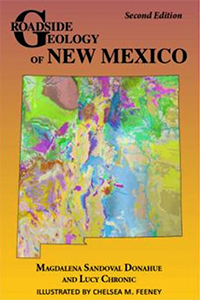
 New Mexico geologist and author Magdalena Sandoval Donahue published her second book, Roadside Geology of New Mexico, in April. Courtesy photo
 By KIRSTEN LASKEY
Los Alamos Daily Post
kirsten@ladailypost.com
“Growing up in Los Alamos, I learned a lifelong learning philosophy and have a continuous curiosity about how things work. ” –Magdalena Sandoval Donahue
New Mexico geologist and author Magdalena Sandoval Donahue’s origins as a rockhound are right here in Los Alamos.
She explained that it was while working as a summer intern at Los Alamos National Laboratory alongside her best friend’s father, who was a geologist, that she realized geology “was pretty much the best job on the planet.”
Donahue said she loved having the opportunity to get outside, hike and draw maps. Her passion for geology was so strong she decided to add a geology degree to her art major.
Donahue attended the University of Oregon as an undergraduate and earned her master’s and PhD in Earth & Planetary Sciences at the University of New Mexico.
Although she lives in Albuquerque, Donahue said she stayed in touch with one of her professors in Oregon, who was writing a book. This professor said their publisher was looking for someone to write a book on Colorado geology and referred Donahue as the person to write it. So, in 2021, Donahue published “Colorado Rocks! A Guide to Geologic Sites in the Centenial State” through Mountain Press.
Now, she has turned her attention and writing to the geology in her home state of New Mexico. Donahue, along with co-writer Lucy Chronic and illustrator Chelsea Feeney, released “Roadside Geology of New Mexico” in April.
Donahue said the book had been in the works for a while. It is the second edition; Chronic’s mother wrote the first edition, but it was several decades old and science has come a long way in that time, Donahue said.
Initially, Chronic headed the project for the second edition but family responsibilities pulled her away and Donahue assumed the role as lead writer on the book.
The book is a roadside guide to the state’s geology, Donahue said, adding more scenic byways and tourist destinations such as the High Road to Taos and the Turquoise Trail. She also strove to include every state and National Park included within New Mexico’s boundaries, and over 100 illustrations, cross sections and photographs.
“Our state parks are valuable resources and people come from all over the world to visit New Mexico’s landscapes,” Donahue said.
Writing was a lengthy process; Donahue said it took six years to complete the book. However, having one published book under her belt made the process smoother, she said.
“It was easier in that I kind of knew how to interact with a publisher and an editor,” Donahue said. “I also think that having collaborators this time … (was a plus) … I learned a lot and it was smoother sailing writing the second time …”
All three collaborators live in different states. Chronic resides in Idaho and Feeney lives in Montana. Still, Donahue said she collaborated with Fenney to tie all the maps and figures together and worked to ensure that all the visual details are technically consistent.
“We really had a nice collaboration through the process … it turned out to be a really robust book,” Donahue said.
One of the ways it is robust is that the book focuses on the geological sites in the state by the mile. Donahue explained the book showcases mile by mile what people can see in terms of geology. She added that it is also geared toward the layperson by explaining the basic geology of the region.
The idea, Donahue said, is that as one travels through New Mexico, they can see and identify the huge diversity of geological formations and landforms.
“It is a lot of trying to communicate what our landscape is made of and why it is shaped the way it is,” she said.
New Mexico is such a great subject for a book on geology because not only is a lot of its geology visible, but it is some of the most diverse in the world, Donahue said. She further noted that the state has some of the oldest rock formations in the continental U.S. as well as some of its youngest rocks.
“We have so many geologic areas … Great Plains, the Rio Grande rift, the Rockies and plateaus,” Donahue said. “We are the juncture point of all these geologic areas.”
Not only that but New Mexico has fossils and extensive mining history that continues today.
“New Mexico has it all,” Donahue said.
A few places spotlighted in the book that Donahue recommends travelers check out include White Sands National Park and a little closer to home – the Jemez Mountains. Another great place to take in almost every type of geology at once is the very top of Sandia Crest.
Donahue plans to continue writing, and is working on a handful of book proposals.
“One of the most interesting parts of writing a comprehensive guide like the Roadside Geology book is that it requires a lot of curiosity,” Donahue said. “Growing up in Los Alamos, I learned a lifelong learning philosophy and have a continuous curiosity about how things work. I think being exposed to the amazing landscape of Northern New Mexico and having a curious mind set … was instrumental in setting me forward on a scientific life pathway. I really enjoy sharing this with a wider audience.”
Roadside Geology of New Mexico can be purchased at all online book sellers and Mountain Press Publishing. It can also be purchased on Amazon as well as at the Pajarito Environmental Education Center’s gift shop inside the Los Alamos Nature Center.
More information about the author can be found at www.magdalenadonahue.com.