
 Aspen Studio Apartments are one of the two properties Los Alamos County is considering offering as affordable housing through a private/public partnership with 9th Street Apartments, LLC. Photo by Kirsten Laskey/ladailypost.com
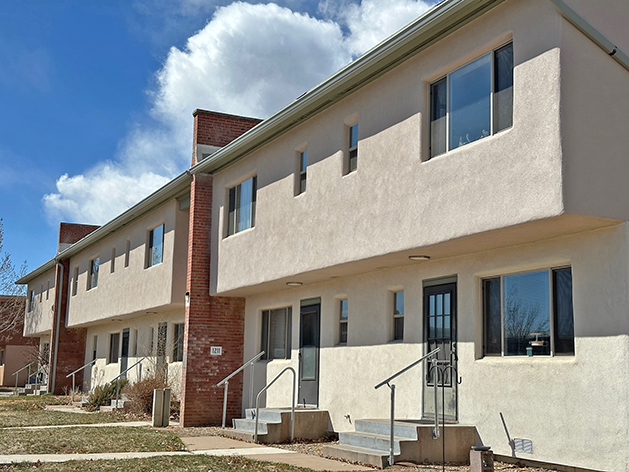 Thunderbird Apartments is the second apartment complex being considered for affordable housing. Photo by Kirsten Laskey/ladailypost.com
By KIRSTEN LASKEY
Los Alamos Daily Post
kirsten@ladailypost.com
Affordable housing has been a long-time theme in Los Alamos. It has been investigated and discussed constantly but during the March 11 Los Alamos County Council meeting, a concrete plan was presented to expand the County’s affordable housing options.
This plan suggests a public/private partnership to purchase deed restrictions on existing apartment units to provide them to income qualified tenants at below market rates for 20-years.
Acting Community Development Director Dan Osborn explained what this partnership would entail. The partnership would include the County and 9th Street Apartments, LLC.
Through this partnership, he explained, 24 studio apartment units in the Thunderbird Apartments, 1211 11th Street, and 63 units in the Aspen Studio Apartments, 1027 9th Street, would be deed restricted at less than or equal to 45 percent of the area median income (AMI) for 20 years.
“This project is to provide affordable housing for income qualified households … (it) provides more diverse housing options for low- and moderate-income households,” Osborn said.
The justifications for this project are numerous. For instance, Osborn noted that rent prices for existing studios to one-bedroom apartments are steep.
“We took a pretty broad look at available units across the community – there’s a pretty wide range – the top is very expensive and there is not very many of them available,” he said.
Osborn reported in general, rent for studio and one-bedroom units in the County range from $1,250 to more than $2,900 per month. Furthermore, Osborn said that a recent analysis of 10 multi-family properties with studio and one-bedroom units in proximity to the proposed affordable units indicated rents ranged from $925 to $2,931.
Additionally, he said that by preserving existing units, this proposal will immediately provide permanently affordable long-term units. This saves time and money. Council Chair Theresa Cull asked what the cost would be to construct housing from scratch and Osborn estimated it would range from $250,000 per unit, at the very low end, to more than $400,000 per unit.
Not only are the rental prices high but there is low availability and long waiting lists, he said.
As an example, Osborn reported that the Canyon Walk and The Bluffs housing developments have approximately 100 individuals on their waiting list.
There is not only a high demand for rental properties but also for housing vouchers; Osborn said 83 individuals utilize vouchers and there are another 124 on the waiting list. The wait time is up to two years, he added.
The proposed partnership could alleviate some of the demand and offer affordability, Osborn said.
“This public/private partnership which represents a significant opportunity to achieve the council’s goal by leveraging private investment capital with affordable housing grants that will allows us to preserve these units,” he said.
Osborn broke down how it would work: For renters making 45 percent AMI or less, rent would be 30 percent of their monthly income.
Rents are set for year one through year seven, Osborn said. It would be restricted to approximately 35-40 percent of the AMI for new residents. According to a table in his presentation, the average rent for year one would be $900; year two the average rent would be $945, then $992 in year three, $1,042 in year four, $1,094 in year five, $1,138 in year six and $1,183 in year seven.
“I would like to note that those rents are set between that 30, 38 and 43 percent, which are below that target AMI, so I think that is a bonus and a plus to the community and to this project and our participation,” he said.
Regarding the rents starting year eight through year 20, Osborn reported that “income qualified residents will be restricted to those making at or below 45 percent AMI with the rents then set to 30 percent of the qualified incomes.”
The rent could increase no more than seven percent each year, he added.
So, if a person is making 45 percent of the AMI, then they are earning $49,230, Osborn said. To calculate their rent, it would be 30 percent of their annual income or $1,233 a month. Those making less, would pay less. If a tenant starts to make more than that, then there are off-ramps for them to pay an appropriate amount in rent and if they make more than 80 percent AMI they would have two years to find alternative housing options.
These units also will not be available for short-term or transient housing. Osborn said the plan is to offer six-month or one-year leases.
He identified funding sources for this project, which include a $3,480,000 County affordable housing grant for the deed restriction and a $520,000 grant for rehabilitation projects as well as $4,953,950 from private capital.
It is expected acquisition costs would be $6,133,700 and capital improvements would total $2,300,250.
The capital improvements include, among other things:
- Roof replacement
- Parking lot improvements
- Electrical upgrades
- Heating, cooling, and water system upgrades
- Painting and siding upgrades
- Washer/dryer replacements
- Unit upgrades for older units such as kitchens, bathrooms, flooring, etc.
In general, Osborn said the units are in good condition, despite their approximately 70-year-old age.
“I have walked some of the units in the building and I have found them to be in good condition.”
There are obligations the developer is expected to meet, Osborn added.
These include:
- Completion of capital improvements within 3 years
- Income verification – ongoing for the term of the 20-year agreement
- Annual reporting – ongoing for the term of the 20-year agreement
- Inspections – ongoing for the term of the 20-year agreement
- No tenants will be displaced without their consent for renovations of units
County Manager Anne Laurent commented that the County is not breaking the anti-donation clause by participating in this partnership.
“The anti-donation clause has an exemption for affordable housing,” she said. “This is one way where it is very clear that local governments are able to subsized a private development for the purpose of affordable housing. We have done all the steps that we need to do legally by adopting our affordable housing plan … that enables us to have this conversation.”
Several councilors expressed enthusiasm for the project.
“This project to me demonstrates putting your money where your mouth is,” Councilor Beverly Neal-Clinton said. “I don’t have enough words to say how much we need affordable housing and this to me is just smart.”
Councilor Ryn Herrmann said it could be a huge asset to businesses.
“I am always concerned about trying to help the small business community and this is a great way we can do that,” she said.
“I think that while this is a small project, it still chips at a lot of our strategic goals,” Council Vice Chair Suzie Havemann said. “The benefit to our business community to hopefully help them with recruitment and retention of wage-earning employees, maybe young employees … quality of life enhancements … I think it just makes the town more livable when you can potentially offer homes for seniors, for young people … recently displaced people … that opens housing for other income levels…”
Councilor David Reagor questioned what the savings would be to renters each month.
“Overall, if we are looking at overall numbers for the life of the project. It is about $166 per month (subsidy) over the 20-year life of the project,” Osborn said. “For $166, we are getting $400 of rent reduction. From that standpoint, it is pretty good bang for our buck … we are buying a deed restriction that will hold those rents below a certain rate. That cost will be $166 over the 240 months that we are a participant in this project.”
As far as the next steps, Osborn said he plans to return to Council March 25 for a continued conversation and a formal land development agreement for the rehabilitation of the units and the affordable housing component deed restriction. He added the hope is to sign off on the agreement and close on the property in April.