
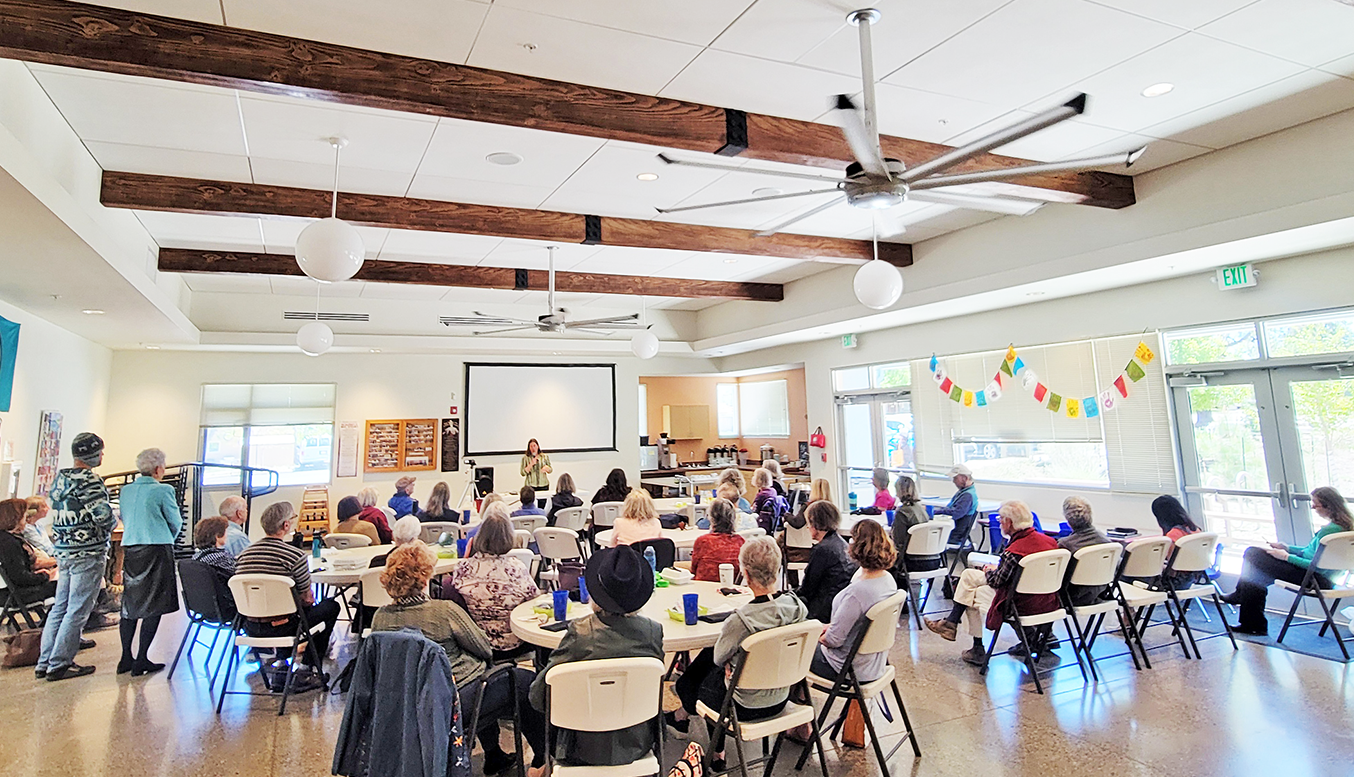
 Think New Mexico Associate Director Kristina G. Fisher, speaking at the League of Women Voters ‘Lunch with a Leader’ event held May 15 at the Unitarian Church. Photo by Carol A. Clark/ladailypost.com
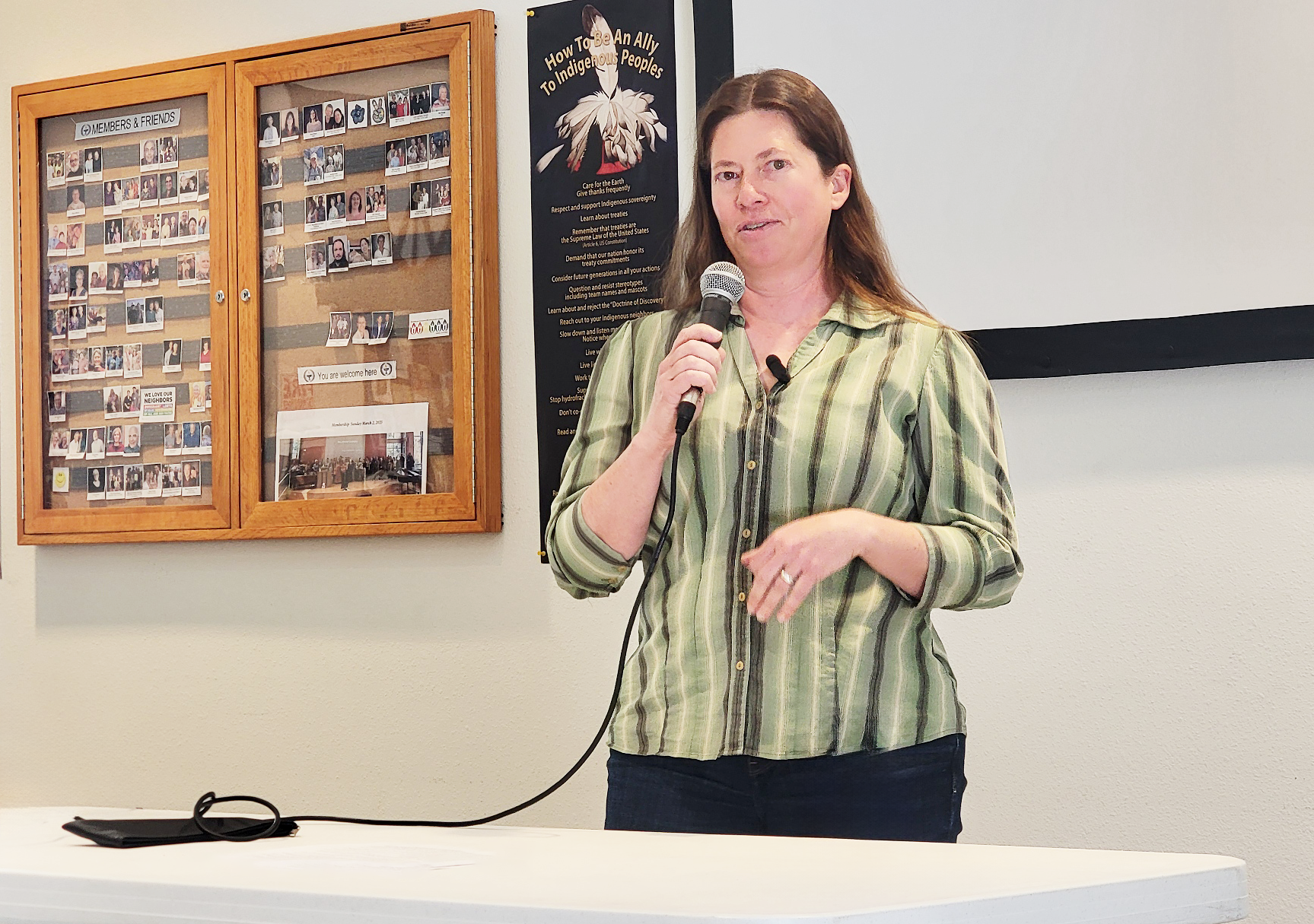 Think New Mexico Associate Director Kristina G. Fisher discusses the state’s serious and growing shortage of health care workers during the May 15 ‘Lunch with a Leader’ event. Photo by Carol A. Clark/ladailypost.com
By CAROL A. CLARK
Los Alamos Daily Post
caclark@ladailypost.com
Think New Mexico Associate Director Kristina G. Fisher was the featured speaker at the monthly League of Women Voters of Los Alamos “Lunch with a Leader” presentation held May 15 at the Unitarian Church.
Fisher explained that Think New Mexico, at 505 Don Gaspar in Santa Fe, is a nonpartisan think tank that develops and advocates for public policy reforms that benefit New Mexicans. She said Think New Mexico’s latest initiative seeks to address the state’s serious and growing shortage of health care workers.
“I’m sure many of you have had the experience of struggling to get in to see a doctor, having to wait for months, or travel out of state for care,” Fisher said. “Based on a national study of active physician licenses, New Mexico is the only state in the nation that experienced a loss of physicians between 2019-2024. In our report, Think New Mexico identified 10 reforms that would help the state train, recruit, and retain more health care workers – from doctors and nurses to physical therapists, dentists, psychologists, etc.”
Fisher presented an overview of the four reforms the Think New Mexico worked to pass during the recent 60-Day Legislative Session at the Roundhouse in Santa Fe:
Reform 1: Create a permanent fund for Medicaid
- 42% of New Mexicans are insured by Medicaid, a higher percentage than any other state, and the program often pays doctors, dentists, and other health care professionals less than the cost of providing care.
- These low Medicaid reimbursement rates are one of the three biggest factors causing doctors to leave the state or retire early.
- In Think New Mexico’s report, the organization pointed out that since 1973, New Mexico legislators have created a dozen permanent funds to provide long-term dedicated funding for policy areas ranging from higher education to rural libraries.
- However, even though Medicaid is the single largest line-item in the budget, and health care overall is the state’s second largest expenditure (after education), up until this year the state did not have a permanent fund for health care.
- Think New Mexico recommended that the legislature create a $2 billion fund for health care.
- During the session, they worked with Senator Muñoz and his staff to develop Senate Bill 88, which would establish a $2 billion permanent fund for Medicaid.
- There are two revenue sources to grow the fund: first, surplus oil and gas taxes, which are estimated to total approximately $511 million over the next three years, and second, annual “reversions” to the general fund that exceed $110 million (averaging $67 million a year).
- Once the fund reaches its $2 billion goal, it will generate $100 million a year in state funding for Medicaid. With the current 3:1 federal match, that would make $400 million available to increase reimbursement rates for health care providers.
- Senate Bill 88 passed two Senate committees, two House committees, the Senate on a unanimous vote of 37-0, and the House on a vote of 52-13. It was signed into law by the governor.
- Over the long term, this fund will allow New Mexico to increase Medicaid rates.
Reform 2: Make Tax Policy Friendlier to Health Care Workers
- Another of the three biggest factors contributing to New Mexico’s health care worker shortage is the state’s Gross Receipts Tax (GRT) on medical services.
- Only one other state, Hawaii, imposes a GRT, and Hawaii caps its tax at 4.7%, well below the 8% that many New Mexico doctors, dentists, and other health care providers pay.
- Unlike most businesses, which simply pass on the gross receipts tax to their customers, medical providers are generally not able to pass the tax on to insurance companies, Medicaid, or Medicare.
- As a result, doctors, dentists, and other health care providers end up bearing the full burden of the tax, making it more expensive to practice medicine in New Mexico than in other states.
- For the past two decades, the legislature has gradually chipped away at the tax, exempting specific types of payments for medical services.
- Most recently, in 2023 the legislature and governor suspended the GRT on co-payments and deductibles for five years. Yet the GRT continues to cost health care professionals tens of millions of dollars a year.
- During the 2025 session, Think New Mexico pursued three tax reforms:
- Repeal the rest of the gross receipts tax on medical services and
- Expand the Rural Health Care Practitioner Tax Credit.
- Establish a tax credit for preceptors
- Senate Bill 295 and House Bill 344 proposed to repeal the rest of the GRT on medical services.
- In recent years, the legislature’s approach with tax bills has been to have the tax committees hear all of them and then select a few for inclusion in an omnibus tax bill. This year, that bill was House Bill 14. As it passed the House, it did not include any tax relief for medical services, but the Senate added a big piece of Think New Mexico’s legislation: it repealed the tax on coinsurance, which would have reduced the tax on medical services by nearly $50 million annually.
- Unfortunately, the bill was ultimately vetoed by the governor because it lacked a funding source to pay for the tax reductions. In her veto message, the governor did note that she was supportive of the proposal to provide tax relief to health care professionals.
- Along with working to expand the GRT exemption, Think New Mexico also supported House Bill 52, to expand eligibility for the Rural Health Care Practitioner Tax Credit to include EMTS, paramedics, occupational therapists, audiologists, speech and language pathologists, and licensed practical nurses, among others.
- Finally, Think New Mexico supported House Bill 395 to create a tax credit for preceptors. Preceptors are the practitioners who provide hands-on clinical education for incoming health care providers, such as during medical residencies. Most are not paid, but a growing number of states provide a tax credit to recognize the service they are providing and provide at least some compensation for their time.
- Unfortunately, neither of those reforms made it into this year’s omnibus tax bill, but Think New Mexico plans to bring them back during next year’s short session. They are all fiscal bills, so they would not need a message from the governor.
Reform 3: Reform New Mexico’s Medical Malpractice Law
- New Mexico’s unbalanced medical malpractice law is at the top of the list of reasons why doctors tell us they are retiring early or leaving the state, as malpractice insurance premiums here are twice as expensive as in our surrounding states.
- The reason why premiums are so high is that New Mexico has the second highest rate of medical malpractice lawsuits of any state in the U.S., as well as unlimited punitive damages and the lowest standard of proof to receive punitive damages. Insurance companies are charging for this risk.
- In Think New Mexico’s report, we made six recommendations to address this situation.
- This session we pursued three reforms in Senate Bill 176:
- capping attorney’s fees in medical malpractice attorney lawsuits, based on the California model (33%/25%),
- ending lump-sum payouts from the Patient Compensation Fund (PCF), as you call for, and
- sending 75% of any punitive damages awarded in a medical malpractice cases to a new fund designed to improve patient safety.
- These reforms have been adopted in a variety of other states from across the political spectrum.
- For example, 20 states cap attorney’s fees, including California, Connecticut, Delaware, Hawaii, Illinois, Massachusetts, Nevada, and Oregon. New Mexico has no limits on attorney’s fees. SB 176 follows the California model, which caps attorney’s fees at 25% of the money awarded if a case is settled, and 33% if a case goes to trial. Every dollar that goes to the attorney is a dollar that fails to reach the injured patient.
- New Mexico also recently began allowing lump-sum payouts from the Patient Compensation Fund (PCF). The PCF was created to make sure that patients who are injured by malpractice will have all of their medical needs paid for.
- The problem with this is that the lump-sum payout is meant to cover the patient’s medical costs for the rest of their life, but as much as 40% now comes off the top immediately for their lawyer. As a result, he patient may very well run out of money for their medical care.
- SB 176 would return to the system that worked well for many years, which is having the PCF pay out medical costs as they were incurred by a patient injured by malpractice, for as long as needed.
- Finally, there is the issue of unlimited punitive damages. Punitive damages are meant to be an extraordinary remedy, awarded in rare instances where it is necessary to punish someone for committing gross negligence or intentional harm. They are separate from compensatory damages, which are meant to compensate the patient.
- Recent punitive damage verdicts in New Mexico have included a $22.7 million against a Rio Rancho hospital for a bad prostate operation and a $68 million against a hospital in Gallup for a botched hernia surgery.
- These unlimited damages provide a windfall for the attorneys bringing the cases, but they undermine medical care across the state.
- Three states, Alaska, Oregon, and Pennsylvania, have decided that a significant portion of any punitive damage award should be used to benefit the public instead.
- SB 176 proposed to send 75% of any punitive damages to a new fund earmarked for improving patient safety, such as by improving medical staffing ratios and training.
- Senate Bill 176 was introduced on the 8th day of the session but did not receive a hearing in its first committee until the 53rd day of the 60-day session.
- When it was finally heard, it failed to pass the committee on a 4-5 vote.
- However, Think New Mexico was encouraged by several developments. First, 24 bipartisan sponsors signed onto Senate Bill 176 – 12 Democrats and 12 Republicans – over one-fifth of the legislature and a more sponsors than signed onto any other bill this session.
- Second, the bill received significant media coverage, including multiple front-page articles in the Albuquerque Journal and Santa Fe New Mexican, supportive syndicated columns that ran across the state, and extensive radio and television news coverage.
- Finally, in her post-session press conference, Governor Lujan Grisham came out strongly in favor of reforming the malpractice system and named the trial lawyers as the reason it hadn’t happened. She said that the law needs to be reformed. This is a big change from prior to the session when she said that medical malpractice reform was off the table.
- So taken together, Think New Mexico is optimistic that they have laid the groundwork for enacting substantive reforms that will improve the environment for practicing medicine in New Mexico.
Reform 4: Join the 9 Major Interstate Compacts for Health Care Workers
- Finally, the fourth major health care reform Think New Mexico pursued during the 2025 legislative session was a package of nine bills, introduced by bipartisan sponsors, to bring New Mexico into interstate compacts for physicians, physician assistants, psychologists, counselors, dentists and dental hygienists, emergency medical personnel, audiologists and speech therapists, physical therapists, and occupational therapists.
- Interstate compacts are agreements among states to recognize and accept professional licenses issued by other states participating in the compact. Similar to the way that a person can hold a driver’s license from one state and legally drive in another, states that participate in an interstate compacts agree to recognize licenses issued to health care professionals by other states.
- Without these agreements, doctors from other states cannot legally provide services in New Mexico – even via telehealth – unless they go through New Mexico’s lengthy licensing process.
- Since 2003, New Mexico has been one of 40 states in the Nurse Licensure Compact, which allows nurses to easily practice in other compact states. As many as 80% of the nurses at some New Mexico hospitals, especially in rural and border areas of the state, would not be practicing here but for this compact.
- A majority of other states have also joined the other nine compacts.
- With the vast majority of other states participating in these compacts, New Mexico is putting itself at a competitive disadvantage in attracting health care providers to our state, not to mention missing out on opportunities for virtual care.
- Think New Mexico worked with bipartisan sponsors in the House to introduce nine bills to bring New Mexico into interstate health care compacts that the state is not yet participating in.
- Seven of the nine compact bills introduced this session passed the House unanimously (the last two ran out of a time awaiting a hearing in their final House committee). The compacts did not receive a single vote against them in the House.
- The big challenge was the Senate Judiciary Committee. That committee is dominated by trial lawyers, and they object to the provisions about qualified immunity, venue, etc.
- Think New Mexico worked to counterbalance the trial lawyers by building a very broad coalition in support of the compacts. The doctor compact even gained the support of Planned Parenthood of the Rocky Mountains and the Conference of Catholic Bishops.
- After weeks of advocacy, Senate Judiciary finally took up the doctor compact two and a half days before the end of the session.
- The general counsel of the compact commission, Rick Masters, was the expert witness.
- Nevertheless, Think New Mexico was unable to deter the committee from making 32 amendments to the compact, which would have prevented New Mexico from joining if it had passed in that form.
- Unfortunately, we were not able to resurrect the bill before the session adjourned.
- The good news is that the issue received strong, focused media coverage, and the governor brought up the issue in her post-session news conference, so Think New Mexico is making plans to build on that momentum.
The full report is available on the Think New Mexico website here.
In discussing next steps. Fisher said that Think New Mexico always takes a long view and in its experience, big reforms often take a few years to get through the legislature.
“We will be back with the tax reforms next session for sure, since they are fiscal bills that do not need a message from the governor in order to be considered during the 30-day session,” she said. “We’ll also be seeking additional funds to grow the Medicaid trust fund as quickly as possible. We are urging the governor to take up the compacts and Medical malpractice reforms – either in a special session or in the 2026 short session. That will be her final regular session as governor, so this is an opportunity for her to have a legacy issue.”
To learn more about Think New Mexico, visit https://www.thinknewmexico.org.
To learn more about League of Women Voters, visit https://my.lwv.org/new-mexico/los-alamos/about-us.
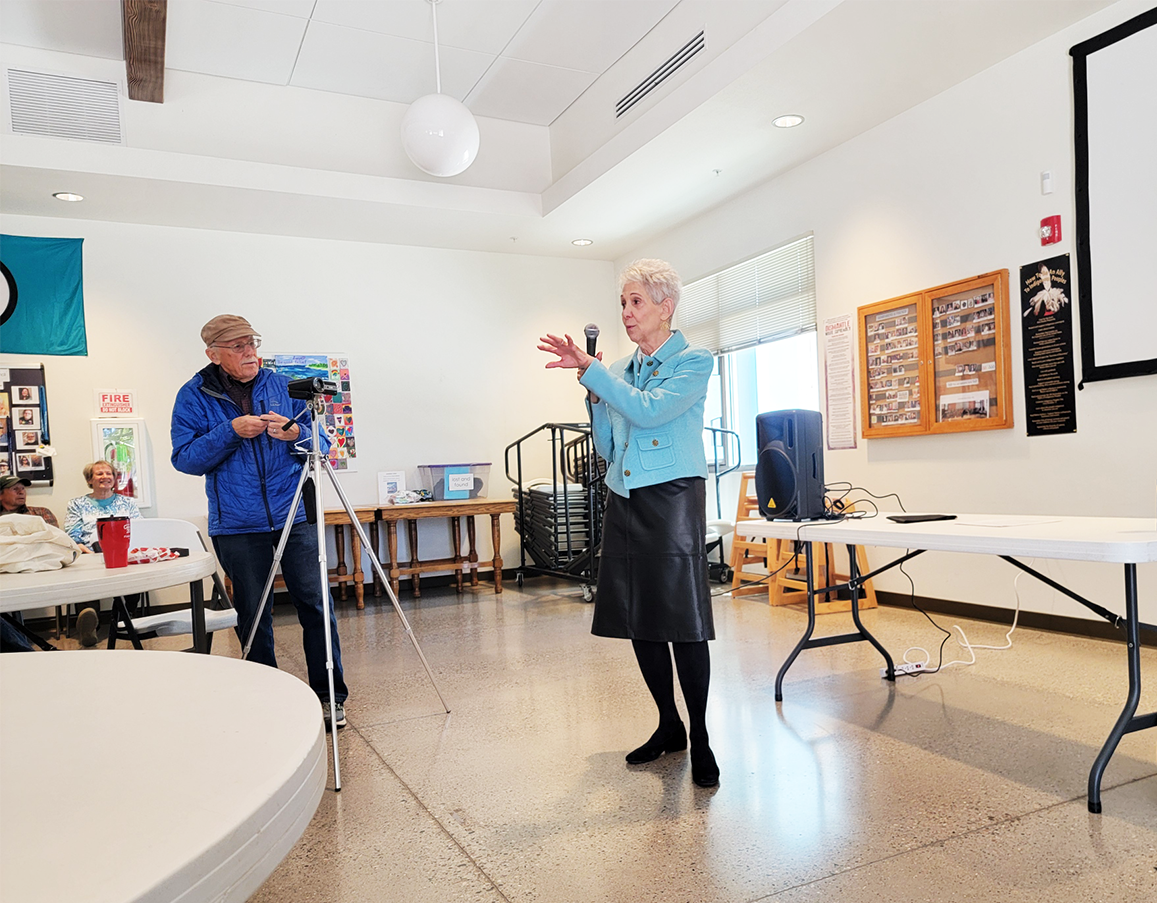 League of Women Voters ‘Lunch with a Leader’ Director Karyl Ann Armbruster briefs the audience on the protocol for the questions and answers portion of the event held May 15 at the Unitarian Church. Photo by Carol A. Clark/ladailypost.com
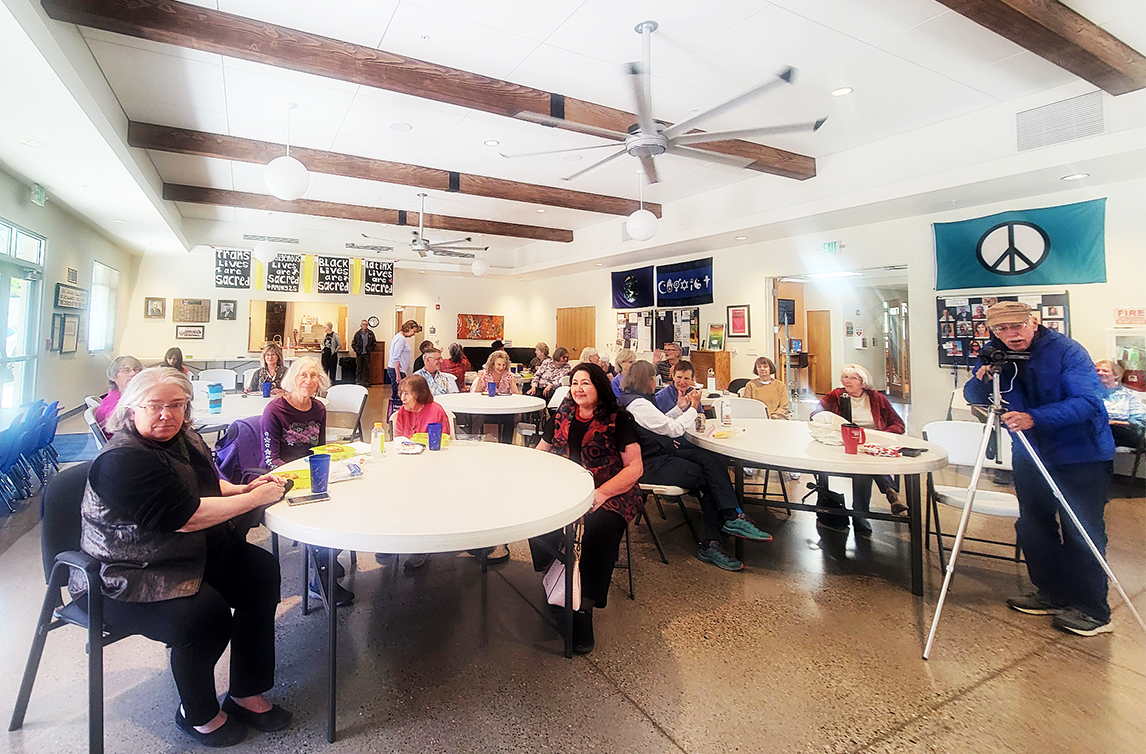 Among those preparing for the May 15 ‘Lunch with a Leader’ talk to get underway, from left, League of Women Voters of Los Alamos Board President Felicia Orth, Past Board Presidents Barbara Calef and Becky Shankland and Enterprise Bank & Trust Market President Liddie Martinez. Bob Williams is videotaping the event. Photo by Carol A. Clark/ladailypost.com