
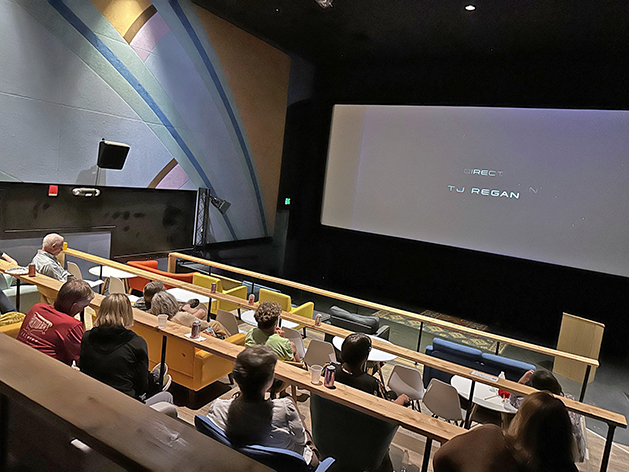
 A scene from the screening of ‘Paradise Paradox’ June 24 at SALA Event Center. Photo by Kirsten Laskey/ladailypost.com
By KIRSTEN LASKEY
Los Alamos Daily Post
kirsten@ladailypost.com
Small, rural towns can be deceiving. Quaint town centers and close-knit communities seem appealing and add to that some kind of tourist destination like a ski resort and small towns appear as havens from all the turmoil of big cities. The trouble is, a safe haven that is totally immune from troubles, doesn’t exist; so, what happens when significant issues such as depression and suicide find their way into these small towns? More importantly, what is the best way to address these issues?
To help answer these questions, the Los Alamos Public Safety Association and Los Alamos Community Health Foundation hosted a screening of the documentary, The Paradise Paradox, June 24 at SALA Event Center.
The screening was followed by an informal discussion led by Los Alamos Police Cmdr. Daniel Roberts.
The film spotlights different mountain towns, particularly those that offer attractive outdoor recreation including Deer Valley, Utah, Mammoth, Calif, Eagle County, Colo., and Winter Park, Colo.
All these locations are included in the disturbing trend of high rates of suicide and mental health challenges found in ski towns.
The film applauds groups of citizens that banded together and pooled resources to combat this issue. Their efforts helped hire clinical psychologists at a high school, organize support groups for those who experience trauma and even achieve building a multi-million-dollar mental health facility.
But how does this apply to Los Alamos? Several stakeholders invited to the screening shared their thoughts.
“I thought the most surprising, and the best thing I saw about the film was the community’s reaction to the need for care and the fact that it was so unaffordable and unattainable by these local residents but because these people grouped together to … make a difference, I thought that was really awesome,” Marco Lucero said.
Another attendee said she found the discrepancies between the “haves” and the “have-nots” and how much that impacts rates of mental health and suicide. She added that even though the towns featured in the film are different than Los Alamos, she saw a lot of parallels between them.
Police Chief Dino Sgambellone agreed.
“We have a lot of resources here,” he said, “probably more than the towns they outlined there.”
“I know we can make a difference together … we saw a great example of what that can look like,” Sgambellone said.
Roberts noted that it doesn’t even need to be on a huge scale.
“I think maybe a solution doesn’t have to be as grand … sometimes a simple or a small gesture can make a profound difference especially in someone else’s life if they are suicidal or something of that nature,” Roberts said.
It also was emphasized that anyone can get involved and help.
“I think it is really important to know that anyone can be trained in behavioral health response,” one attendee said. “We do have an active team … the training is free … you get certified, you are para-professional, you don’t have to be a mental health professional but it gives you enough of a skill set so that if you are in a situation, especially with regard to police and fire, it gives you a basic skill set of how to respond to someone when they are in crisis. It makes you feel less helpless and hopeless…”
“I think it is interesting in this movie because (the film) talks about … we need all these therapists, we need behavioral health specialists coming and they talk about how expensive it is to live there, which is something we are facing up here,” Municipal Judge Elizabeth Allen said. “We could have 150 more (therapists) show up and there would still be a waiting list. We still are battling affordable housing … I feel there are things trying to plug these holes, these gaps until people can get off therapists’ waiting lists.”
These options include arts and resiliency at the Teen Center, grief groups, JJAB’s one circle program and programs at the school, Allen said.
Furthermore, Patrick Soran with the Community Foundation discussed money the foundation received from the Anchorum Health Foundation that totals $150,000 that will be paid out each year over five years to address health stability whether that is physical health or mental health.
In summation, Roberts said the screening is just one stepping stone to start moving in the right direction. He encouraged the discussion to continue.
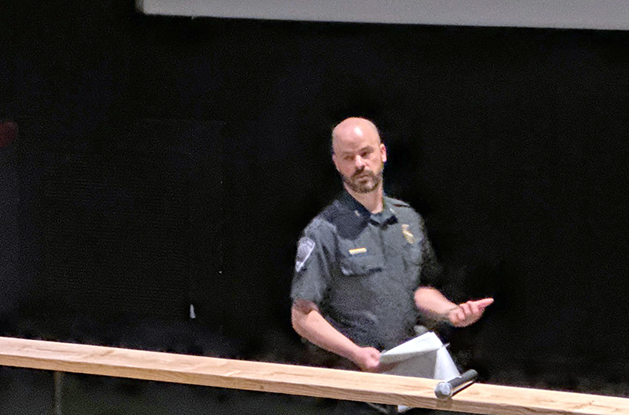 Los Alamos Police Cmdr. Daniel Roberts leads a discussion following the screening of ‘Paradise Paradox’ June 24 at SALA Event Center. Photo by Kirsten Laskey/ladailypost.com
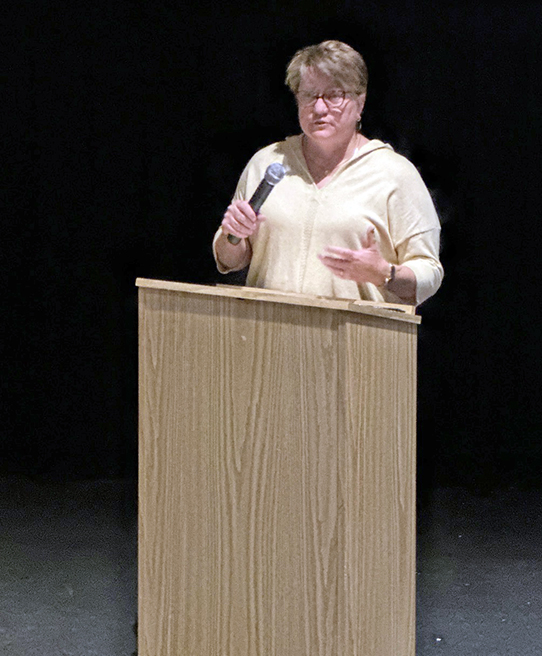 Dr. Liz Maines, one of the presenters at the documentary screening, makes opening remarks. Photo by Kirsten Laskey/ladailypost.com