
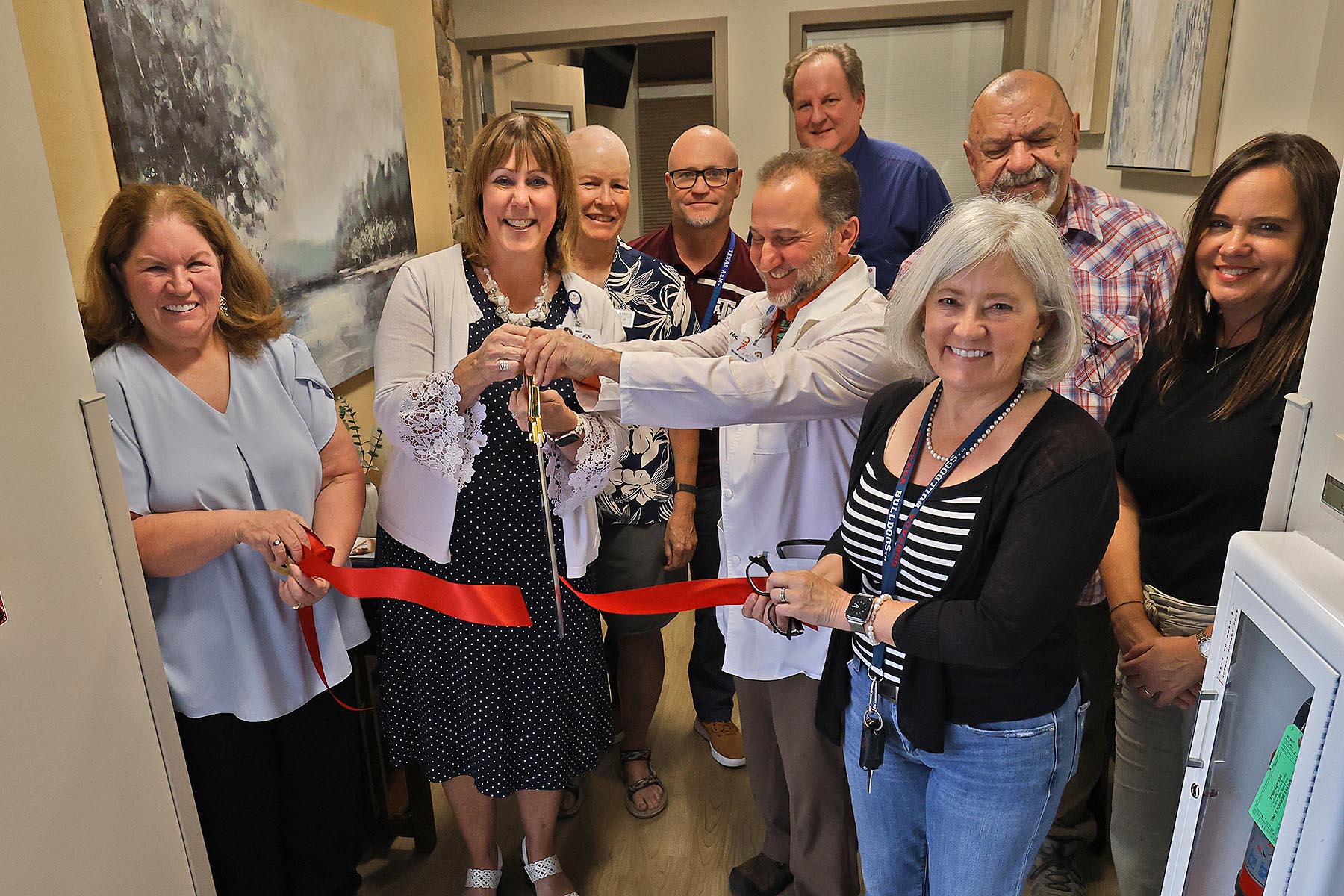
 Gathered for the Ribbon Cutting ceremony Monday at the new Sleep Lab are from left, Los Alamos Chamber of Commerce incoming Director Sandy Jones, LAMC CEO Tracie Stratton, Dr. Michael Lucia and Chamber Director Ryn Herrmann who retired Wednesday. Pictured in the background are County Council Vice Chair Theresa Cull, Sleep Technician Francis Bourget and County Economic Development Program Manager Janice Krish, Photo by John McHale/ladailypost.com
 Dr. Carolyn Linnebur stopped by the ribbon cutting and open house for the new Sleep Lab held Monday at LAMC. Here she looks over one of two private suites inside the Sleep LAB equipped with a television, Wi-Fi access, private bathroom and adjustable temperature control. Photo by John McHale/ladailypost.com
By CAROL A. CLARK
Los Alamos Daily Post
caclark@ladailypost.com
Los Alamos Medical Center Chief Executive Officer Tracie Stratton and Dr. Michael Lucia cut the ribbon on the new Sleep Lab Monday afternoon. The Los Alamos Chamber Of Commerce hosted the ribbon cutting ceremony, which included an open house of the facility located on the back side of LAMC at 3917 West Road. The Sleep Lab features two private suites equipped with a television, Wi-Fi access, private bathroom and adjustable temperature control.
Dr. Lucia of Los Alamos Pulmonology & Sleep Medicine spoke at the event on the importance of having a Sleep Lab here in Los Alamos. He explained that there are few labs around the area so the wait to get in is quite long. He commended Stratton saying he approached her about creating a Sleep Lab at LAMC and now they have one that is available to both the local community and surrounding area.
“We are thrilled to be opening our diagnostic sleep center,” Stratton said. “Unfortunately there are not enough options in the state for patients with sleep disorders to be seen, receive the needed tests, and obtain the appropriate diagnosis. The information gathered from these tests help our pulmonologist determine the best course of treatment to advance the care and wellbeing of patients suffering from sleep disorders. We are proud to be making our communities healthier by providing this much needed service.”
According to the National Institutes of Health, nearly 70 million Americans have chronic sleep disorders such as insomnia, sleep apnea, restless legs syndrome and narcolepsy. These are conditions that make it hard for people to sleep at night or stay awake during the day. Sleep disorders that interfere with a good night’s rest are more than an annoyance — they can greatly impact your health.
Daytime sleepiness or excessive snoring can be signs of a more serious sleep disorder. Los Alamos Medical Center’s Sleep Center is available to help people get a better night’s sleep.
Sleep disorders that interfere with a good night’s rest are more than an annoyance—they can greatly impact one’s health.
Sleep disorders may put people at risk for developing serious health conditions such as:
- Depression
- Diabetes
- Heart disease
- Hypertension
- Obesity
- Stroke
- Substance Abuse
- Additionally, you may have an increased risk of a motor vehicle or workplace accident.
The Sleep Lab team helps diagnose and treat:
- Narcolepsy
- Sleep Apnea
- Restless Leg Syndrome
- Problems with nighttime behaviors, such as sleep walking, night terrors, or bed wetting.
The most common sleep studies
- Polysomnogram – This test records several body functions during sleep, including brain activity, eye movement, oxygen levels, heart rate and rhythm, cessation of breathing, snoring and body muscle movements;
- Multiple Sleep Latency Test (MSLT) – This test measures how long it takes you to fall asleep and if the REM stage of sleep is present in a measured amount of time; and
- Home Sleep Apnea Testing (HSAT) – This test requires a portable monitoring unit that patients take home overnight for diagnosis of sleep apnea.
What happens during a sleep study?
- When you arrive at the Sleep Lab for your sleep study, a sleep technician will greet you at the door and show you to your private suite, equipped with a bed, television and Wi-Fi access. You can make yourself at home and adjust the temperature to your comfort level;
- As you prepare for bed, you will complete a questionnaire about your sleep habits. The technician will then place painless monitors on your head, chest and legs. These electrodes monitor vital signs, including your oxygen level, heart and breathing rates, and whether or not there are disruptions in your sleep cycle. Technicians also monitor snoring, and movement of your arms and legs in your sleep; and
- Once the study is complete, your physician will receive a report on your sleeping patterns that you can review together to form a treatment plan.
Prepping for a Sleep Lab Visit
- Make sure your visit is as successful as possible with these get-ready dos and don’ts:
- Don’t drink or eat caffeine on the day of your sleep study;
- Do bring your favorite pillow and comfortable sleep clothes;
- Do feel free to bring electronic devices, such as an iPad or iPhone. We do ask, however, that you turn these devices off before going to sleep;
- Do take medicines prior to coming to the Sleep Lab, if possible. If you have any questions regarding your medicines, please call the Sleep Lab prior to your appointment; and
- Do plan to spend at least nine hours at the Sleep Lab.
To learn more about the Sleep Lab or to schedule an appointment, visit losalamossleeplab.com/sleep or call 505.661.9534.
 LAMC Sleep Technician Francis Bourget attaches sensors to the head and body of the patient to monitor sleep patterns from 6-8 hours during the overnight stay at the Sleep Lab. Photo by John McHale/ladailypost.com
 The entrance to the new Sleep Lab is at the back of LAMC with ample parking in the back parking lot. Photo by John McHale/ladailypost.com