
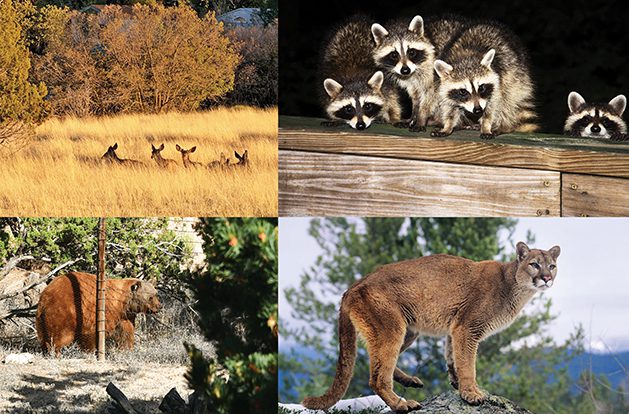
 Los Alamos County and its contractor are working on a plan to address local wildlife issues. Courtesy photos
By KIRSTEN LASKEY
Los Alamos Daily Post
kirsten@ladailypost.com
Bears rummaging through trash cans, deer’s antlers getting entangled in holiday lights and mountain lions preying on household pets are all issues that are commonly heard in Los Alamos.
The question is, what can be done about it?
Los Alamos County is starting to work on the answer; during the June 9 County Council meeting, representatives from the contractor, Environmental Solutions and Innovations (ESI), laid out its plan to address wildlife issues.
ESI Wildlife Biologist Amanada Rhyne presented the plan to council.
She started off by listing the common concerns the public had about wildlife including: becoming habituated to human environments, causing traffic collisions, spreading parasites and diseases, causing property damage and interacting with humans.
“We understand over the last few years the County has been working with New Mexico Department of Wildlife and local police to identify some of these concerns and assess the level of public awareness regarding wildlife feeding and how to interact with wildlife,” Rhyne said. “We know that last year the County passed an ordinance against feeding wildlife on public and private property to protect health, safety and welfare of the community and wildlife. Los Alamos is a really beautiful and unique place, and you are surrounded by national forests and tons of variety of wildlife, the goal is to reduce negative interactions while also maintaining positive interactions like safe wildlife viewing.”
To achieve this, Rhyne said the proposed plan will have three phases. The first phase will review existing information and frame issues. The emphasis will be on synthesizing existing data from previous County surveys, records and research.
“We want to have a clear, defensible understanding of current wildlife-related challenges,” Rhyne said.
The second phase will focus on assessing risks and priorities.
“Not every issue carries the same urgency,” Rhyne said. “So we’re going to help the County identify where to focus first and develop strategies that can realistically move forward given the current constraints.”
The third and final phase will address management and policy options.
“Those will focus on practical action options aligned with the County’s authority and resources,” she said. “These recommendations will be realistic things the County can actually have the jurisdiction and capacity to do.”
Going more in depth on the three phases, Rhyne said during first phase, ESI will look at collision records with wildlife, wildlife-related complaints, existing reports, policy and public materials and documented concerns. For the second phase, she said information will be built on what was collected during phase one and then evaluated and prioritized based on public safety, feasibility and public acceptance.
Then ESI will identify practical management strategies across four categories: regulation, education, infrastructure and coordination-based approaches, Rhyne said. Costs, effectiveness and implementation challenges also will be described along with responsibility for implementation. She explained it will be determined what the County can do and what will require partnership.
Development of the plan is estimated to take a year, so in June 2027, the finalized plan would be presented to Council.
Council Chair Randall Ryti observed he didn’t see any mention of community engagement and wondered where it came in.
“There will be a few different opportunities,” ESI Project Manager Daniel Leavitt said. “One, community engagement will be through the actual reporting and the briefing. And any of the potential options that involve engagement would be identified in that assessment.”
So, there is no formal communication plan? Ryti asked.
“I think within the scope of work for this assessment, we’re starting with assessing the community as it is and there may be an opportunity throughout the process, especially as we move from phase one to phase two to reach out to the community and do some engagement …,” Los Alamos County Assistant Public Information Officer Leslie Bucklin said.
Ryti also asked if there was any way the plan could take less than year to draft.
Bucklin responded that once the process begins, there may be the ability to do that.