
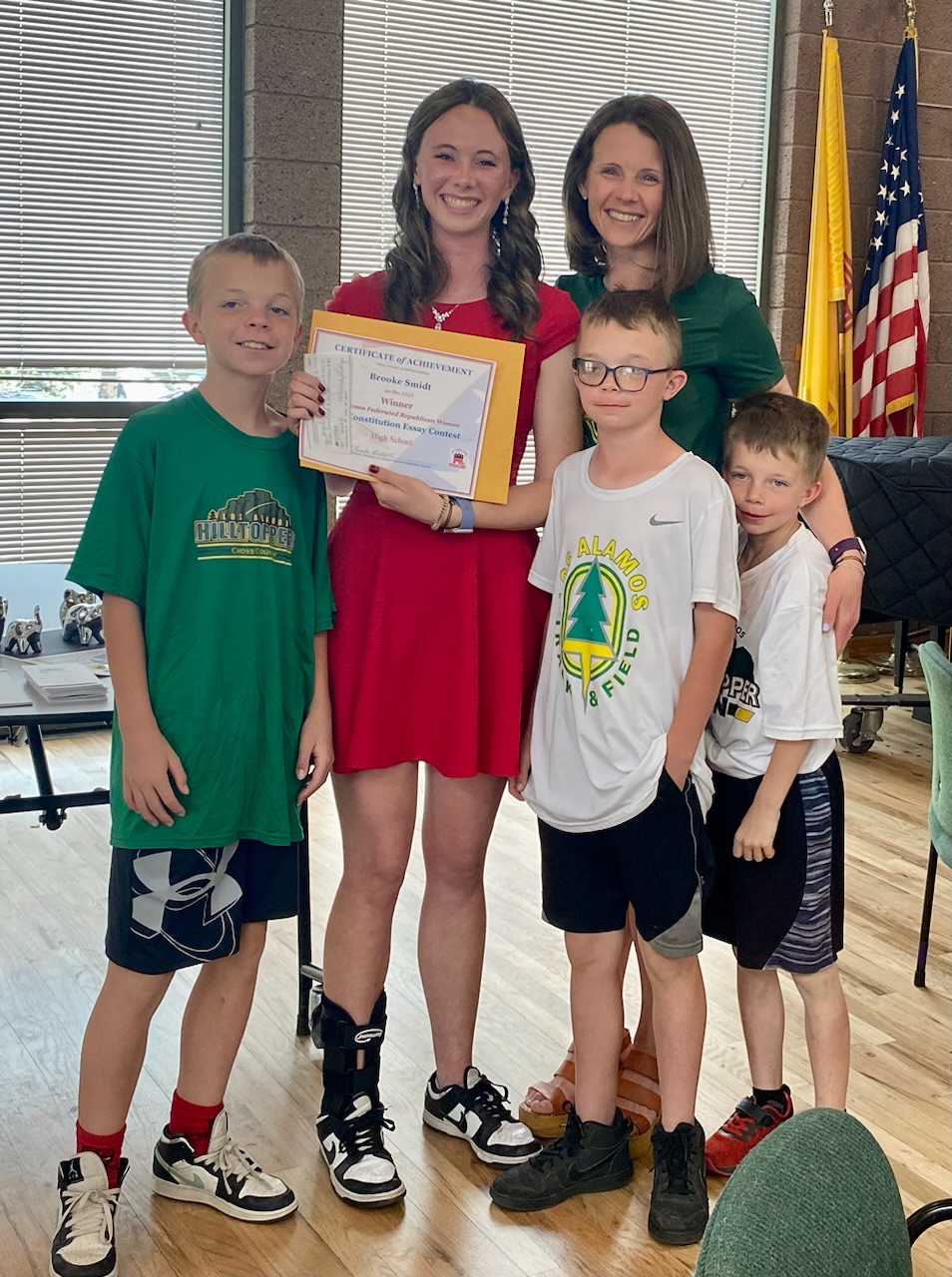
 The Smidt family, from left, Ethan, scholarship recipient Brooke, mom Esther, Adam and Jared. Courtesy/LAFRW
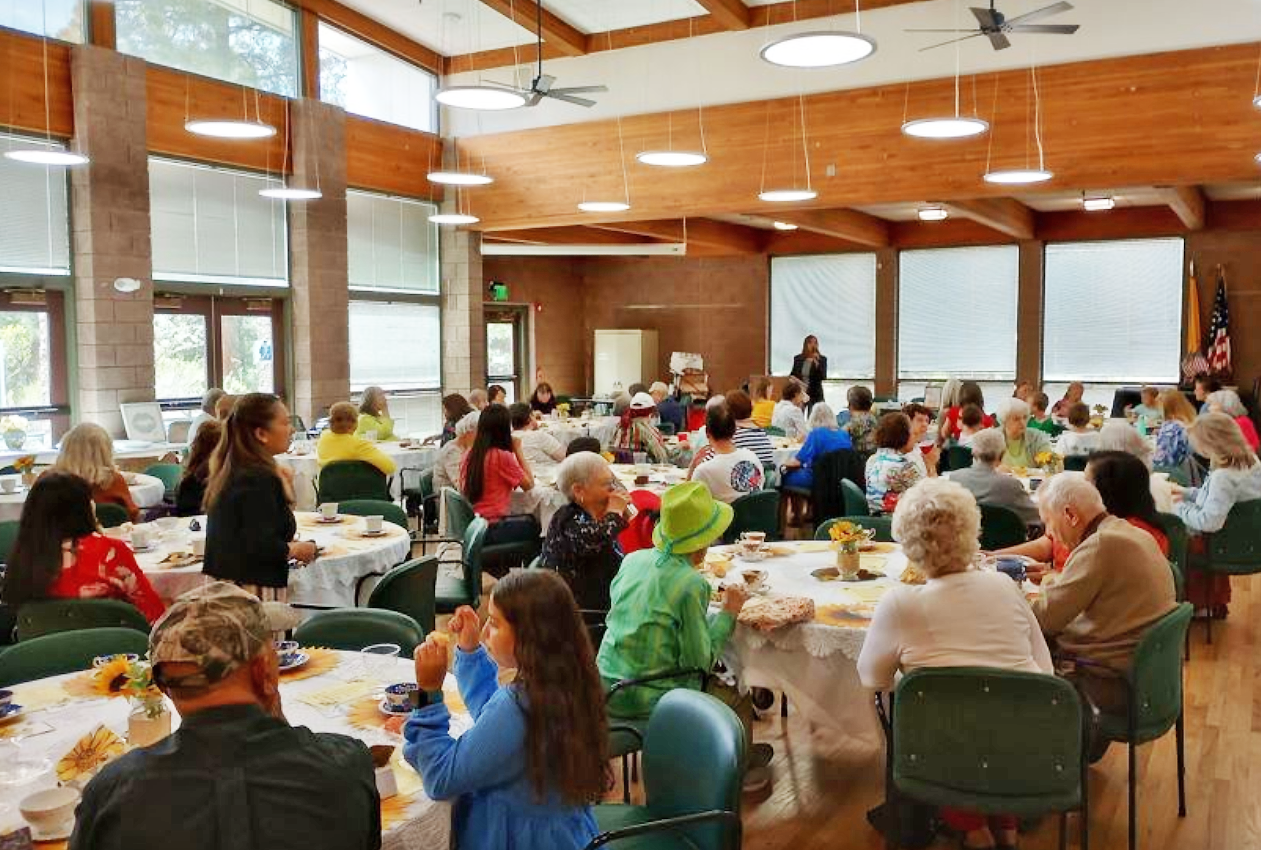 Rep. Rebecca Dow (District 38: Doña Ana, Sierra & Socorro) gives the keynote address at the Sunflower Tea held May 3 in the Great Room of the Betty Ehart Senior Activity Center. Courtesy/LAFRW
LAFRW News:
More than 80 attendees enjoyed tea, fellowship, a variety of foods and desserts at the Sunflower Tea, hosted by the Los Alamos Federated Republican Women (LAFRW). The event was held May 3 in the Great Room of the Betty Ehart Senior Activity Center. LAFRW President Linda Bullock officiated the event, and after the prayer and pledge, Rep. Rebecca Dow (District 38: Doña Ana, Sierra & Socorro) gave the keynote address.
Rep. Dow discussed her background as coming from a Democracy family but aligning with conservative values. Dow highlighted her campaign experiences, including flipping a previously Democratic-leaning district and her unsuccessful run for governor. She emphasized the importance of grassroots engagement and advocates for measures like paid poll challengers to address voting integrity concerns. Dow discussed legislative battles over issues like abortion, gender identity, and social welfare programs. She stated, “…having gone to all 33 counties in this state, there is an absolute misalignment between the people who are making the laws and the people they’re supposed to represent…because your neighbors, regardless of their party affiliation, don’t believe in redistribution of wealth.”
Rep. Dow suggested that when conservatives talk to people about politics, “ask them the last time they read the party platforms because only one party platform mentions God. Only one party platform mentions marriage. Only one party platform mentions a mother and a father.” Dow asserted that New Mexico is trending more Republican, with several counties and districts flipping from Democratic to Republican control.
Another highlight of the event was the presentation of the winners of the U.S. Constitution Essay Contest, now in its 10th year:
Aly Martinez (4th grade) won in the grade school division and received a $100 check. Her winning art depicted a man voting and people cheering. She expressed appreciation to her teachers and family who have taught her.
Matias Rodriguez (8th grade) placed first for grades 6-8 and won a $200 check. He wrote about the different powers vested in our three branches of government and why the concept of checks and balances, as guaranteed by our Constitution, are vital to the preservation of our government. Since Matias was traveling on a choir trip, he was unable to attend the event. His parents accepted his certificate and award check on his behalf.
High School winner, Brooke Smidt (11th grade) won a $300 check. She read her essay, which addressed the topic of how our First Amendment rights enable citizens to influence the laws of our country or initiate a constitutional amendment and, in so doing, prevent the dissolution of the Republic.
Linda Bullock concluded the event with information about the steady growth of the award-winning Los Alamos chapter, a member of the NMFRW and the National Federated Republican Women (NFRW). Founded in 1938, the NFRW is a grassroots political organization with thousands of active members in local clubs across the nation, making it one of the largest and most influential women’s political organizations in the country.
The Three Branches – by Matias Rodriguez
1. Introduction
The Government of the United States was designed to ensure that no one person or group of people would have too much power, and because of that, the Constitution established three branches: the legislative, executive, and judicial. Each one has specific functions and one system of checks and balances to guarantee that no one branch becomes too powerful.
2. The Legislative Branch
This branch is the one that makes the laws, and it has two parts: the House of Representatives and Senate. In addition to making laws, the Congress approves the budget of the government to supervise the president and remove officials if it is necessary. If the House of Representatives votes in favor of a political trial, the Senate decides if the person should be removed. When Congress approves a law, the president can accept it, not accept it, or veto it. If he vetoes it, Congress can cancel the veto with a two-thirds majority. This is very helpful because it regulates the president’s power. It would be even better if the citizens could participate in that vote.
3. The Executive Branch
This branch is led by the president, who has the responsibility of enforcing the laws approved by Congress. The president is also the leader of the army and in charge of foreign policy. The president doesn’t work alone. He is accompanied by the vice-president and the cabinet. Also, there are a lot of federal agencies that help to implement policies and enforce the laws. Although the president has a lot of power, Congress limits him, and if he abuses the power, he can be removed from office. This branch has seven powers: initiate legislation, issue decrees, initiate constitutional amendments, declare an emergency state, veto a power, and change the constitutionality of legislation. This section could improve if the seven powers it has were weakened because this is power for only one group of people. There could be a corrupt political party that would abuse these powers.
4. The Judicial Branch
This branch is in charge of interpreting the laws and making sure that they follow the Constitution. The Supreme Court is the highest tribunal in the country, and it has nine judges that are named by the president and the Senate. Their most important function is judicial control, which means they can annul laws or government actions if they are not constitutional. This branch has seven powers, interpreting laws, settling legal disputes, punishing violators of the law, hearing civil cases, protecting individual rights, determining the guilt of innocence of those accused of violating the criminal laws of the state, and acting as a check upon the legislative and executive branches of the government. This could be improved if this branch could not annul laws because the laws need to be stable and without exceptions. Otherwise, the power could be corrupted, or this branch could become too powerful.
5. Checks and Balances
To avoid abuses of power, each branch can limit. Congress can annul a presidential veto, override the president, and approve the budget. The president can veto laws and judges. The Supreme Court can declare unconstitutional laws and the president’s actions. This is very useful because it gives every branch power to annul another branch’s powers.
6. Conclusion
The three branches work together for the systems to work. The legislature makes the laws, the executive branch applies them, and the judiciary interprets them. Because of checks and balances, none of the branches can be too powerful, making sure that the government works. Every branch helps other branches be more useful regulating the power of every branch. Checks and balances are very helpful to the branches because they give power to each branch to reduce the power of branches.
Our Constitution’s First Amendment – by Brooke Smidt
The US Constitution was written in 1787 and ratified the following year. The Constitution is a government charter guiding our young country for 238 years and is still used as an instrument in our nation today. The First Amendment guarantees Freedom of Speech and is sometimes overlooked or taken lightly, but it could be one of the most important amendments in our Constitution. The First Amendment gives our country the freedom we craved when fighting in the revolution, the inspiration to stand up for our beliefs and not be afraid to confront injustice, and the assurance that our country stands for us and our beliefs.
When creating our Constitution, James Madison knew that if this country they had just fought for didn’t allow freedoms, the fighting would have all been for nothing. So that’s why the very first amendment keyed in on American citizens’ freedom. This amendment was such a big deal that “free expression…was extensively defended as such by James Madison” (Presidential Library & Museum), showing that our own founding fathers knew the importance of freedom to us. This is also why other revolutions failed. Right after the American Revolution, France wanted to mimic us and get rid of the monarchy and its power. After they got rid of the king and queen, people like Napoleon wanted that power and ignored France’s citizens’ hunger for freedom. Their revolution failed because the people trying to put the pieces of their country together forgot what they were fighting for: freedom.
Our First Amendment has changed the course of history since it allows everyone to voice their opinions and stand against injustice. If women were not allowed to stand up for themselves, we would still not get the right to vote. If people were not allowed to express their beliefs, then certain religions would not be a thing. Basically, “our right to speak freely is a prerequisite for all of our other freedoms” (Ford Foundation). This First Amendment is like the snowball effect:
allowing freedom allows American citizens the right to vote and not be turned away because of one’s sexuality and race, it allows people to choose their political party and voice their beliefs, and it allows religion to be practiced without persecution.
The First Amendment reassures us that our country represents and stands for us. Without freedom of speech, we would have a country that stood for what whoever was in charge believed. It would not represent us. This is why the first three words of the Constitution are “‘We The People’ – affirm[ing] that the government of the United States exists to serve its citizens.” (United States Senate). It’s a comfort to know that our country respects and stands with us no matter our beliefs. It’s even in the name: United. We all join together as one melting pot of different thoughts, beliefs, races, religions, and so much more, building a country that is strong enough to withstand just about anything.
The First Amendment is one of the things to thank for our country’s prosperous nation. It affects all sorts of things that we might not even realize or take for granted. I for one am very grateful for the ability to voice my opinion and stand for what I believe without the fear of getting tormented. I am also grateful to have a country that cares about my beliefs and wants to better itself for its people. The First Amendment stands for us, even if we might not realize just how much.
“Constitutional Amendments – Amendment 1 – ‘The Freedom of Speech.’” Ronald Reagan, www.reaganlibrary.gov/constitutional-amendments-amendment-1 freedom speech#:~:text=The%20freedom%20of%20religion%2C%20composed,author%20 of%20the%20First%20Amendment. Accessed April 1, 2025.
“Constitution of the United States.” U.S. Senate: Constitution of the United States, Aug. 7, 2023, www.senate.gov/about/origins-foundations/senate-and constitution/constitution.htm.
“With the Freedom of Speech, the Responsibility to Listen.” Ford Foundation, July 13, 2023, www.fordfoundation.org/news-and-stories/big-ideas/with-four-freedoms four-responsibilities/with-the-freedom-of-speech-the-responsibility-to listen/#:~:text=It%20must%20come%20first%20because, vote%20or%20call%20our%20representatives.
 Brooke Smidt reads her winning essay. Courtesy/LAFRW
 The Martinez family, Aly, her mother Audrey, and Camden. Courtesy/LAFRW
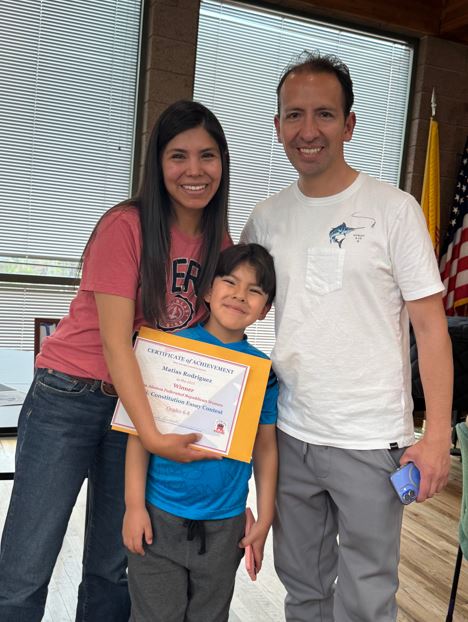 Rodriquez family receives Matias’s award, mother Leila, brother Joaquin and father Dagner. CourtesyLAFRW
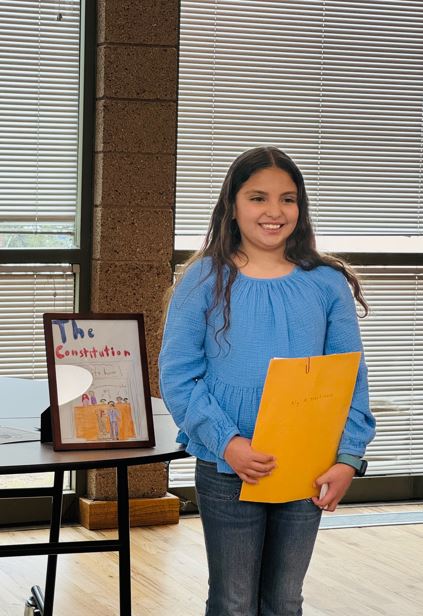 Aly Martinez with her winning art. Courtesy/LAFRW
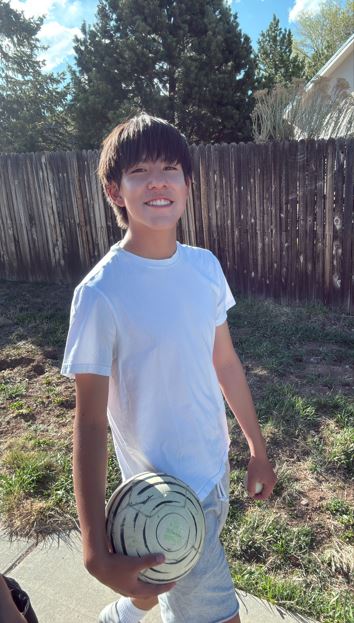 Matias Rodriquez, MS winner was unable to attend the event. Courtesy/LAFRW
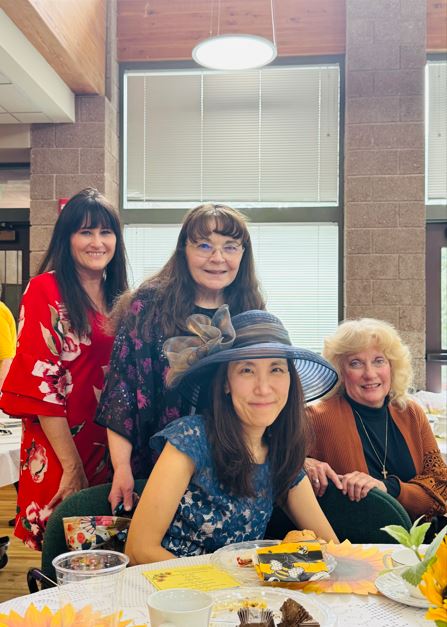 Valerie Fox, LAFRW Recording Secretary Dianne Coane, Republican Party of Los Alamos Chair Lisa Shin and Beverly Bender. Courtesy/LAFRW
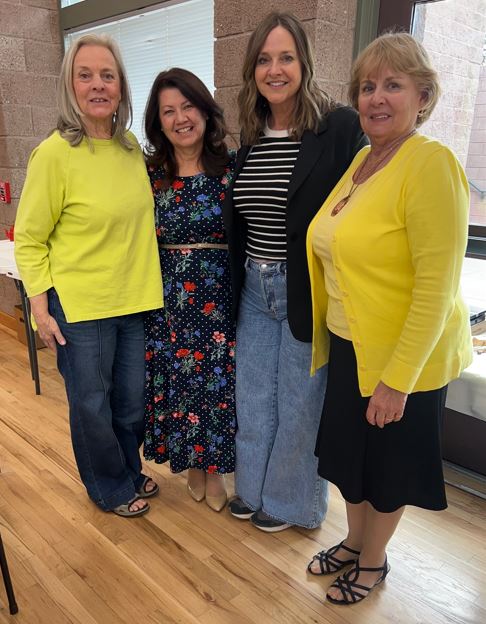 Rep. Rebecca Dow‘s mother Elaine Skidmore, Jolyn McTeigue, Rep. Dow and LAFRW Corresponding Secretary Trish Granich. Courtesy/LAFRW
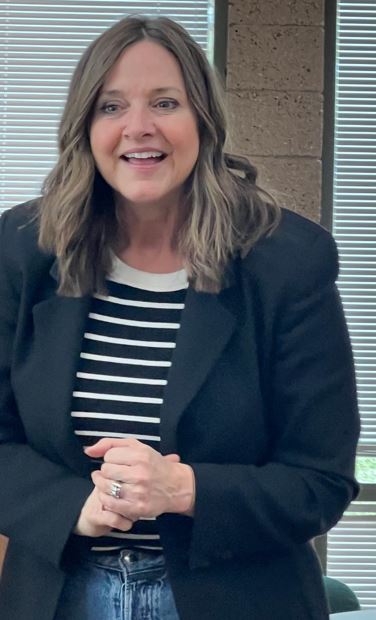 Rep. Rebecca Dow speaks to the audience. Courtesy/LAFRW
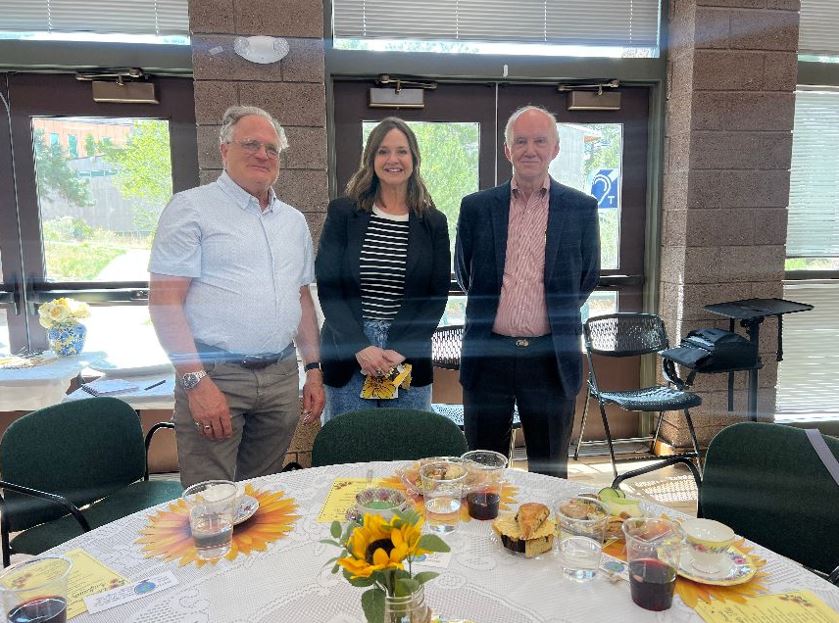 Republican Party of Los Alamos Secretary Gary Stradling, Rep. Rebecca Dow and Bill McKerley. Courtesy/LAFRW
 LAFRW President Linda Bullock, right, introduces Rep. Rebecca Dow. Courtesy/LAFRW