
 The boundary of the East Downtown Los Alamos MRA Plan. Courtesy/LAC
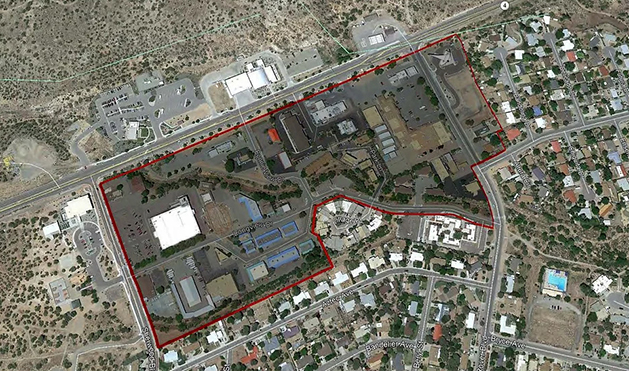 The boundary of the White Rock Town Hall MRA. Courtesy/LAC
By KIRSTEN LASKEY
Los Alamos Daily Post
kirsten@ladailypost.com
The two Metropolitan Redevelopment Areas (MRA) in Los Alamos County are just about ready to open for business.
During an interview with the Los Alamos Daily Post Monday, Community Development Department Director Eli Isaacson discussed the Downtown Los Alamos and White Rock Town Hall MRA plans. He explained the application and handbook for property owners, business owners or developers should be finalized by the end of the month and applications will start being accepted at the beginning of 2026.
Isaacson explained the handbook and application will be available on the County’s website and announcements will be made when the material is ready.
MRAs have been discussed a lot in the County; most recently during a Q&A session held Nov. 5 in the Municipal Building.During the session, attendees got a brief overview of an MRA.
According to County Planning Manager Danyelle Valdez, the MRA program enables local governments to identify and revitalize areas where deterioration, underutilization, or blight conditions hinder economic and community development.
Furthermore, she said the Los Alamos County MRA program is guided by two adopted plans: the White Rock Town Hall MRA Plan and the East Downtown Los Alamos MRA Plan. These plans provide framework for encouraging private reinvestment, improving public infrastructure, and advancing redevelopment projects that align with the County’s economic vitality and community goals. The session also allowed the County to address some concerns toward the MRAs.
Isaacson said one concern was how the County intended to interact with Columbus Capital, the owner of the majority of properties in Mari Mac Plaza, which is included in the East Downtown Los Alamos MRA.
“At the Q&A session, someone asked if the County would contribute $50 million towards the redevelopment of the shopping center … we are just not in the position financially to participate in that level and I don’t know even if we were if that’s something we would be interested in,” Isaacson said.
What the County is interested in is utilizing the MRAs to support projects and clear some hurdles in the way of private developers’ projects.
Valdez told the Daily Post that this could be anything from infrastructure support and utilities to placemaking and demolition.
“That’s where the MRA is useful. The County can’t provide financial assistance to most private development projects outside of the MRA areas because of anti-donation constraints, so an MRA opens up some opportunities for the County to participate. However, the County is not meant to … take on the major financial responsibilities of these projects,” Isaacson said.
There is no minimum or maximum amount an applicant can apply for, he said, the amounts can fluctuate project to project based off scale and magnitude.
“It’s dependent on the project,” Valdez added. “There has to be contribution from both parties. The County participates in a certain percentage; the property owner has to participate in a certain percentage. The benefit and the percentage have to be in alignment with each other.”
Another question that has been posed is if the County is going to use bonds for capital projects and if those bonds would go towards the MRAs. Isaacson said the answer is no. The bonds the County is currently pursuing are primarily for the Community Broadband project. The MRA plans will be funded through the County’s general fund. Valdez said there have also been questions raised if the MRAs will displace tenants or businesses.
“We would not support a project that was displacing tenants,” she said.
Isaacson added that any housing project that contributed to net loss of affordable housing would not be supported by the County through MRA funds.
Once an application is submitted then work begins on a development agreement, Isaacson said. Working with staff, the applicant would create a draft development agreement that would go to council for approval. If approved, the agreement is executed and based on its terms would dictate the funding, how it is distributed, the schedule and performance metrics.
“We’re really hoping to keep the program as simple as we can,” he said.
Isaacson said it is ultimately up to the applicant to make a proposal to the County regarding MRA assistance, but staff will be available to assist throughout the application and review process. Examples of MRA projects, Valdez said, would include demolishing a derelict building, or installing new infrastructure like waterlines, or applying for funds for landscaping, beautification or pedestrian amenities. Isaacson added that this is why an MRA is helpful. A typical developer works with tight margins, but the County can provide funding, he explained.
“It’s a win-win for us,” Isaacson said. “It’s a nicer project for them; it’s a more attractive entry experience for visitors and residences alike.”
While the application process is not yet opened, Isaacson said there is some initial interest in both White Rock and Los Alamos. He added the MRAs should benefit the whole community.
“There’s not always an opportunity for the County to assist with private development so these areas make it easier for the County to participate. We are hoping that we can help make projects that are almost feasible, feasible through the MRA process and program, and clear hurdles and obstacles to redevelopment where we can.”