
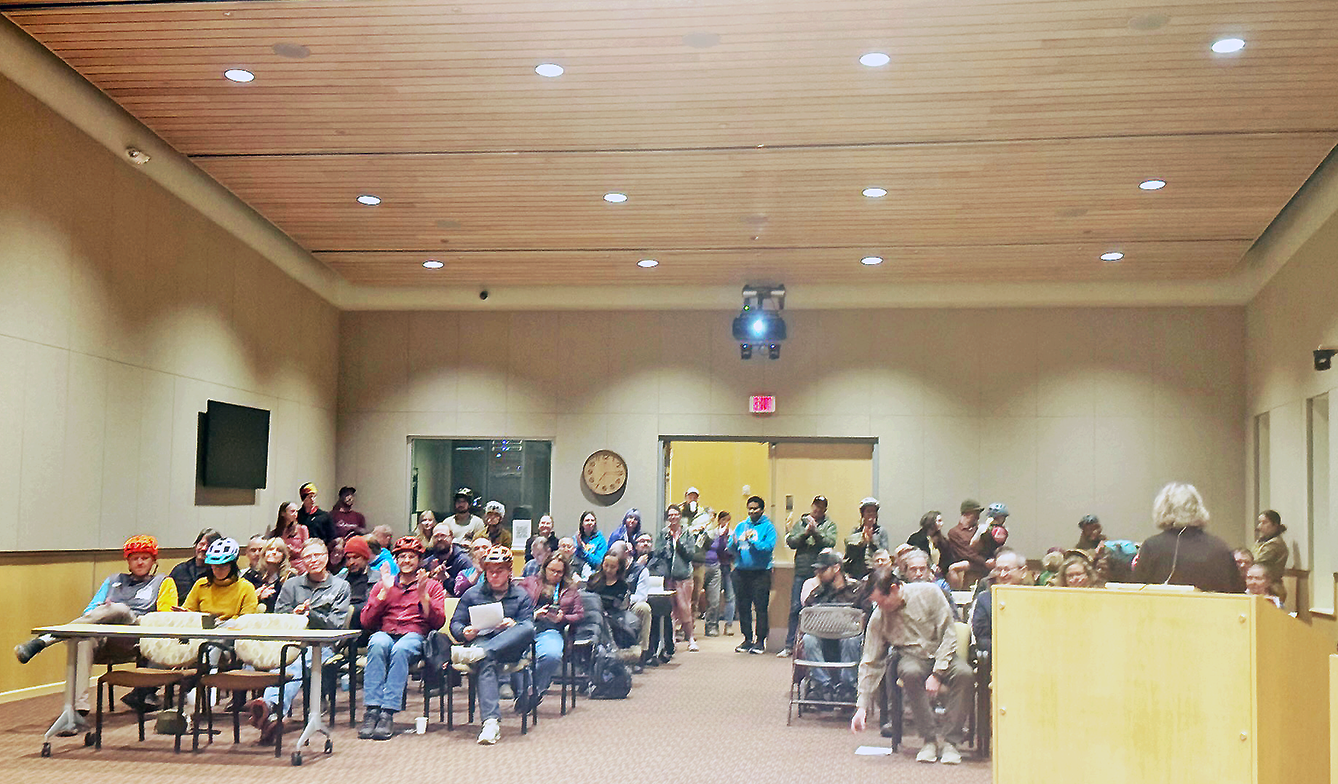
 Besides voting against an MRA commission, Los Alamos County Council unanimously approved the North Mesa Recreation Master Plan Tuesday night in Council Chambers. The public filled the chambers, many wearing bike helmets, to voice their support for the plan. Council Chair Randall Ryti encouraged everyone to return during the budget hearings and contact the council to discuss funding for the master plan. Photo by Ryn Herrmann
By KIRSTEN LASKEY
Los Alamos Daily Post
kirsten@ladailypost.com
While Los Alamos County Council passed on forming a Metropolitan Redevelopment Area (MRA) commission, its efforts to improve transparency will continue.
During the regular council meeting Tuesday night, council voted 5-2 with Councilors Melanee Hand and David Reagor opposed, to not take any action on forming an MRA commission. However, Councilor Teresa Cull suggested that County Manager Anne Laurent present any MRA proposals to council during open meetings to allow for public comment. Laurent agreed she would move forward with doing that.
Council Chair Randall Ryti posed the question to council on whether to pursue the MRA commission.
The whole idea was sparked from comments and concerns about the transparency of the MRA approval process, Ryti said. If the commission was implemented the idea was to have five members who would each serve five-year terms. He mentioned there is one MRA proposal in development.
Hand and Reagor spoke in favor of creating a commission.
“Regarding the existing process as things that are in the works, I think they should just follow our current process,” Hand said. “In the long term, I think it should not be council that makes the decisions on this. I think we should have a new commission and set up something similar to what we do for all the other topics and decision making that we have.”
The commission would help with transparency, and it is something the community has supported, she added.
Reagor said not only would he like to see a MRA commission but a second commission for the Local Economic Development Act (LEDA).
The commissions would be made up of business representatives who are knowledgeable in banking, construction, retail and restaurants, he said. It could be helpful, Reagor said, noting that other County-supported projects such as the Marriott hotel on 20th Street stalled before being scrapped entirely.
“…We’re not getting good business advice from the public except people complaining later on when they don’t like the results … but we need to have them talking to us earlier,” Reagor said. “But as we get new LEDAs and MRAs, we need business people giving advice. I think we need exactly this kind of thing…”
Others on council expressed different opinions on the issue.
Cull pointed out that a similar board, the Lodgers Tax Advisory Board (LTAB), struggles to have quorums and is forced to cancel meetings.
The reason, she said, is because LTAB members are business representatives who can’t make time for meetings.
“So, what makes us think that we can find a group of business people that are willing to review and frankly do our job for us with regard to MRA projects and LEDA projects,” Cull said. “There are other ways to have transparency. We’ve been adjusting how we do business by bringing things to council more than once.”
Furthermore, Cull said she felt trying to fill another board will cause delays and business owners do not seem to appreciate being told by other people how to conduct their business.
“I don’t understand what the real benefit is,” she said.
Councilor Beverly Neal-Clinton said she understands the need for transparency; however, “we invest in so much in communication, in having conversations, in having outreach and having forums and having surveys … if we are not being transparent, I want to know what it looks like to someone else.”
As a business owner herself, Neal-Clinton said she hears a five-year commitment and thinks, that is time she doesn’t have, and it may or may not be well received by other entrepreneurs.
“If it’s about the transparency then let’s figure out how to improve that,” Vice Chair Ryn Herrmann said. “… we can figure out how to improve that. I just can’t see adding in another layer to make this take more time. It’s just adding in more complication especially when the decision ultimately comes down to (the council).”
Councilor Suzie Havemann said good governance is about transparency, but it is also about efficiency and effectiveness.
“I just don’t see adding a layer of what some might characterize as bureaucracy to the process as enough value,” she said.
Ryti noted that regardless of whether there is a commission, MRA applicants are still going to talk with County staff and those are not public meetings.
He added that it wasn’t clear how a commission would solve any problems with transparency or trust.
The public weighed in on this issue, too.
Lisa Shin, whose optometrist practice is in the Eastern Downtown Los Alamos MRA, said she felt a commission was necessary.
“If we don’t do this commission then it will be a review committee and that review committee is internal and it is only County staff …,” she said.
The committee makes a recommendation, and the council would decide on it over the course of two meetings, which Shin said, “… just seems rather fast to me. I just want the assurance that the public does have adequate time to review the application and provide meaningful input that matters.”
She said several businesses in the Eastern Downtown Los Alamos MRA feel like they are being left in the dark and it would be great for the public and the business community to be invited to all the review committee’s meetings and to have the meetings recorded.
Jeffrey Branch of Columbus Capital, which is the biggest property owner in the Eastern Downtown Los Alamos MRA, opposed a commission. It is already hard to do business in Los Alamos, Branch said, pointing to high interest rates and construction costs hindering Columbus Capital’s plans.
“It’s been a haul, but we have done our best to be transparent to the community about what we’re doing … we’re at the stage where we are ready to submit an (MRA) application,” Branch said.
He added a MRA commission could jeopardize Columbus Capital’s plans although he didn’t elaborate on how.
Greg Gonzales of Columbus Capital said, “Incorporating a project into a MRA is a very complicated process. It’s going to address issues of economic development. It’s going to include land use, public infrastructure and definitely have financial and legal implications. The challenge with establishing a board … is trying to find someone with expertise in all those areas.”
He added the council already has access to expertise, in the County staff and trying to recruit members to a board will only take up time.
Los Alamos resident Phil Gursky, who is affiliated with a project in the White Rock MRA that also plans to apply for MRA funds, voiced opposition, too.
“We still must go through every land use, development code, building permit … that are necessary for development,” he said. “The requirements of the MRA and the tools of the MRA are largely financial tools and specific kinds of development tools that may be helpful in making a project more feasible …”
Gursky noted that it might be beneficial to post MRA applications on the County’s website, so they are available for the public, the same as building permits, business registrations, etc.