
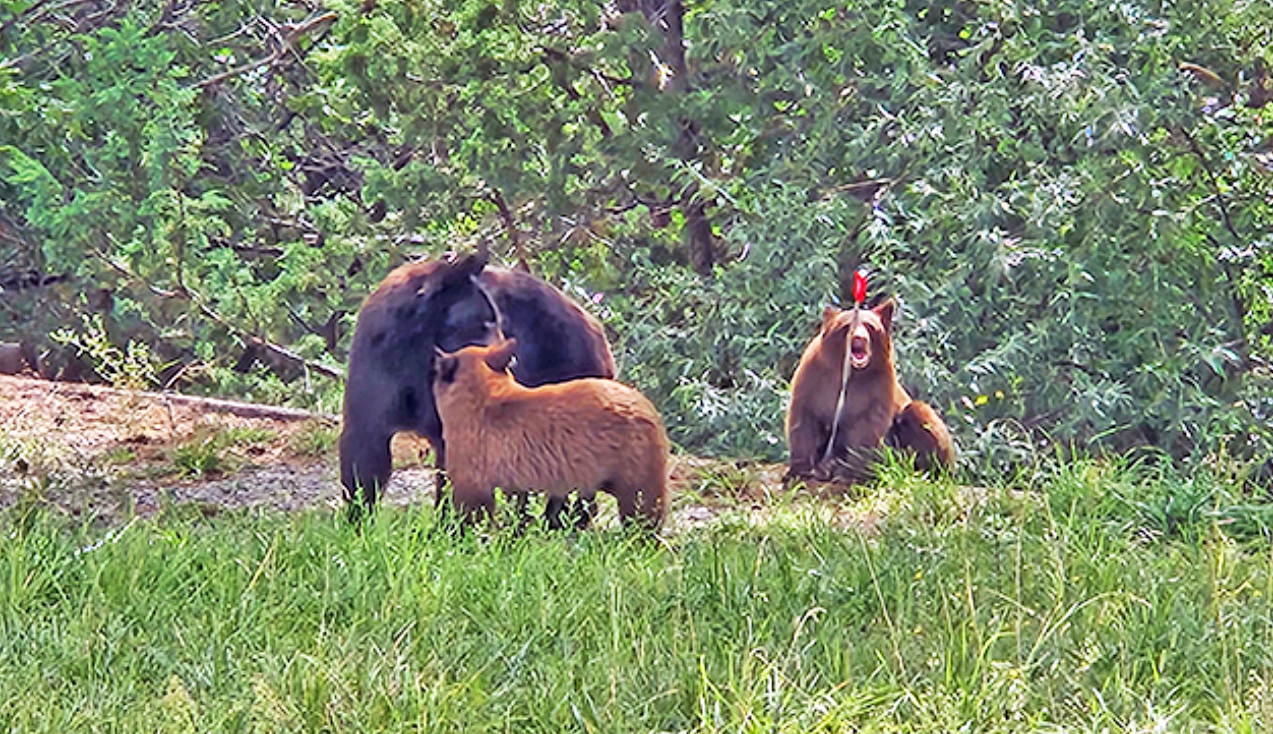
 A bear and cubs meander in August near the First Baptist Church. With incidences involving humans and wildlife continuing to occur, Los Alamos County Council voted for County staff to create an ordinance prohibiting feeding wildlife. Photo by Ben Martinez
By KIRSTEN LASKEY
Los Alamos Daily Post
kirsten@ladailypost.com
Los Alamos has created a problem that needs fixing. According to New Mexico Department of Game and Fish (NMDGF) Officer Tyler Carter, the number of calls logged from either NMDGF or Los Alamos Police Department for wildlife incidents keep piling in.
During Carter’s presentation to Los Alamos County Council Tuesday, the numbers for the different incidents were broken down.
Here are some highlights:
- From January through November, the number of calls logged for traffic accidents involving animals totaled 91. This increased from the 64 calls that were received in 2023.
- For the first six months of 2024, the number of calls regarding dead, sick or injured animals totaled 87.
- The calls for the second half of the year were not reported. In 2023, there were 319 calls.
From January through November, the number of calls regarding predators totaled 42, a jump from the eight that were received in 2023. - Calls regarding an immediate threat to human safety due to wildlife that resulted in the animal being euthanized total 13 from January through November. These calls were not reported in 2023.
Carter emphasized that calls regarding predators posing a direct threat to humans is a big concern.
For instance, he noted that in January Little Forest preschool was locked down during its pickup time because a mountain lion became too comfortable around humans. Another incident involved a bear wandering into a residence while people were sleeping, and a third event had a bear going into an occupied office on laboratory property because of food that was left out. It’s not just predators, Carter said while a young child played in his yard, a deer stomped on him because it viewed the child as a threat to its food source.
The common denominator for these incidences? People are feeding animals and creating at least 12 feeding locations that are active year-round.
“They are causing a very tight cluster around these incidents – not only car accidents but animal kills, attacks, sick animals – they are facilitating a lot of these incidences,” Carter said.
In response, Carter encouraged creating an ordinance to prohibit feeding wildlife and council agreed. In a 6-1 vote, with Councilor David Reagor opposed, council passed a motion to have County staff implement wildlife education plan recommendations and return to council with an ordinance to prohibit feeding wildlife and consider how NMDGF and local law enforcement could coordinate.
Councilor Randall Ryti made the motion.
“This is a problem that has been apparently decades in the making,” he said. “…I think certainly the public safety part of it (is important)… there’s also an impact on the wildlife themselves of feeding them inappropriate foods … it’s going to be something not everyone is in favor of, I think, but there are certainly benefits to helping with the education campaign if we actually had an ordinance … we can’t just rely on education if there is no local ability to enforce this…”
Reagor disagreed; saying the County’s education campaign was effective enough.
“It looks like they made a lot of progress first with the education campaign … and then actually identifying the feeding areas … that’s all a lot of progress and so I don’t see why we need to change anything … and I think we just continue forward for another year looking at this as a program moving in the right direction…,” he said.
Assistant Public Information Officer Leslie Bucklin provided an update on the County’s educational efforts.
She explained that through several avenues, which include the County Line, an online newsletter, social media, digital signs, press releases, a website, utility bill inserts, seasonal activity guides and collaboration with the Pajarito Environmental Education Center, the campaign touched on a variety of issues such as feeding wildlife, roadway safety, home tips, how to safely respond to wildlife encounters, contact information for local resources, as well as general information about local wildlife.
This is in addition to the rollout of bear-proof trash carts for residences and in County-owned parks where bear activity has been spotted, as well as the deer whistles being provided by the Customer Care Center, Bucklin said.
The efforts are paying off; she noted that there has been an increase in interest, participation and accountability regarding wildlife issues, but the education efforts need to continue.
Carter explained his role in addressing human and wildlife issues. He emphasized that his focus and interactions with people have nothing to do with individuals who properly hang bird feeders or grow gardens and fruit trees.
His focus is on nuisance animal problems.
To talk to a person responsible for the nuisance, Carter said someone else needs to report it. His first visit would be to educate the offender about the nuisance. The second visit would be a written warning to cease and desist feeding. The third visit would be a written citation in the Los Alamos County Magistrate Court.
This system is not exactly perfect, Carter said, because statutorily, Los Alamos Police Department cannot help to enforce this state regulation, and Carter cannot enforce local ordinances.
“So, this creates an enforcement gap in some of these issues where we are in limbo in a sense to some of the issues we have to deal with,” he said.
An ordinance would help with these gaps, Carter added.
“I am looking for council and community support, that we can move forward on a cooperative integration of a local ordinance allowing Los Alamos – not only animal control but maybe LAPD – to help me with enforcement so we can cover those gaps … it is our job as leaders to find a well-managed balance between a healthy wildlife population and harmoniously coexist with wildlife here in Los Alamos.”
Even with an ordinance, Carter said improvements wouldn’t change things instantly. Feeding wildlife has created significant consequences.
“…this is a longstanding effect that we have seen over 20, 30, 40 years that is established probably because of the Cerro Grande Fire … we started feeding them, we kept feeding them … so we are seeing a complete ecological breakdown of what their natural process should look like. That’s going to take a while to re-establish. It may take generations– animal generations – for them to establish.”
The public had mixed feelings about the ordinance. One speaker, Jonathan Dowell, said he felt people should be allowed to feed wildlife.
“I am sympathetic to the problem that our colleagues at the NMDGF are facing but I want to present the other side of this coin as a reminder of how important this issue is and why it is important to be able to feed wildlife – primarily birds but collaterally all the squirrels and the deer that feed on the seeds that fall on the ground. The threshold of which feeding these animals becomes an issue is undefined … so writing an ordinance to allow the police department to participate enforcing regulations is a legal slippery slope where the definition of these terms must be carefully chosen …”
Dowell added he felt education was the best route.
Former County Councilor James Robinson said he felt the ordinance was a step in the right direction. To have an effective wildlife campaign, three things are needed, he said, education, infrastructure and enforcement. Robinson said he supports the ordinance because it would complete the pillars needed for an effective campaign.
David Hampton also voiced support for the ordinance.
“I want to applaud the County’s efforts in educating the public … in my mind they have been very effective … and I think they are more than adequate for more than 99 percent of our population but as you can see from the presentation, we still have a very small amount of people in the County who insist on creating wildlife feeding areas … I would encourage you to pass an ordinance which would allow local law enforcement to deal with these 12-14 feeding areas …”
Hampton added if tools are not given to law enforcement, despite knowing these issues exist, and someone gets hurt or a traffic accident is caused by wildlife, it will be on the County’s conscience and could hold it legally liable.