
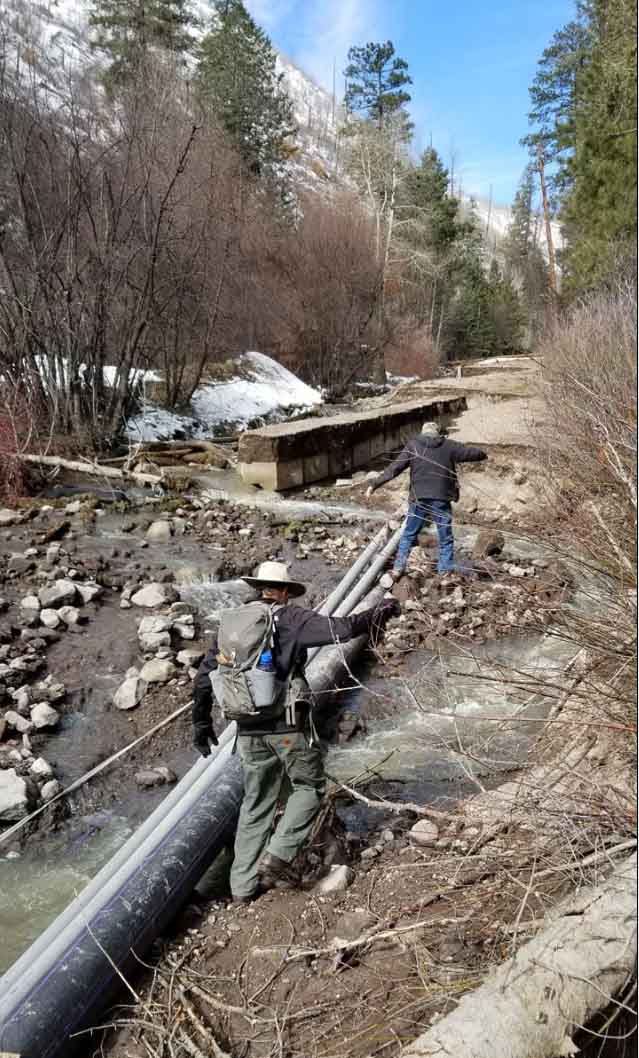
 The damaged caused by erosion is visible in Los Alamos Canyon. Courtesy photo/LAC
By KIRSTEN LASKEY
Los Alamos Daily Post
kirsten@ladailypost.com
The watershed in Los Alamos Canyon has had a rough time. It was hit with two major wildfires and several floods. As a result, the watershed has become choked with sediment causing damage to the pipeline that connects Los Alamos Reservoir to the townsite’s non-potable water system as well as the road leading to the reservoir.
The bad luck continued when after receiving approximately $2 million from Federal Emergency Management Agency (FEMA) in 2019 to restore the watershed, the money was pulled by the Trump administration to help fund the border wall.
However, it seems the bad luck is about to change. Los Alamos County Department of Public Utilities (DPU) recently received a $300,000 grant from the River Stewardship Program, which is run through the New Mexico Environment Department.
The grant, combined with $500,000 that will be taken from DPU’s budget and Los Alamos County’s general fund, will go towards restoring the watershed, Deputy Utility Manager Jack Richardson said.
The work includes clearing debris such as fire logs and dead tree limbs, he said. Additionally, DPU plans to restore the floodplain and the natural water channel.
Right now, Richardson said, there is so much sediment that the natural channel has been “plugged up”, forcing water to move to the road and destroying it.
What’s exciting, he added, is that natural materials will be used in the effort to make improvements to watershed and channel.
“It will help protect the road and the pipeline in the future,” Richardson said.
Using natural materials offers numerous benefits, he added.
For one, it will help restore the habitat in Los Alamos Canyon, which is located between the County’s ice rink and the reservoir.
“The benefits, first off, is that it will give (the canyon) a more natural appearance,” Richardson said. “These are temporary structures that help the natural environment create itself. The plan is we won’t need concrete and steel because it will be natural and self-sustaining.”
DPU Manager Philo Shelton agreed.
“What’s unique about this project is the natural channel design,” he said. “I think it’s a better design because we have the salamander (the endangered Jemez Mountains salamander) so it will protect that habitat and protect the waterline from erosion.”
Shelton added the natural design should have long-lasting effects.
“The goal is to get this done right,” he said. “So hopefully the channel design will reduce erosion – that is what is crucial for this to be long lasting.”
Plus, by protecting the pipeline and the road, DPU will be spared money and time spent on regularly repairing these two things, he said.
The cost to do repairs is significant, Richardson said. So much so that when DPU did the cost-benefit analysis for the FEMA money, it was proven that “the costs were large enough that it was a slam dunk.”
Besides doing the environmental work, he said the hope is to offer off-street parking at the foot of the trail to the reservoir and well as some limited recreational facilities such as benches and a path around the reservoir.
The grant was just finalized with the state last week, he said. This summer, DPU along with its contractors, will work on the environmental clearances, design and engineering plans with construction expected to begin next summer. He added the reservoir will most likely be closed during the construction.
This is the first time that DPU has been awarded a grant from the River Stewardship Program, Richardson said. He credited DPU Engineering Project Manager Clay Moseley for pursuing the grant and spear-heading the project. Additionally, Richardson thanked the U.S. Forest Service and the Department of Energy (DOE) for helping to shepherd the project through their agencies. Richardson explained the project is taking place on U.S. Forest Service and DOE land.
By having the grant and consultants experienced with a softer bio-engineering approach, Richardson said he feels optimistic about the project. Luck seems to be on its side.
“It’s really exciting,” he said.
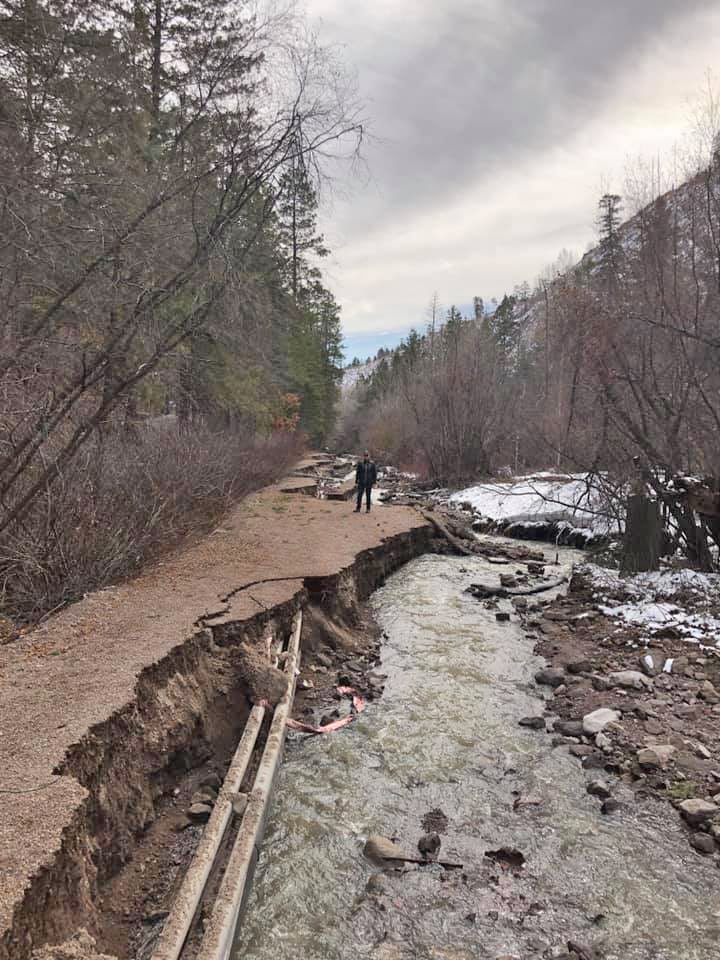 Another view of damage caused by erosion in Los Alamos Canyon. Courtesy photo/LAC