
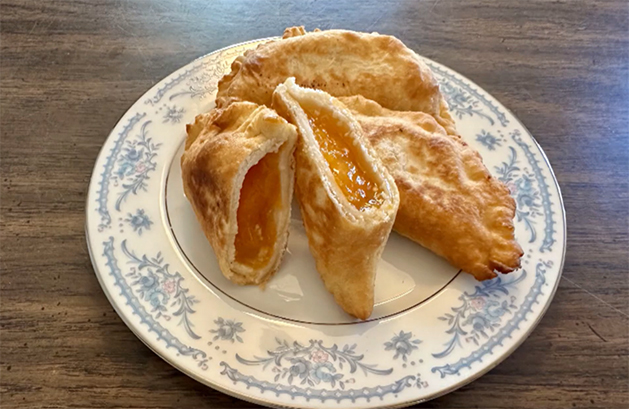
 Apricot Empanadas. Photo by Liddie Martinez
 By LIDDIE MARTINEZ
Española Valley
This week I have seen numerous posts on social media filled with elation about apricots! All have pictures of the velvety fruit in various stages from blossom to small green nugget and can be found all around our region this year. Looks like the growers survived the frost! Apricots!! Those elusive morsels that ignite glee in our hearts and trigger fond memories of yesteryear.
My neighbors all had apricot trees that were shared among the families. The boys used them as rapid-fire ammunition hurled at us girls from carefully contemplated cover as we made our way home from school along our irrigation ditch. My Godparents had a beautiful orchard of ruby red apples, plump pear trees and purple plums but the apricots were the most coveted. Their soft, fuzzy texture, sweet tart flavor and beautiful sun kissed flesh glistening on the dark green boughs of a heavily ladened branch was a rare sight, indeed, and cause for celebration! We would pick them green to eat with salt or carry them home in convenient baskets made by folding up the hems of our shirts. Grandma would place a handful in a small pot sprinkled with sugar and a few splashes of water to simmer gently into a shimmering preserve that we would spread on tortillas or on top of vanilla ice cream. Later, buckets of them would arrive from the neighbors and we would sit around the table pitting them and tossing the halves into a large, blue-specked basin. They would be boiled gently to fill sparkling jars that waited in our pantry all winter for a special occasion or to share with company.
Apricots first made their debut in northern New Mexico in the early 1700s with the Spanish settlements as Missionaries moved north from Mexico. Known as albercoques in New Mexico, apricots were among the first fruits introduced by the Spanish in northern New Mexico. Originally, they traveled from China to the Middle East on the Silk Road and then were introduced to Spain during the occupation by the Moors about 800 AD. The Moors planted apricot trees at the Alhambra in Granada, and apricot trees still give fruit there among the pomegranates and oranges as my husband Rick and I saw when we visited Spain last year. It warms my heart to trace the tradition from Spain to my kitchen.
This recipe is as old with its beginnings in medieval Spain as empanadas were filled with both savory and sweet ingredients. My version uses my tortilla recipe for the pastry and the filling is much as my grandmother made as described above but I use orange juice instead of water as the citrus keeps the fruit from discoloring. As always, keep pets and small children out of the kitchen when frying; hot oil burns are extremely painful and scar badly. And don’t forget that any extra dough you may have should be made immediately into sopapillas to drizzle with honey or stuff with whatever is in the fridge and top with chile to serve as dinner.
Apricot Filling
3 cups pitted apricots, frozen is ok. Just set out to slightly thaw before cooking
¾ cup sugar
¼ cup orange juice
3 teaspoons corn starch
½ cup cold water
Place apricots in a heavy bottomed saucepan and add sugar and juice and bring to a boil then reduce heat to low and simmer for 18-20 minutes stirring often. In a small bowl combine cold water and corn starch to make a slurry. Stir until it is smooth then add all at once to the cooked apricots. Stir the slurry in until well combined. It will look cloudy at first but let the mixture come to a boil a second time over low heat and the preserves will become a bright apricot color when thick. Remove from heat and allow the preserves to cool while you make the dough.
Tortilla Dough
3 cups flour
1 teaspoon salt
2 teaspoons baking powder
3 Tablespoons shortening
1 cup hot milk
Combine flour, salt, and baking powder. Add lard and work it into the flour mixture until it is crumbly. Add milk and knead into a ball. Allow dough to rest for at least 10 minutes. Divide into golf-ball-sized balls and roll out one at a time. Heat vegetable oil in deep cast iron skillet over medium high heat to about 350°.
Roll the dough out into a small circle and place a heaping teaspoon of filling on one half of the circle leaving a ¼ inch of space. Dip your finger into a small bowl of cool water and trace the half circle on the outer edge of the filling. Fold the other half of the pastry circle over and press lightly around the edge to seal. You will have a half moon shape. Press a fork along the edge to seal firmly then fold over edge to flute with thumb and forefinger if desired.
Fry for a minute on each side in the hot oil. Set on paper towels to drain and cool.
Makes 12-16 empanadas.
Editor’s note: Liddie Martinez is the author of the popular award winning Chile Line Cookbook: Historic Recipes of Northern New Mexico, which is available online at https://thechileline505.square.site/
Video showing how to make Apricot Empanadas. Video by Liddie Martinez