
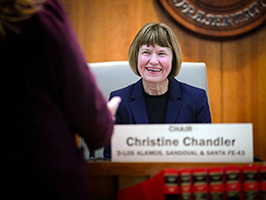
 Rep. Christine Chandler, D-Los Alamos, chair of the House Judiciary Committee, meets with committee members for their first meeting of the 2025 legislative session at the state Capitol on Wednesday, Jan. 22, 2025. Chandler is the sponsor of House Bill 4, which would change involuntary commitment policies. Gabriela Campos/The New Mexican
By MARGARET O’HARA
The Santa Fe New Mexican
Democratic lawmakers are bringing forth a revamped proposal on the involuntary commitment of criminal defendants who are deemed incompetent to stand trial, after a bill seeking a similar objective died on the vine during a failed summertime special session.
House Bill 4, a piece of legislation aimed at reforming the state’s system for criminal commitment, was among a slurry of bills introduced in the House on the first day of the legislative session Tuesday, as New Mexico lawmakers get to work in what promises to be a public safety-focused session.
The bill is intended to take a “balanced” and “compassionate” approach to the issue, said its sponsor Rep. Christine Chandler, D-Los Alamos.
“We’re recognizing we need to do more to deal with dangerous incompetent people with serious mental illnesses, but we’re also addressing concerns about the lower-level felons who have mental health issues and they are not being treated,” Chandler said in an interview Wednesday.
Chandler, a civil attorney who chairs the House Judiciary Committee, noted the bill will have to work in tandem with planned legislative expansions to the state’s behavioral health system. Democratic lawmakers earlier this month unveiled a package of proposals to help rebuild New Mexico’s system of behavioral health care, with a proposed billion-dollar trust fund and potential allocations of $150 million to $200 million for infrastructure.
The criminal competency reform is consistent with Gov. Michelle Lujan Grisham’s request to lawmakers during her State of the State address on Tuesday.
“… am calling on all of us, calling on the Legislature to take action now … to compel humane civil commitment for those who need treatment the most and to reform criminal competency laws that let too many dangerous people remain on the streets,” Lujan Grisham said during the speech.
As of the end of the day Wednesday, Lujan Grisham’s office was reviewing various pieces of legislation — including HB 4 — but hadn’t yet made a call on whether to support the bill, spokesperson Jodi McGinnis Porter, wrote in an email to The New Mexican.
Chandler said she’s been in communication with the governor’s staff.
“My sense is they’re generally positive about the approach we’re taking,” she said. “As with all bills, I am always open to helpful suggestions that will improve the process.”
Chandler’s proposal has been months in the making and comes after a special session the governor convened in July to address public safety.
The governor proposed a criminal competency bill that drew opposition from behavioral health providers and others. Lawmakers urged the governor not to call a special session, saying the criminal competency proposal and other bills the governor was pushing needed more work and could lead to unintended consequences if passed.
The Legislature adjourned in five hours without taking up any of the governor’s proposals, angering Lujan Grisham, who called it one of the most disappointing days of her career.
Chandler said the governor’s bill was more prescriptive than hers.
“It required [district attorneys] to do certain things,” Chandler said. “In our case, we are providing options to the courts and [district attorneys], recognizing that they need prosecutorial discretion.”
Advocacy organizations had decried legislation that would mandate the initiation of involuntary commitment proceedings and prevent prosecutors and judges from making case-by-case assessments.
If passed, House Bill 4 would expand the list of crimes eligible for criminal commitment to include child abuse, child sexual exploitation and human trafficking, in addition to the existing offenses of aggravated arson, criminal sexual penetration, sexual contact with a minor and felonies committed using a firearm or that inflict great bodily harm.
“It expands the opportunity to offer someone treatment through criminal commitment. … More people, they won’t be on the streets because they’ve been deemed dangerous — and we hear the public loud and clear on that,” Chandler said.
The bill also proposes mental health treatment for those accused of misdemeanors and low-level felonies who, as the law currently stands, would be released and see their cases dismissed.
“We’re releasing people who have a serious mental illness, and we’re not getting them the help that they need,” Chandler said.
Under HB 4, defendants deemed by the court not to be dangerous could be ordered to participate in a “community-based competency restoration program” in their home community for no longer than 90 days. Alternatively, the judge could advise the prosecutor to pursue involuntary civil commitment or assisted outpatient treatment.
However, increasing the number of people eligible for criminal or civil commitment, competency restoration programs and assisted outpatient treatment won’t be feasible without expanding the state’s behavioral health system, which providers say already struggles to hire enough providers to serve existing clients. Parts of 28 of New Mexico’s 33 counties are designated by the U.S. Department of Health and Human Services as mental health professional shortage areas, according to a June 2024 report from the Legislative Finance Committee.
That means changes to behavioral health and criminal commitment will have to happen simultaneously, Chandler said.
“There’s going to be a package of initiatives in terms of expanding resources for mental health treatment [and] facilities for mental health treatment,” she said. “This will all have to be built at the same time we’re working on this law.”
Editor’s note: Staff writer Daniel J. Chacón contributed to this report.