
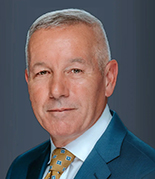
Mark Davis
LANL Deputy Director for Operations
By KIRSTEN LASKEY
Los Alamos Daily Post
kirsten@ladailypost.com
Los Alamos National Laboratory (LANL) is in a dynamic situation, LANL Deputy Director for Operations Mark Davis told Los Alamos County Council during the May 5 meeting.
Davis recalled the last time he went before council he touched on the evolving geo-political position that the laboratory was in and that it has only grown.
“It’s hard to believe a year later the situation is even more dynamic than it was last year and LANL is at the forefront of the strategic deterrence efforts that our country is undertaking,” he said.
To further emphasize the significance, Davis read a quote from NNSA Administrator Brandon Williams, “the heart and soul of the nuclear weapons enterprise is right here in Los Alamos.”
“We are now entering what we at the lab like to call the fourth age of deterrence,” Davis said. “With the end of the Cold War and the foregoing of nuclear testing, we are in the third age of deterrence, which is stockpile stewardship. We maintained our stockpile, didn’t build any substantially new weapons, kind of maintained the status quo. Now we are entering what we call the stockpile modernization period. Our country is endeavoring to update all three legs of the triad simultaneously, which is a really huge undertaking.”
Despite the changing situation, Davis also reported that 2025 was a very good year at the lab.
“We accomplished a great deal and showed a lot of progress,” he said.
A few accomplishments included:
- Meeting pit production requirements;
- Making significant progress with LAP4, which is a capital project to upgrade and modernize the lab’s pit production facility;
- Progressing on the electrical power capacity upgrade project;
- Collaborating with OpenAI and NVIDIA to launch AI models on the laboratory’s Venado supercomputer, which is the latest one it has; and
- Announcing the development of two next generation supercomputers.
Still, one of the biggest efforts is the nuclear stockpile. The enterprise has shifted from sustainment to production and delivery and LANL plays a central role in that, Davis said.
“We need to really adapt quickly to this stockpile modernization effort,” he said.
NNSA has given LANL transformation directives on how to change its approach to how it does work, Davis added.
“They’re really focused on how we can accelerate mission delivery; how we can deliver those things the nation needs more efficiently and effectively and obviously at a reasonable cost,” he said.
In relation to that, pit production is accelerating, he said.
“We’ve been asked to do more – how much more is still up for debate,” Davis said. “We know we will be asked to do more than we have in the past.”
Despite the changing situation and the focus on the production, Davis said there is still a need and a desire to preserve science and engineering expertise “because that’s what we need to do for the future.”
He gave a brief rundown on various areas for the laboratory: budget, partnerships and economic impact.
Budget
Davis reported that in January, LANL got a full year appropriation of $5.5 billion. Of that, $2.2 billion is in procurement, he added.
“We anticipate going forward in FY27 and beyond that national security will play a center role so our budgets will stay at the same level if not increase,” he said.
As far as hiring, Davis said no major spurts of hiring are projected. This year, the lab anticipates hiring between 1,000 to 1,200 employees to handle growth and attrition.
Partnerships
“Regional partnerships are really essential to our success,” Davis said.
In FY25, the focus was on project execution and had $356 million in the construction spending plan, he said. Going forward, the lab has 1.65 million square feet in near-term construction that must be executed. In the mid- to long-term, there is 4.7 million square feet of new construction that must be undertaken.
“That’s a big lift for us,” Davis said. “We’re looking for ways to become more effective and efficient at that – obviously the goal is to deliver these projects at a quality level that we need on time and on budget.”
He explained that the laboratory is looking at commercial construction standards and how to follow the commercial industry’s lead at the laboratory.
In response to Los Alamos County’s big concern regarding traffic and housing, Davis said more off-site options are being looked at.
“Can we transfer some of the non-hands-on work that we do perhaps off the lab in Santa Fe … (or) down the hill in Pojoaque …,” he said.
Regarding collaborations with the County, Davis said the laboratory works daily with the police and fire departments. He further noted that all parties have collaborated on wildfire prevention efforts, an active shooter drill and a wildfire drill is being planned.
Economic impact
Davis reported that LANL has spent a little more than $381 million on New Mexico procurement. He added that $2.04 billion is designated for salaries.
Looking at the laboratory’s employees, 40 percent of employees are native New Mexicans and the laboratory spent $141 million in gross receipts taxes in the last fiscal year.
Davis added that the laboratory works closely with the Regional Development Corporation to leverage local resources and work together to meet the lab’s and community’s needs. Additionally, LANL supports 644 non-lab jobs.
Regarding slowing down on job hiring, Councilor Melanee Hand wondered if the County was taking the right direction with its housing plans.
Davis said he felt the County was taking the right direction.
“The growth over the next several years will be modest … we work very closely – I meet with your (County) manager every month and we talk about these things, and housing is always at the top of both our lists,” he said. “I will share with you antidotally … I’ve been at LANL a little over four years, when I first got here pretty much the one thing on the minds of the employees was housing. I don’t hear that as much anymore. It is obviously still a concern, but I don’t think it is as much of a concern as it has been previously.”
Councilor Suzie Havemann wondered what the percentage was of employees who lived off the hill and if it would be lower if they had more housing choices.
Davis said he estimated more than 50 percent of lab workforce lived outside Los Alamos. The biggest concern for employees, he said, was the commute to and from work so the laboratory is always looking for ways to make it easier and safer. As far as employees wishing they could live in Los Alamos, Davis said he hadn’t heard that wish.
Councilor Beverly Neal-Clinton said she had some concern about the optics of the looming pit production and questioned what is at the forefront for LANL.
Davis responded that the concern is on everyone’s minds.
“We cannot lose that legacy and that heritage … we have to produce for today, but we also have to maintain that science and research and development capability for tomorrow,” he said.