
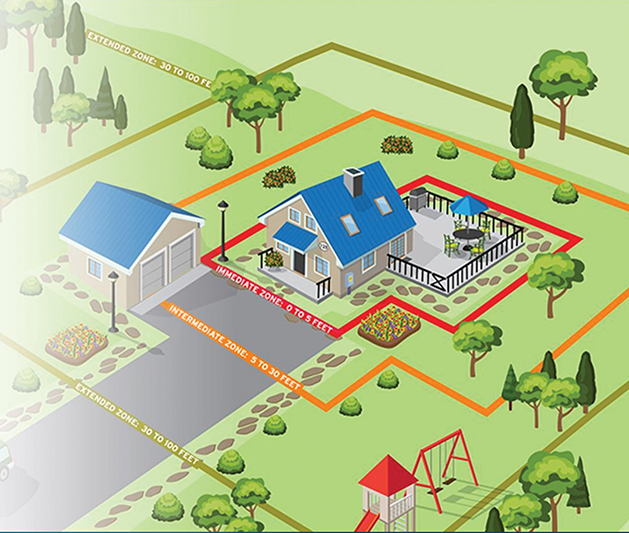
 An example of defensible zones for a residence. Courtesy/LAC
By KIRSTEN LASKEY
Los Alamos Daily Post
kirsten@ladailypost.com
It is only February and there are already fires igniting in New Mexico.
During the Los Alamos County Council work session Feb. 10, Wildland Division Chief Van Leimer reported that this month there are two wildfires in the eastern part of the state. One is about 4,000 acres and the second is approximately 3,500 acres, he said. Luckily, they are grass fires and as of Feb. 10, Leimer said both were 70 percent contained.
It isn’t looking good for the rest of the country, either. Leimer showed a map of the U.S. that displayed the wildfire predictions for the country in March, and the southwest and southern portions of the U.S. are dipped in red for high fire alert.
Locally, there are extreme draught conditions, he said, however, it isn’t all dire. Los Alamos County is preparing and has a plan should another wildfire get sparked here.
Leimer shared what mitigation the Los Alamos Fire Department performs.
He noted through using the burn bot, the department mitigated about 32 acres near Los Alamos County Airport. Further, Leimer and County Open Space Specialist Eric Peterson collaborated on other areas to mitigate.
The County also adopted the wildland urban interface code chapter 5, which has to do with construction of new buildings and chapter 6, which addresses the defensible space area around homes. The way the fire department addresses residential mitigation is through its home assessment program, which is offered to all residents free of charge.
To successfully prepare for wildfire season everyone’s participation is required, Leimer said.
To prove this point, he played a short video of the Cerro Grande Fire.
“I just wanted everybody to remember for those of us who were here and those of us who weren’t here what occurred when that fire came into the west side of Los Alamos,” he said.
Within 40 seconds of the fire coming in, it took out a portion of the community. To be blunt, Leimer said Los Alamos wasn’t very prepared and ready in 2000. But things have changed and the goal is to never replay the events captured in the video.
“Mitigation is the primary factor, and the County has to set an example,” he said. “So that’s why we have done all the mitigation that we have done … I think ultimately in the last three to five years we’ve done approximately 200 acres with the grant we got in 2020 – the DHS (Department of Homeland Security) grant.”
The County also follows the Ready, Set, Go plan.
The Ready Phase, is the phase the County is in right now. This is when families discuss and create a plan for what they are taking with them and where they are going to go.
Touching on what to take, Leimer said it should be any important papers, medications, cash, credit cards, food, water and items needed for an extended stay, as well as a portable radio. Residents will be encouraged to register for Ever Bridge, which is replacing Code Red. Lamier said efforts to promote Ever Bridge and get everyone registered will begin in the spring. He explained Code Red is being replaced because there was a problem with it in December.
Another step to take is to do the home assessment. Leimer said during the assessment, firefighters will inspect the roof and siding to make sure they are sealed and do not have cracks. Around the home, he recommends first doing the cheap things like picking up pine needles and fallen branches. Then, homeowners can move on to the bigger things. Fences should be five feet away from the house, a quarter-inch mesh covering is suggested to be installed over chimney openings, and a defensible space should be maintained.
Within zero to five feet from the home, Leimer said there shouldn’t be any fuel: no flowers and no combustible material such as wood. Five to 30 feet away from the house, trees should be spaced 10 feet apart and nothing should be below six feet. Also, trees should be trimmed and there shouldn’t be any branches hanging over the house.
Mitigation needs to continue even further.
“In Los Alamos we are in extreme fire danger,” Leimer said. “We want to have 100 feet away from your home mitigated to the point where you have enough space where we can keep that fire on the ground and not move up to the trees. Not only is it safe for the community but it’s safe for the firefighters when we go in and do our job to try to suppress that fire.”
He added that any out-buildings need to be 20 feet away from the home and fuel tanks should be 10-30 feet away.
The next phase is Set. Leimer said this is when people should put the necessary items in a clear box and make a list of the contents. Their go-bags should be ready to be put in the car. If staying, homeowners are encouraged to patrol their property, have a fire extinguisher and hook up their garden hoses and turn on their sprinklers. If they are leaving, residents should turn off their water and close windows and doors. Furniture inside should also be moved away from windows. Air conditioning units should be shut off and if possible, close vents.
“Be organized; be ready,” Leimer said.
For the Go phase, the County does have an evacuation plan in place, Leimer said but if people feel uneasy, they can leave at any time.
During public comment, resident James Wernicke wondered if there were grants available for residents to do fire mitigation. During his presentation, Leimer said mitigation is not cheap; it can cost $50,000 or more.
Fire Chief Erik Litzenberg said while he hasn’t heard about grants for individuals there are grants available for communities. In fact, Litzenberg said the State Fire Marshal is coordinating for a grant that would be allocated for high risk and low-income communities.
Councilor Melanee Hand advocated that homeowners take advantage of the fire department’s home assessments.
“I’ve actually had the fire department come out and do an assessment on my home,” she said. “It was very enlightening to find out some of the things that were recommendations. I didn’t expect some of the things that were recommendations. Getting your house in the ready stage … it is not an easy job especially if you are doing it yourself, so I highly recommend that people keep up with it … (and) I appreciate that service from the fire department, I think it is very valuable.”