
 Los Alamos National Laboratory Director Thom Mason participates in a Q&A session with LANL’s Community Partnerships Office Director Kathy Keith during Monday’s community conversation event at New Mexico Highlands University in Las Vegas, N.M. Photo by Kirsten Laskey/ladailypost.com
 LANL Director Thom Mason, left, speaks with Collins Lake Ranch Founder Steve Smaby, center, and LANL Foundation Board Member Bill Wadt at Monday’s event. Photo by Kirsten Laskey/ladailypost.com
By KIRSTEN LASKEY
Los Alamos Daily Post
kirsten@ladailypost.com
During Los Alamos National Laboratory’s (LANL) Community Partnerships Office’s community conversation event, LANL Director Thom Mason put it succinctly: if interested in working at the Laboratory, some type of higher education is necessary.
The good news is there are multiple avenues, resources and funding to achieve that required education, Mason noted during the talk, which was held Monday at New Mexico Highlands University in Las Vegas, N.M. About 100 educators, elected officials, nonprofit leaders and economic developers attended the event.
He noted that the laboratory had been through a period of rapid growth, but that hiring spike is leveling off. However, to maintain staffing levels, he said between 700-800 people a year need to be recruited. Scientists and engineers are certainly needed, Mason said, but so are employees for the Laboratory’s business operations as well as technicians and skilled craft such as welders, electricians, pipefitters and carpenters. Workers are needed for the lab’s security and cyber-security, too.
“It is actually pretty broad … we don’t have a lot of jobs for people who stopped at high school,” Mason said. “No matter what you do here you are going to need something beyond that … but there are many different ways to get there.”
Through its various partnerships and programs, a career at LANL is possible.
Mason emphasized all those partnerships are important.
“We are not educators … so we have to work with people who know that in the schools, in higher institutions and philanthropic community,” he said. “We cultivate those partnerships and rely on them.”
Some of these partnerships, he said, involve Highlands University to address the laboratory’s finance and comptroller space. Another is the lab’s multi craft core curriculum, which is a pre-apprentice training program that is offered with UNM-Taos to high school students for dual enrollment. It transitions into an apprenticeship at the conclusion. Additionally, the lab partners with Luna Community College on its plutonium workforce development initiative, which provides funding for a welding program at Luna. This is just the tip of the iceberg; Mason said the lab has partnerships with Northern New Mexico College, Santa Fe Community College and UNM-Los Alamos.
“We have found that local higher education institutions are really interested in learning our needs and tailoring specific programs that draw on their strengths to produce the curriculum that will help us recruit and then retain people from the region around us,” Mason said.
The laboratory also provides direct support through the LANL Foundation as well as the Community Partnerships Office and the Bradbury Science Museum, he said. Mason also mentioned the lab offers Challenge Tomorrow mobile trailers that travel to student groups, the Support Math, Science Academy for teachers and a summer physics camp. LANL employees also put in volunteer hours to various education endeavors.
Education is a big component of LANL’s philanthropic activities, Mason said. The Laboratory provides grants and scholarships as well as shares its expertise. This is important, he said, because education has such a significant impact on young people’s lives.
“The choices kids make, often very early in their educational career, can have a big impact,” he said.
It is not just students who are impacted but teachers, too.
“If we can equip a teacher or give them an experience that they can bring back to their students … it is not just one person you have impacted but everyone they interact with,” Mason said.
Another major influence that was brought up during the conversation, was AI.
While Mason said it is hard right now to see the ramifications of AI since “we are kind of in the middle of it now”, he sees two aspects of how AI is playing out for the lab.
One is being a useful tool for automating repetitive, not very interesting tasks.
The other is more exciting, he said.
“But the thing I am really excited about is the tool to accelerate the pace of scientific progress because science is a big feedback machine,” Mason said. “Breakthroughs in one area makes something new possible, which leads to a breakthrough in another area, and artificial intelligence in its various forms we have been using for a while … it is pretty clear that it’s going to allow us to arrive at solutions, pose better questions, target the experiments that we do in a way that I think is going to speed up the pace of scientific progress that I think has transformational possibilities, because as I said science is a feedback machine and if you change the slope on human progress then over time that will compound and we all know the magic of compound interests, that’s how you get exponential growth.”
Mason said LANL is taking advantage of AI’s tools and the possibilities include building its own AI systems through partnerships with private companies.
“I think it will lead to pretty dramatic changes over the years,” he said.
All of this, of course, takes money. Mason was asked about the Laboratory’s budget and if it was affected by the federal government’s cuts.
“Not in a terribly significant way,” he said. “There have been a few programs that were funded by the prior administration, and they are not on the priority list to do by this administration. We have seen some selective reductions but overall, our prospects for funding are pretty good. The budget being proposed for next year … actually has a pretty sizable increase in funding for the lab … we have had pretty solid bipartisan support …”
The budget is not yet certain, but Mason emphasized what is certain is the importance of LANL’s commitment to education in the region.
“I think it is incumbent on us to find ways to support the region around us; make it more prosperous, make it more successful, and of course we all live here, our kids go to school in the region and so we want them to get a good education,” he said.
About LANL’s Community Partnerships Office
The Laboratory’s Community Partnerships Office supports education, economic development and nonprofit giving in the seven counties surrounding the Laboratory. They are: Los Alamos, Mora, Rio Arriba, Sandoval, San Miguel, Santa Fe and Taos. Community Conversation events are held three times per year at locations throughout the region. To learn more, subscribe to the free Community Connections newsletter
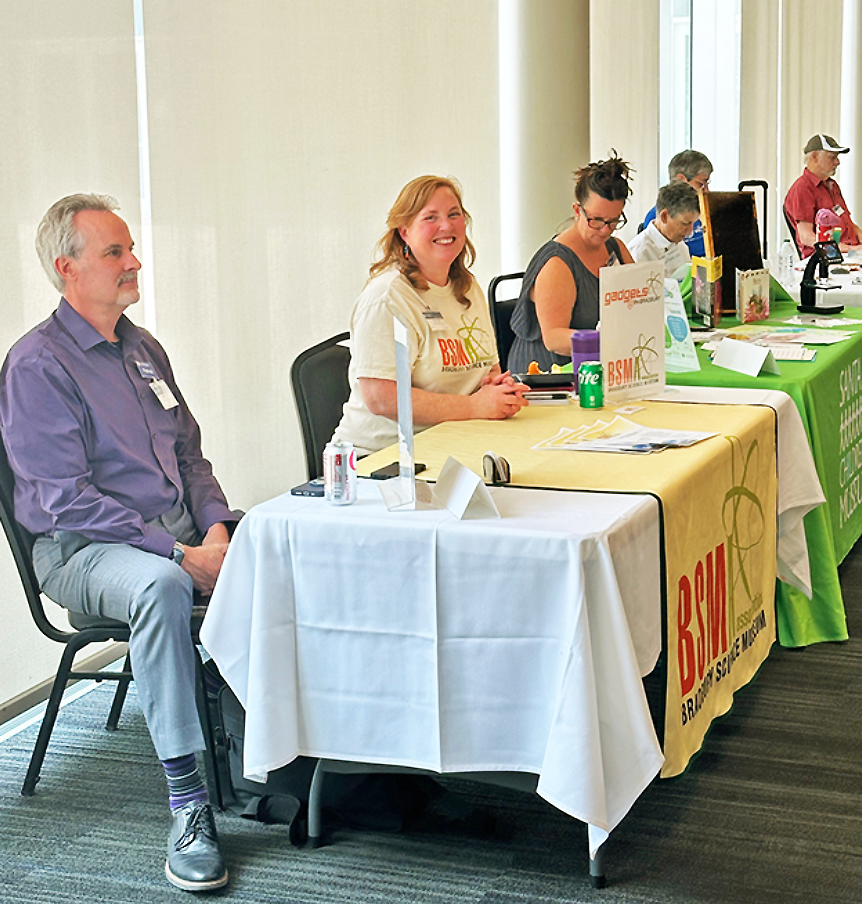 At left, Bradbury Science Museum Director Patrick Moore and Jennifer Cline of the Bradbury Science Museum Association are among many nonprofits, elected officials, and economic developers attending LANL’s Community Conversation event Monday at New Mexico Highlands University. Photo by Kirsten Laskey/ladailypost.com