
 Rendering of Ice Age muskox relative Speleotherium logani. This new species was identified from fossils collected in Carlsbad Caverns National Park. Courtesy/NMMNHS
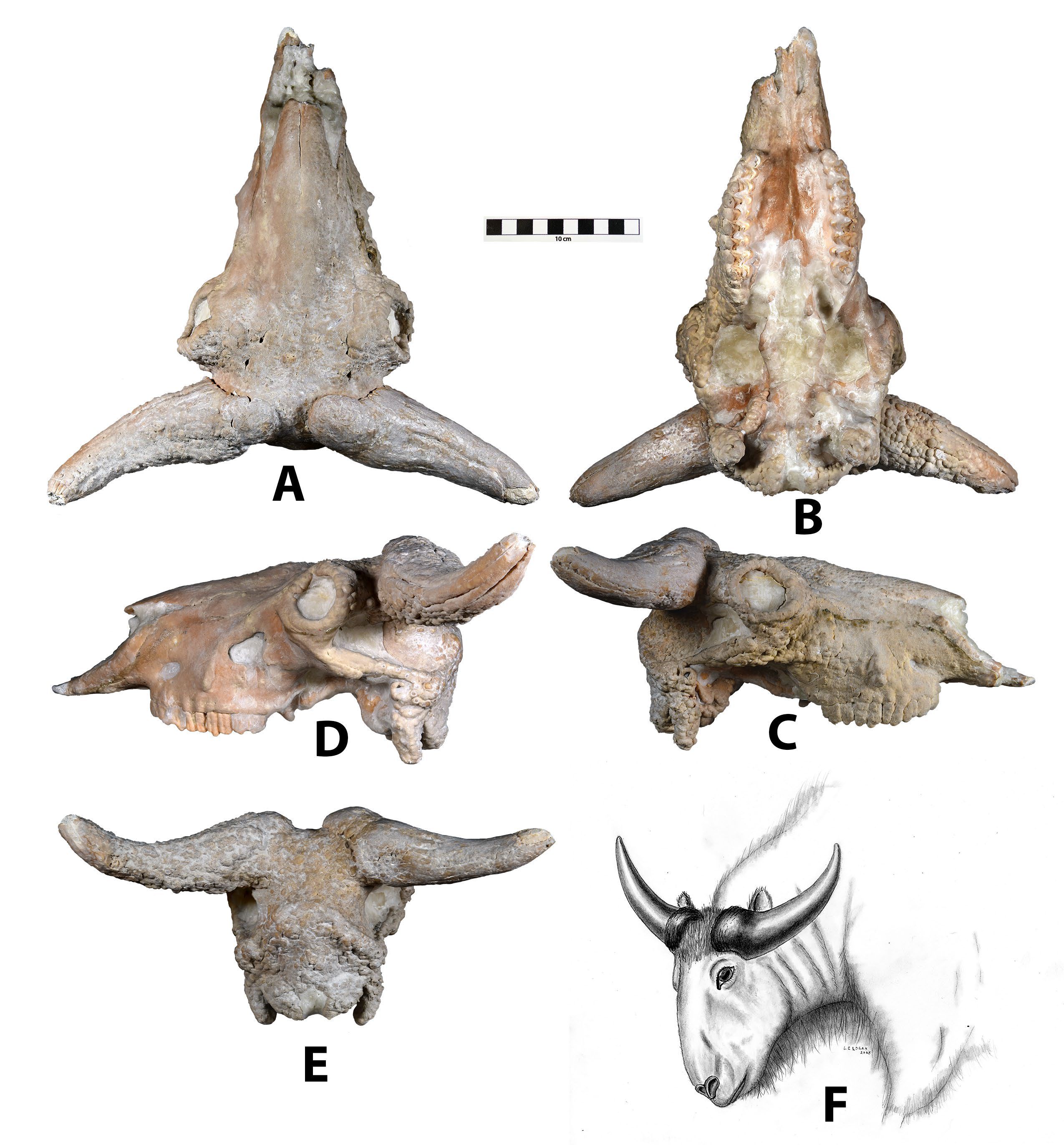 Speleotherium logani gen. et sp. nov., holotype skull, USNM 598576, Muskox Cave, Carlsbad Caverns National Park, Eddy County, New Mexico in (A) dorsal, (B) ventral, (C) right lateral, (D) left lateral, (E) posterior, and (F) reconstructed view. Note that most surfaces are encrusted with flowstone from 3 to 12 mm in thickness. Scale bar = 10 cm. F drawn by Lloyd E. Logan, Courtesy/NMMNHS
NMMNHS News:
ALBUQUERQUE — A New Mexico Museum of Natural History & Science researcher was part of a team that identified an Ice Age relative of the muskox from fossils uncovered in Carlsbad Caverns National Park.
This new species, Speleotherium logani, was identified in a paper authored by New Mexico Museum of Natural History & Science (NMMNHS) paleontology curator Gary Morgan, along with first author Richard White, Jim Mead, and Sandy Swift of the Mammoth Site in Hot Springs, South Dakota. The findings were published in a recent edition of the New Mexico Museum of Natural History and Science Bulletin.
“New Mexico is known as a hotbed for dinosaur fossils, but discoveries like this remind us that our state’s fossil record extends long after the Cretaceous extinction,” NMMNHS Executive Director Dr. Anthony Fiorillo said. “This discovery offers new clues about what mammals were living in New Mexico during the last Ice Age.”
Speleotherium logani was named for researcher Lloyd Logan, the paleontologist who led the exploration uncovering the fossils in 1976 and 1977. These fossils, which include a perfect skull and much of the animal’s skeleton, were discovered in the aptly named Muskox Cave in Carlsbad Caverns National Park. For more than four decades, the fossils were stored in the collections of the Smithsonian’s National Museum of Natural History.
In 2023, the research team began to study the fossils and realized that they belonged to a new species, a previously unknown relative of the muskox. Comparisons with bones of both the front and hind legs in the Muskox Cave collection allowed researchers to identify bones of this new species from four other fossil sites, including U-Bar Cave in the bootheel region of southwestern New Mexico, two caves in Mexico and a cave in Belize.
“Fossils of most large Ice Age mammals, such as mammoths. mastodons, ground sloths, and sabretooth cats, were discovered more than a century ago, with only a few new species, including Speleotherium logani, recognized within the past few decades,” Morgan said. “The discovery of Speleotherium in Muskox Cave and U-Bar Cave attests to the extraordinarily rich fossil record of Ice Age mammals in New Mexico.”
Speleotherium lived during the Late Pleistocene Period, which ended less than 12,000 years ago. The species is closely related to the modern muskox, found north of the Arctic Circle in Alaska, Canada, and Greenland. Its horns resemble those of the modern muskox, and played a key role in helping researchers identify Speleotherium as a new species. Speleotherium was slightly smaller than its modern cousins, up to four feet tall at the shoulder and weighing between 400 to 700 pounds.
Fossils from Speleotherium have been found farther south than those from any of its relatives. Researchers believe the mammal lived in rocky, mountainous regions of the southwestern US and Mesoamerica, with habits much like those of the mountain goat from the Northern Rocky Mountains.