
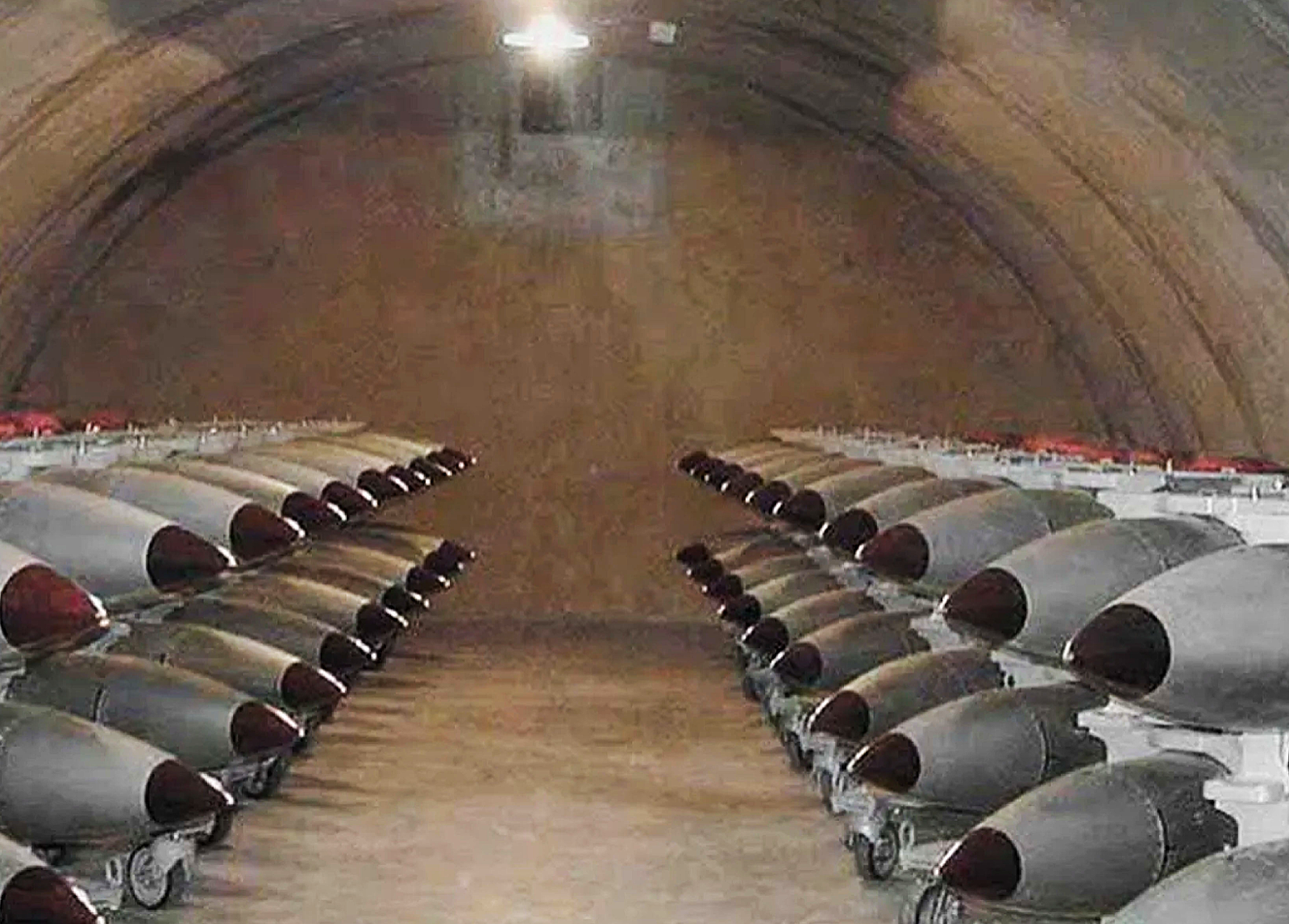
 A B61 Nuclear Bombs in a Bunker illustrates the unimaginable destructive power located in one storage bunker. Courtesy/Bulletin of the Atomic Scientists 2025
By Mark MacInnes
For the Los Alamos Daily Post
Adversaries and Urgency
As the United States confronts growing competition from China and Russia, much of the public discussion about nuclear deterrence focuses on missiles, submarines, and bombers. A recent online forum hosted by the Advanced Nuclear Weapons Alliance Deterrence Center highlighted a less visible challenge: rebuilding the industrial and scientific infrastructure needed to support the nuclear weapons systems after decades of post-Cold War decline.
 LLNL Director Dr. Kim Budil
Presenters included Lawrence Livermore National Laboratory Director Kim Budil and Eric Wollerman, president and CEO of Honeywell Federal Manufacturing Technologies, which operates the Kansas City Plant.
Together, they described an enterprise struggling with a major problem: America’s nuclear infrastructure is aging, many specialized skills have become scarce, and critical production capabilities that once existed at scale must now be recreated. The clock is ticking, and the stockpile and its supporting weapons systems are both aging.
The meeting focused narrowly on weapons production.
 President and CEO Eric Wollerman
Honeywell Federal Manufacturing Technologies
These laboratory leaders hope that new technologies, such as digitizing production steps to a greater extent than ever before and using advanced manufacturing and artificial intelligence, can help accomplish the task faster and at a lower cost than would have been possible during the Cold War.
Rebuilding Capabilities
One of the strongest themes throughout the discussion was that the National Nuclear Security Administration is attempting to rebuild capabilities that largely disappeared after the Cold War. At Lawrence Livermore, Los Alamos, Kansas City, Pantex, Y-12 and other sites, leaders are trying to recreate manufacturing capacity while simultaneously modernizing it.
Dr. Budil noted that the W87-1 warhead, intended for the future Sentinel intercontinental ballistic missile, represents something the United States has not attempted in decades: a newly manufactured nuclear warhead and delivery system. The effort is driving investments across the weapons complex, including the essential production of plutonium pits at Los Alamos National Laboratory.
Wollerman described the challenge from the production side. Kansas City Plant, designed for at most two simultaneous production lines, now supports eight separate modernization programs.
He said, “It’s not a conventional production line at KCP.”
Each workstation may be tasked with multiple different jobs for different systems.
“It’s a high-tech job shop. We delivered 277,000 components to our customers last year,” Wollerman said. “The machine’s moving.”
Both Directors acknowledged that rebuilding infrastructure is difficult, expensive, and time-consuming. Facilities designed for a smaller workload now face demands far beyond their original mission. New buildings, manufacturing space, and workforce expansion are underway across the complex.
From Rocky Flats to Artificial Intelligence
Perhaps the most fascinating moment came when Kim Budil described efforts to reestablish pit production. Plutonium pit production is ‘decades old’ technology. The United States previously produced pits at the Rocky Flats Plant near Denver by the hundreds before that facility closed in 1989. Yet much of the practical knowledge behind those operations was never fully digitized.
“Our designers are reading the original build books from Rocky Flats to understand what the secret recipe was,” Budil said.
In other words, some of the nation’s most advanced weapons scientists are consulting decades-old paper records while simultaneously deploying some of the world’s most sophisticated supercomputers to the project.
That contrast captures a broader transition occurring across the nuclear enterprise. Yesterday’s manufacturing knowledge often lived in notebooks, procedures and institutional memory. Tomorrow’s manufacturing systems may record every aspect of production in digital form. Budil described a future where engineers can create “digital twins” of components—a complete digital record of how a part was manufactured, inspected and certified.
Instead of relying solely on human judgment to discover defects, future systems will use digital twin simulations and AI-assisted analysis to determine whether a part is acceptable or requires replacement.
Technical and Policy Humility
The most memorable remarks arose during a discussion of computer models and simulations. Asked whether increasingly powerful models could tempt future designers into overconfidence, Budil acknowledged the concern.
“One of our most important core competencies has to be technical humility,” she said.
As an experimental physicist, she added, “Mother Nature always gets a vote.”
Those comments resonate well beyond the nuclear enterprise. A growing number of defense and technology analysts suggest the nature of deterrence may also be evolving. They imagine not only a reliance primarily on nuclear forces but also a move towards a broader mix of nuclear capabilities, artificial intelligence, advanced sensing, and nonproliferation tools.
The community of Los Alamos, which helped launch the atomic age, has spent more than 80 years wrestling with the opportunities and consequences of transformative technologies. As the nation invests in rebuilding the nuclear tip of the spear, it must also decide what, indeed, are “enough” weapon systems, each of which requires enormously expensive military systems to maintain and deploy.