
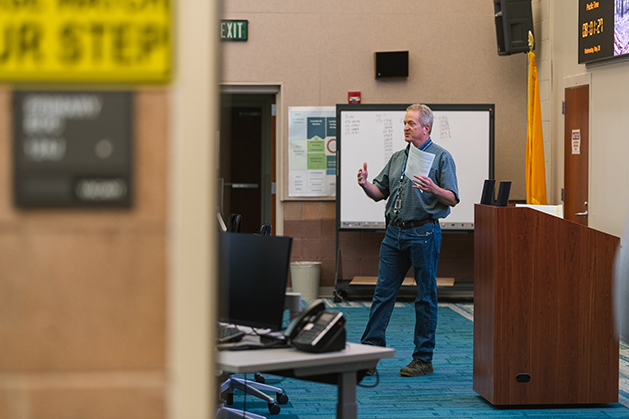
 LANL Emergency Management Division Leader Jeff Dare addresses members of the media on May 28 at the Emergency Operations Center during the Wildfire Preparedness Media Tour. Courtesy/LANL
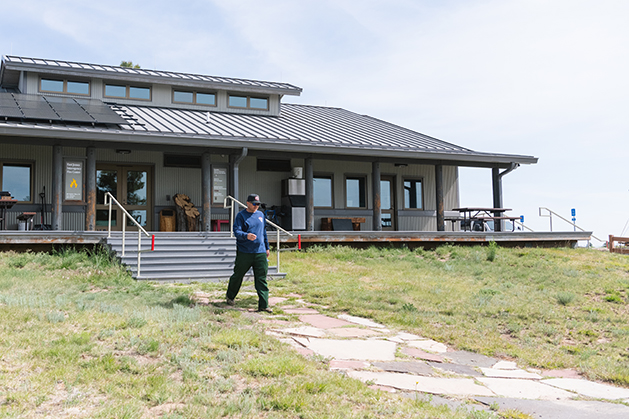 Media visit the East Jemez Interagency Fire Center during the May 28 Wildfire Preparedness Media Tour. Courtesy/LANL
 LANL Wildland Fire Program Manager Richard Nieto addresses the media May 28 at the East Jemez Interagency Fire Center during the Wildfire Preparedness Media Tour. Courtesy/LANL
By KIRSTEN LASKEY
Los Alamos Daily Post
kirsten@ladailypost.com
Let’s face it: the odds are not looking good for wildfire season in New Mexico. The prolonged drought, the expanded timeframe for wildfires all add to the risk of a fire being ignited.
The odds are stacked high but that doesn’t mean giving up or being complicit. In fact, Los Alamos National Laboratory (LANL) is doing the opposite. During a media tour held May 28 that included visits to the Emergency Operations Center, the Interagency Fire Center at TA-49, Transuranic Waste Facility at TA-63 and Area G at TA-54 it proved just how much LANL does to mitigate the risk of wildfire.
As Emergency Management Division Program Manager Rich Nieto said, “hope is not a strategy.”
Whether it was in the Emergency Operations Center’s conference room with its enormous TV screen projecting old KOB 4 news reports of the Cerro Pelado Fire and clips of wildland fire mitigation machinery snapping ponderosa trees into pieces and peeling off branches or outside one of Area G’s giant weather-resistant domes that store cases of transuranic waste, the emphasis was on collaboration with numerous parties to diminish the risk of fire to the laboratory, its workforce, the environment and community.
In the event of a wildfire, these parties include Los Alamos Police Department and Los Alamos Fire Department, Emergency Management Division Leader Jeff Dare said.
“All our partners work very well together,” he said.
Dare explained drills and exercises are held throughout the year and the laboratory strives to be a resource to support the community both internally and externally. This includes assisting Los Alamos County, the NNSA Los Alamos Field Office, the Environmental Management Los Alamos Field Office, U.S. Park Service, U.S. Forest Service and surrounding Pueblos.
“We are very proud of our preparedness effort for wildfire,” Deputy Director for Operations Mark Davis said. “Not just in the spring but throughout the year …”
Communication is a big focus, Nieto said.
During the Cerro Pelado Fire, it was recognized people would be worried, so officials strove to provide detailed information on the fire’s activity as well as the Ready, Set, Go evacuation procedure, he said.
NNSA Los Alamos Field Office Public Affairs Specialist Toni Chiri said the avenue to provide information has moved from issuing press releases to making social media posts as well as updating the LANL website.
Looking at this year’s fire season, Davis assures that LANL is ready.
“I think we are very well prepared,” he said.
So how does LANL get prepared? Nieto described some of the laboratory’s fire mitigation practices.
A tour of LANL’s woodyard showed stacks of logs from pinon, juniper and ponderosa trees cut to implement a mosaic style in forests located on lab property, Nieto said. The goal is to thin the tree canopy and space trees 15-20 feet apart. The cut lumber is donated to Pueblos for firewood, Nieto said.
The laboratory doesn’t come in carelessly slicing and dicing vegetation. Nieto said there are archaeological sites on laboratory property that need to be considered as well as endangered animals such as the Jemez Mountains salamander and the Mexican spotted owl. As a result, biologists and other field experts are consulted.
If a fire is ignited, the Interagency Fire Center at TA-49 is co-located by the U.S. Park Service, U.S. Forest Service and LANL. The facility offers a 23,000-gallon water tank that is filled with groundwater as well as four helipads for helicopters fighting fires to utilize.
“We have the ability to do some really good things here,” Nieto said.
A lot of lessons have been learned from previous fires, he added. Take the Cerro Pelado Fire in 2022; the fire burned more than 45,000 acres and cost more than $45 million. Nieto said fire mitigation was discovered to be the best practice. Additionally, there is a need to work with partners as well as have a uniform message.
“It’s a total collaboration … to have a message going out and saying it with one voice,” he said.
Fire mitigation doesn’t just stop at the edge of tree lines; it is practiced throughout the laboratory facilities.
For instance, John Quintana, group leader at the Transuranic Waste Facility at TA-63, discussed the fire prevention protocols taken at the facility that packs and prepares transuranic waste for transport.
He noted there is a dedicated water tank for all the buildings that house transuranic waste. There are also fire pumps. Furthermore, Quintana said all equipment used at the facility is electric. If a fire is ignited, operations are receded, he said.
“There’s a lot of controls that we have in place, not only for the workers but for the public …,” Quintana said.
At Area G in TA-54, there are rigorous vegetation control efforts, N3B CH-TRU Program Manager Brian Clayman said. Plus, there are inspections daily for combustible material in the waste. Steel pallets rather than wood ones are used, and the packaged waste is stored in weather-resistant domes. As with TA-63, operations can be curtailed as needed in the event of a fire.
“We can reduce a lot of those hazards …,” Senior Director of CH-TRU Facility Operations Gail Helm said.
She said work is done to ensure safe conditions and it is identified when shutting down or curtailing operations is necessary.
Work the laboratory does extends beyond its property lines. Radioactive Air Emissions Management Team Leader Dave Fuehne showed the various air monitor apparatuses used to measure radionuclides in the air.
He showed three that are stationed adjacent to the Los Alamos Medical Center. These three perform ambient air measurements. They continuously measure emissions, do particulate and tritium vapor samples and perform specialized sampling for wildfires or other emergencies.
Fuehne said there are more than 40 air monitors around the laboratory as well as one in Santa Fe, one in Espanola and one in Pojoaque.
He said there hasn’t been any impact on the air; adding that all data is provided to the Environmental Protection Agency.
Fuehne noted that wildfires in Los Alamos do not release anything unique in the air.
“What you see here at a wildfire is the same you would see anywhere in the world,” he said.
Despite all the best laid plans, nothing is certain, especially when it comes to fire. Everything from the weather to human behavior is unpredictable. Nothing can really be controlled. Still, it seemed like a good omen when, as the tour concluded, the clouds gathered, the sky darkened, and it began to rain.
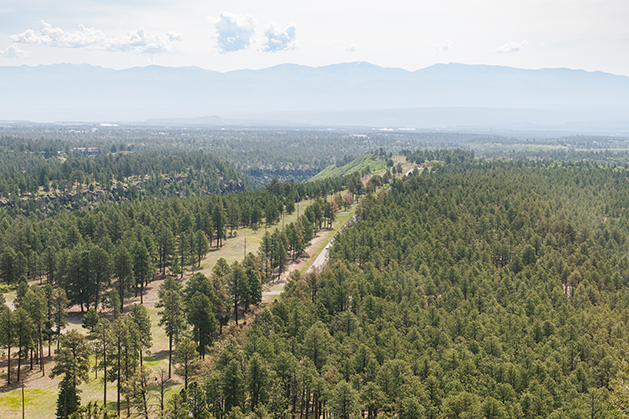 Scene viewed May 28 during LANL’s Wildfire Preparedness Media Tour. Courtesy/LANL
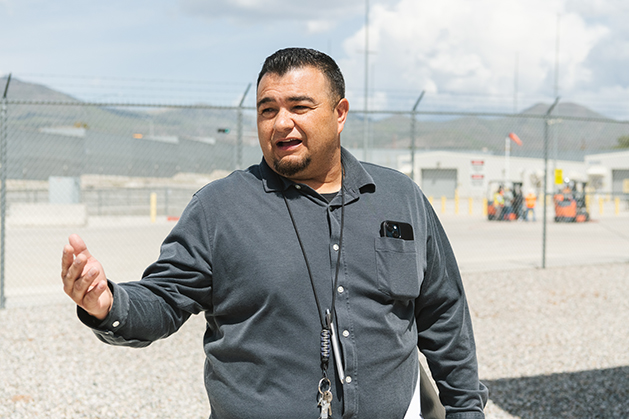 LANL Chemistry and Waste Facilities Group Leader John Quintana addresses members of the media May 28 at the Transuranic Waste Facility (TWF) during the Wildfire Preparedness Media Tour. Courtesy/LANL
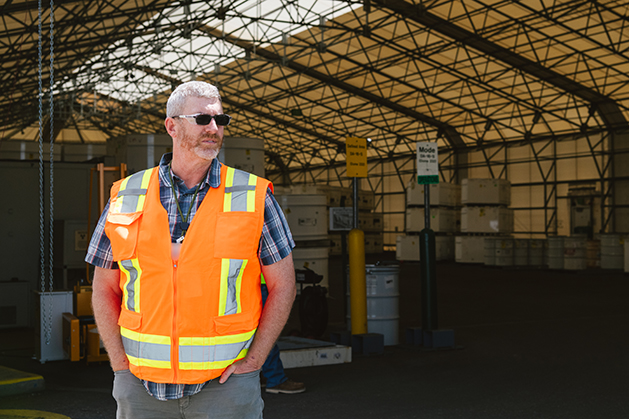 N3B CH-TRU Program Manager Brian Clayman addresses members of the media May 28 at the TRU Waste Storage Facility at Area G during the Wildfire Preparedness Media Tour. Courtesy/LANL
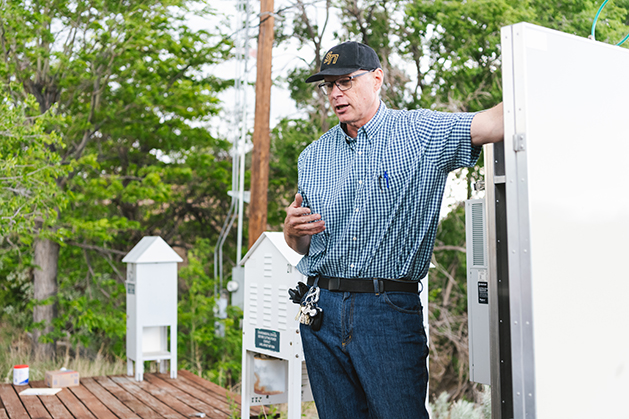 LANL Team Leader for Radioactive Air Emissions Management Dave Fuehne in front of an Air Monitoring System addresses members of the media May 28 during the Wildfire Preparedness Media Tour. Courtesy/LANL